Connect with Us


Every business wants one thing from Google Ads—to appear at the very top of Google’s search results. Whether you’re a local service provider, an eCommerce brand, a SaaS company, a healthcare clinic, or a multinational enterprise, the first few positions on Google receive the highest visibility, strongest click-through rates, and often the highest conversions.
However, many advertisers still believe that the highest bidder always wins. This misconception leads businesses to overspend on advertising while achieving disappointing results.
The reality is very different.
Google uses a sophisticated system called Ads Rank to determine which advertisements appear, where they appear, and whether they appear at all. Winning the auction isn’t simply about increasing your budget. Instead, Google rewards advertisers who provide the most relevant, useful, and engaging experience for users.
That means a well-optimized campaign with an excellent Quality Score, compelling ad copy, relevant keywords, and a high-performing landing page can often outrank competitors spending significantly more money.
Understanding Ads Rank is no longer optional for businesses investing in Pay-Per-Click (PPC) advertising. It is one of the most influential metrics affecting visibility, cost-per-click (CPC), return on investment (ROI), and overall campaign success.
At Hashtag360, we’ve helped businesses improve their Google Ads performance by focusing on what truly matters—not simply increasing bids, but improving the factors Google values most. When Ads Rank improves, businesses often experience lower advertising costs, higher-quality traffic, better conversion rates, and stronger long-term profitability.
In this comprehensive guide, you’ll learn everything about Ads Rank, including how it works, why it’s important, the factors that influence it, and how to optimize your campaigns to achieve sustainable success in Google Ads.
What is Ads Rank?
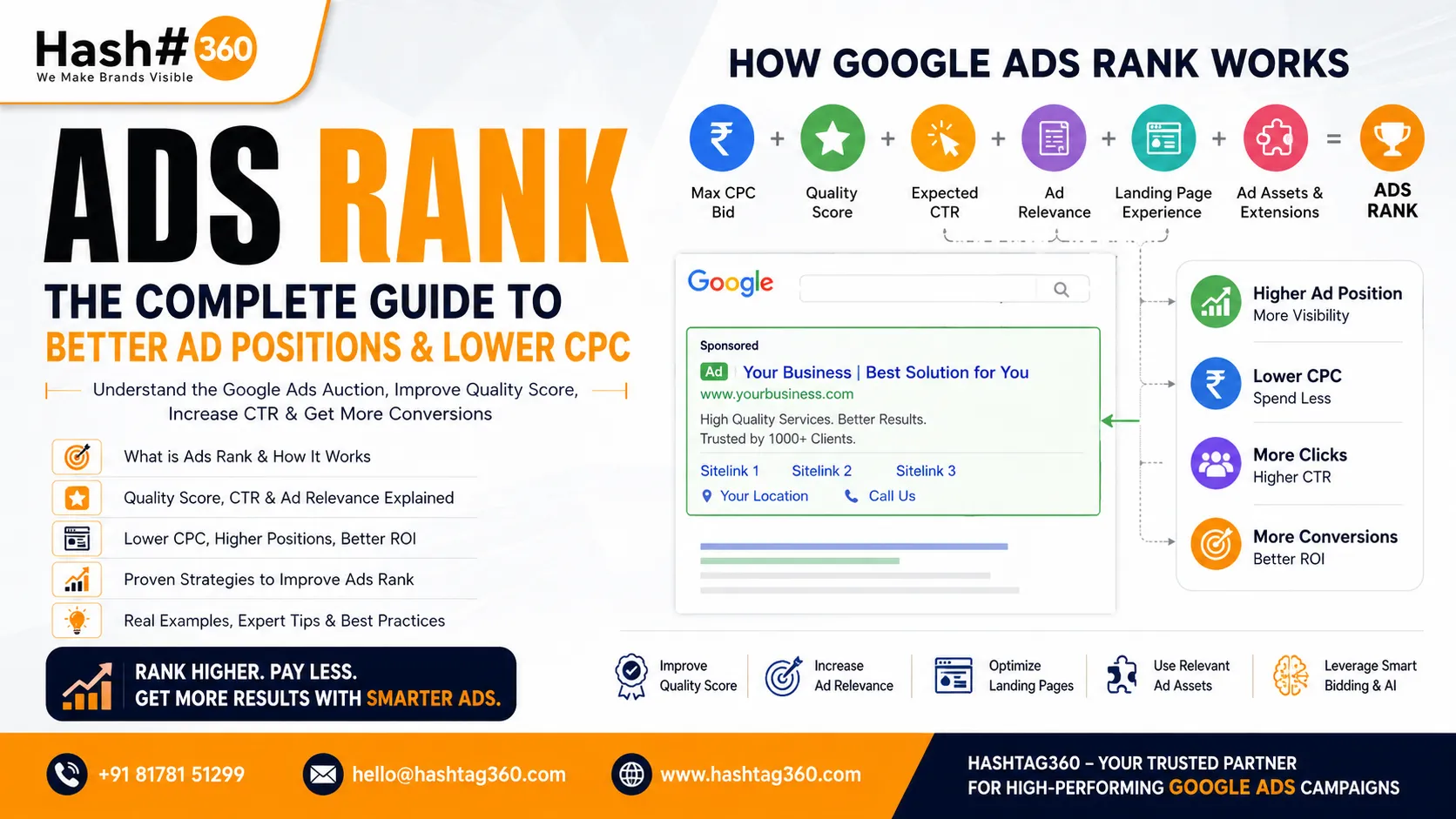
Ads Rank is Google’s internal value used to determine whether your advertisement is eligible to appear in search results and where it will be positioned compared to competing advertisers.
Think of Ads Rank as a score calculated during every Google Ads auction.
Whenever someone searches for a keyword like:
- Best Digital Marketing Agency
- PPC Management Services
- Google Ads Expert
- SEO Company Near Me
Google instantly evaluates hundreds or even thousands of advertisers competing for that search.
Instead of selecting only the advertiser with the highest bid, Google calculates an Ads Rank for every eligible ad.
The advertiser with the strongest overall Ads Rank receives the highest placement.
This means:
- Higher Ads Rank = Better Ad Position
- Better Ad Position = More Visibility
- More Visibility = Higher CTR
- Higher CTR = More Conversions
- More Conversions = Better ROI
In simple words, Ads Rank is Google’s way of rewarding advertisers who create valuable experiences for users instead of simply spending more money.
Why Ads Rank Matters More Than Your Bid
One of the biggest myths surrounding Google Ads is:
“If I increase my bid, I’ll always appear first.”
This isn’t true.
Imagine two advertisers competing for the same keyword.
Advertiser A
Maximum CPC Bid:
₹250
Poor Ad Copy
Slow Website
Irrelevant Landing Page
Low Click-Through Rate
Quality Score:
4/10
Advertiser B
Maximum CPC Bid:
₹120
Excellent Ad Copy
Highly Relevant Keywords
Fast Landing Page
Excellent User Experience
Quality Score:
9/10
Despite bidding nearly half as much, Advertiser B may achieve a significantly better Ads Rank and secure the top position.
Why?
Because Google’s goal isn’t maximizing advertiser spending.
Google’s goal is maximizing user satisfaction.
If users consistently find useful advertisements, they continue using Google Search, benefiting both advertisers and Google itself.
How Does the Google Ads Auction Work?
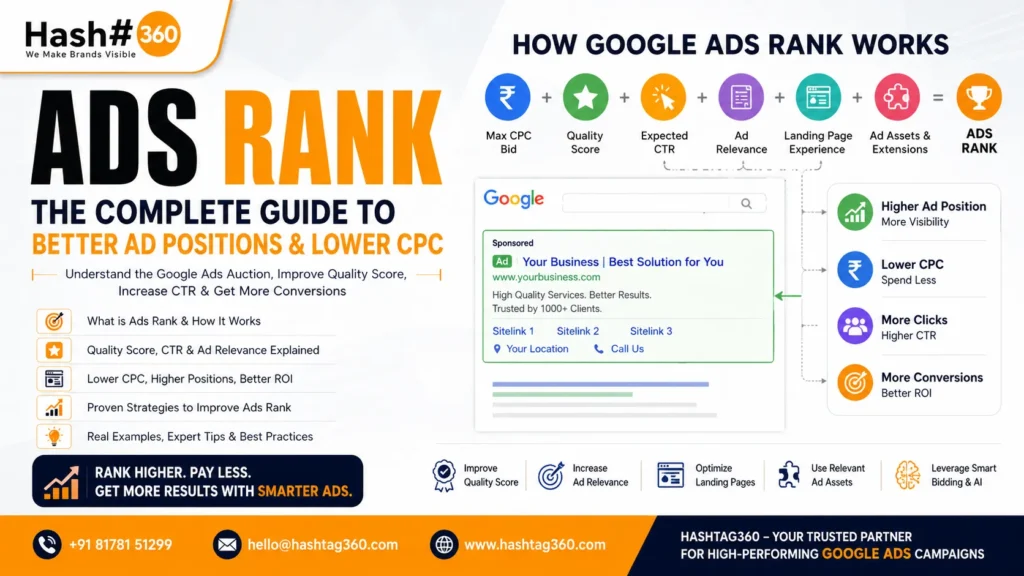
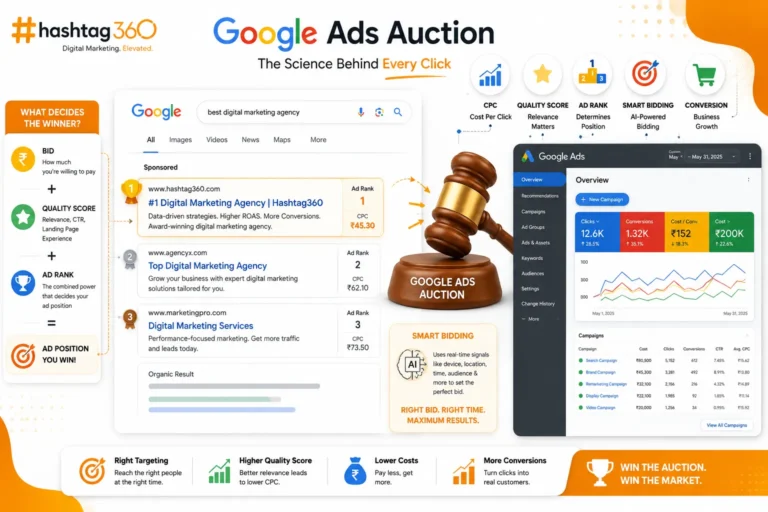
Every search on Google triggers an incredibly fast auction.
This process takes only milliseconds.
Here’s what happens behind the scenes:
Step 1: User Searches
Someone searches for:
“Google Ads Agency Near Me.”
Step 2: Google Finds Matching Keywords
Google scans millions of advertisers whose keywords match the user’s search.
Step 3: Google Calculates Ads Rank
For every advertiser, Google evaluates multiple signals, including:
- Maximum Bid
- Quality Score Components
- Ad Relevance
- Expected CTR
- Landing Page Experience
- User Context
- Device
- Location
- Search Intent
- Ad Assets
Step 4: Winners Are Selected
The advertisers with the highest Ads Rank become eligible to appear.
Step 5: Ad Position Is Decided
Higher Ads Rank receives higher placement.
Step 6: Actual CPC Is Calculated
Interestingly, you usually don’t pay your maximum bid.
Instead, Google charges just enough to beat the advertiser below you.
This system makes Google Ads both competitive and cost-efficient.
Why Google Created Ads Rank
Before Ads Rank existed, search advertising heavily favored advertisers with the largest budgets.
This often resulted in poor-quality ads occupying premium positions simply because they paid more.
Google recognized that this created a bad experience for users.
Today, Google’s advertising ecosystem rewards:
- Helpful advertisements
- Relevant keywords
- High-quality landing pages
- Strong user experience
- Excellent click-through rates
- Useful ad assets
- Fast-loading websites
This approach creates a win-win situation:
- Users see more relevant ads.
- Advertisers receive better-qualified traffic.
- Google maintains trust in its search engine.
The Main Factors That Influence Ads Rank
Although Google doesn’t publicly disclose its exact Ads Rank formula, it has confirmed several core factors that directly affect your ad’s position.
Understanding these signals is essential for building campaigns that consistently outperform competitors.
1. Maximum Bid
Your maximum bid represents the highest amount you’re willing to pay for a click.
A higher bid increases your potential Ads Rank—but only to a point.
Without relevance and quality, simply raising bids becomes expensive and inefficient.
2. Ad Quality
Google evaluates whether your advertisement genuinely answers the user’s search intent.
A high-quality advertisement usually includes:
- Strong headlines
- Relevant keywords
- Clear messaging
- Effective call-to-action
- High engagement
Great advertisements naturally receive more clicks, which improves overall performance.
3. Expected Click-Through Rate (CTR)
Google predicts the likelihood that users will click your ad.
Ads that historically attract more clicks generally receive a stronger Ads Rank.
Expected CTR depends on:
- Keyword relevance
- Headline quality
- Description quality
- Previous campaign performance
- User intent
4. Landing Page Experience
Many advertisers ignore this factor.
Google doesn’t.
Your landing page should provide:
- Fast loading speed
- Mobile responsiveness
- Relevant content
- Easy navigation
- Clear information
- Secure HTTPS connection
- Excellent user experience
Poor landing pages often reduce Ads Rank—even with large advertising budgets.
5. Ad Relevance
Your advertisement should closely match the keyword being searched.
For example:
Keyword:
Google Ads Management
Strong Ad:
“Expert Google Ads Management Services | Increase ROI with Certified PPC Experts”
Weak Ad:
“Digital Marketing Solutions for Every Business”
The first ad is significantly more relevant.
6. Ad Assets (Extensions)
Google rewards advertisers who provide additional useful information through:
- Sitelinks
- Call Extensions
- Location Extensions
- Price Extensions
- Promotion Extensions
- Structured Snippets
- Callouts
- Image Assets
Well-optimized ad assets improve user experience and often contribute to a stronger Ads Rank.
7. Search Context
Google also considers contextual signals such as:
- Device type
- User location
- Time of day
- Search intent
- Language
- Browser
- Previous search behavior
- Competition level
This means Ads Rank isn’t static—it changes dynamically for every search.
How Ads Rank Impacts Your Business Growth
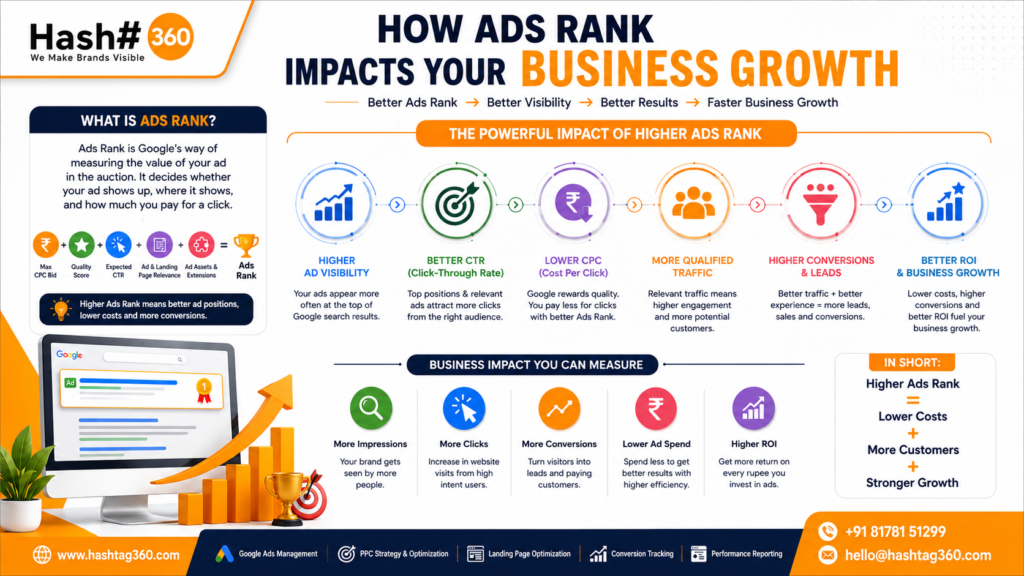
Many advertisers focus solely on clicks and conversions without realizing that Ads Rank influences nearly every performance metric in a Google Ads campaign.
A stronger Ads Rank can lead to:
- Higher ad visibility across competitive searches
- Better positions on the search results page
- Increased click-through rates (CTR)
- Lower average cost-per-click (CPC)
- Greater impression share
- Higher-quality website traffic
- Improved lead generation
- Better conversion rates
- Stronger return on ad spend (ROAS)
- Long-term advertising efficiency
In contrast, a weak Ads Rank often results in limited visibility, higher advertising costs, and missed opportunities—even when your budget is substantial.
This is why successful advertisers focus on improving the quality and relevance of their campaigns, not just increasing bids.
Ads Rank Formula Explained: How Google Determines Your Ad Position
One of the most common questions advertisers ask is:
“What is the exact Ads Rank formula?”
Google has never publicly revealed the precise mathematical formula behind Ads Rank because it is proprietary and constantly refined using machine learning. However, Google has confirmed the primary factors that influence Ads Rank.
A simplified representation looks like this:
Ads Rank = Maximum Bid + Ad Quality + Expected Click-Through Rate (CTR) + Ad Relevance + Landing Page Experience + Ad Assets + Auction Competitiveness + User Context
Unlike traditional auctions, Google Ads does not award the top position solely to the highest bidder. Instead, Google evaluates which advertiser is most likely to provide a valuable, relevant, and satisfying experience to the user.
Example
Imagine three companies bidding on the keyword “Google Ads Management Services.”
| Advertiser | Max CPC Bid | Quality Score | Landing Page | Expected CTR | Ads Rank Outcome |
|---|---|---|---|---|---|
| Company A | ₹300 | 4/10 | Average | Low | Medium |
| Company B | ₹180 | 9/10 | Excellent | High | Highest |
| Company C | ₹250 | 6/10 | Good | Medium | Second |
Even though Company A bids the highest, Company B wins because it delivers a far better user experience.
This is why businesses should invest in optimization rather than relying solely on higher bids.
Understanding Quality Score and Its Relationship with Ads Rank
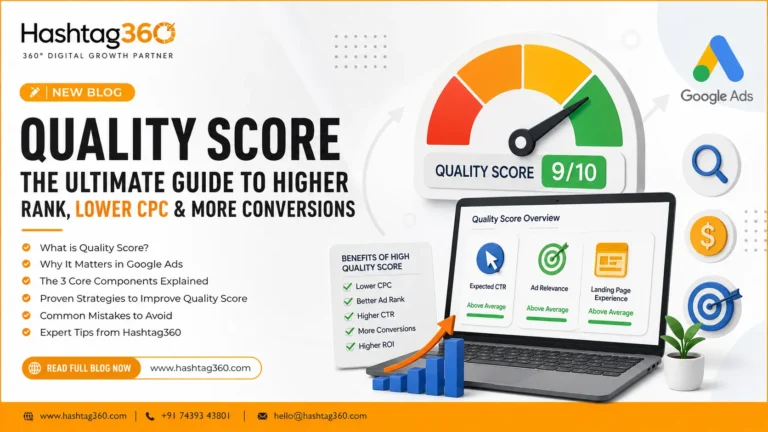
Many beginners confuse Quality Score with Ads Rank. While closely related, they are not the same thing.
What is Quality Score?
Quality Score is Google’s estimate of the quality and relevance of your:
- Keywords
- Advertisements
- Landing Pages
It is measured on a scale of 1 to 10, where:
- 1–3: Poor
- 4–6: Average
- 7–8: Good
- 9–10: Excellent
A higher Quality Score generally contributes to a stronger Ads Rank, lower costs, and better ad placements.
The Three Core Components of Quality Score
1. Expected Click-Through Rate (CTR)
Google predicts the likelihood that users will click your ad when it appears.
A strong Expected CTR indicates that your ad is engaging and relevant.
To improve Expected CTR:
- Write compelling headlines.
- Include the focus keyword naturally.
- Use numbers and benefits.
- Add a clear call-to-action (CTA).
- Match the user’s search intent.
2. Ad Relevance
Google checks how closely your ad aligns with the keyword being searched.
For example:
Keyword: Google Ads Expert
Good Ad:
Certified Google Ads Experts | Maximize ROI with Hashtag360
Poor Ad:
Digital Marketing Services for Businesses
The first example directly addresses the searcher’s intent and is more likely to earn a higher relevance score.
3. Landing Page Experience
A user should land on a page that delivers exactly what the ad promises.
Google evaluates factors such as:
- Page relevance
- Loading speed
- Mobile responsiveness
- HTTPS security
- Easy navigation
- Helpful content
- Clear call-to-action
- Low bounce potential
If users quickly leave your website because it is slow or irrelevant, your Quality Score—and ultimately your Ads Rank—may suffer.
How Ads Rank Affects Your Cost Per Click (CPC)
Many advertisers believe they always pay the amount they bid.
This is false.
Google uses a second-price auction system, meaning you usually pay only enough to beat the advertiser below you.
Simplified Actual CPC Formula
Actual CPC = (Ads Rank of Competitor Below ÷ Your Quality Score) + ₹0.01
This means improving your Quality Score can reduce your actual CPC, even if your maximum bid remains unchanged.
Example
Suppose:
- Your Ads Rank = 80
- Competitor’s Ads Rank = 70
- Your Quality Score = 10
Your Actual CPC:
(70 ÷ 10) + 0.01 = ₹7.01
Now imagine your Quality Score drops to 5.
(70 ÷ 5) + 0.01 = ₹14.01
Without changing your bid, your cost per click has doubled.
This demonstrates why optimizing Quality Score is one of the most effective ways to lower advertising costs.
How Ad Assets Improve Ads Rank
Google has confirmed that Ad Assets (formerly called Ad Extensions) influence Ads Rank.
Ad Assets provide additional information that makes your advertisement more useful and visually appealing.
Common Ad Assets include:
- Sitelinks
- Callouts
- Structured Snippets
- Call Extensions
- Location Extensions
- Price Extensions
- Promotion Extensions
- Image Assets
- Lead Form Assets
- App Extensions
Why Ad Assets Matter
Benefits include:
- Increased visibility
- Higher click-through rates
- More information for users
- Better user experience
- Improved Ads Rank
- Higher conversion potential
For example, instead of displaying a simple text ad, a business can include:
- Pricing information
- Customer testimonials
- Contact numbers
- Business location
- Popular services
- Limited-time offers
These additional details help users make informed decisions and often encourage more clicks.
The Role of Smart Bidding in Ads Rank
Modern Google Ads campaigns increasingly rely on Smart Bidding, where machine learning automatically adjusts bids based on the likelihood of achieving your campaign goals.
Popular Smart Bidding strategies include:
- Maximize Conversions
- Maximize Conversion Value
- Target CPA (Cost Per Acquisition)
- Target ROAS (Return on Ad Spend)
- Maximize Clicks
- Target Impression Share
Smart Bidding evaluates numerous real-time signals, such as:
- Device type
- User location
- Time of day
- Browser
- Operating system
- Language
- Previous search behavior
- Audience characteristics
- Remarketing lists
While Smart Bidding helps optimize bids, it cannot compensate for poor ad copy or weak landing pages. High-quality campaigns remain essential for achieving strong Ads Rank.
How AI Influences Ads Rank
Google’s artificial intelligence now plays a significant role in evaluating advertisements.
AI helps determine:
- Which ad variation to display
- Which headline combinations perform best
- Which users are most likely to convert
- Which bidding strategy should be applied
- Which ad assets should appear
This means advertisers who embrace automation while maintaining high-quality creative assets often see better long-term performance.
However, AI works best when provided with strong inputs—relevant keywords, compelling ad copy, and optimized landing pages.
Real-World Example: Improving Ads Rank
Imagine an online furniture retailer running Google Ads.
Initial Campaign
- Quality Score: 5/10
- Average CPC: ₹85
- CTR: 2.1%
- Conversion Rate: 1.8%
After optimization:
- Improved ad headlines
- Added sitelink and price assets
- Optimized landing page speed
- Matched keywords more closely to user intent
- Added customer reviews and trust badges
Results
- Quality Score: 9/10
- Average CPC: ₹56
- CTR: 5.8%
- Conversion Rate: 4.6%
Without significantly increasing bids, the business achieved stronger Ads Rank, lower advertising costs, and higher profitability.
Common Mistakes That Hurt Ads Rank
Many advertisers unknowingly reduce their Ads Rank through avoidable errors.
1. Using Broad, Generic Keywords
Highly generic keywords often attract irrelevant traffic, lowering CTR and Quality Score.
Solution: Use tightly themed ad groups and keyword match types.
2. Writing Weak Ad Copy
Generic headlines fail to capture attention.
Solution: Highlight unique selling points, benefits, and strong CTAs.
3. Ignoring Landing Page Optimization
A slow or irrelevant landing page can significantly reduce Quality Score.
Solution: Improve speed, relevance, and mobile usability.
4. Not Using Ad Assets
Ads without additional assets occupy less space and provide less value.
Solution: Add all relevant assets to maximize visibility and usefulness.
5. Sending All Traffic to the Homepage
Users expect to land on a page directly related to their search.
Solution: Create dedicated landing pages for each campaign or service.
6. Neglecting Negative Keywords
Without negative keywords, ads may appear for irrelevant searches, wasting budget and reducing campaign efficiency.
Solution: Regularly review search terms and exclude irrelevant queries.
Expert Ads Rank Optimization Tips from Hashtag360
At Hashtag360, we focus on improving Ads Rank through a holistic optimization strategy rather than simply increasing bids.
Our recommended best practices include:
- Conduct in-depth keyword research aligned with user intent.
- Structure campaigns into tightly themed ad groups.
- Write compelling, benefit-driven ad copy.
- Continuously A/B test headlines and descriptions.
- Improve landing page speed and mobile responsiveness.
- Implement all relevant ad assets.
- Monitor Quality Score regularly.
- Use conversion tracking to measure success accurately.
- Leverage Smart Bidding where appropriate.
- Analyze competitor strategies and adjust campaigns proactively.
By combining these tactics, businesses can achieve higher ad positions, lower CPCs, and stronger return on ad spend (ROAS).
Advanced Ads Rank Optimization Strategies That Consistently Deliver Better Results
Improving Ads Rank is not a one-time task. Successful advertisers continuously optimize every component of their Google Ads campaigns to maintain a competitive advantage. Google’s advertising ecosystem is dynamic, meaning your Ads Rank can change with every search, depending on competition, user behavior, and campaign quality.
At Hashtag360, we view Ads Rank optimization as an ongoing process involving keyword strategy, ad copy refinement, landing page improvements, bidding adjustments, and performance analysis.
Let’s explore the advanced techniques that can significantly improve your Ads Rank and overall Google Ads performance.
1. Build Highly Focused Ad Groups
One of the biggest mistakes advertisers make is placing dozens of unrelated keywords into a single ad group.
Poor Example
Ad Group: Digital Marketing
Keywords:
- Google Ads
- SEO Services
- Facebook Ads
- Website Development
- Email Marketing
Writing one ad that perfectly matches all these keywords is nearly impossible.
Better Approach
Create separate ad groups for each service.
Ad Group 1
- Google Ads Agency
- Google Ads Management
- Google Ads Expert
Ad Group 2
- SEO Company
- Technical SEO
- Local SEO Services
Ad Group 3
- Facebook Ads Agency
- Meta Ads Expert
- Instagram Advertising
This structure improves:
- Keyword relevance
- Expected CTR
- Quality Score
- Ads Rank
- Conversion rate
2. Match User Intent Instead of Just Keywords
Google increasingly prioritizes search intent over exact keyword matching.
There are four primary types of search intent:
Informational
Examples:
- What is Ads Rank?
- How does Google Ads work?
These users are seeking knowledge.
Navigational
Examples:
- Google Ads Login
- Google Ads Help Center
Users already know where they want to go.
Commercial Investigation
Examples:
- Best Google Ads Agency
- Google Ads Management Services
Users are comparing options before making a decision.
Transactional
Examples:
- Hire Google Ads Expert
- PPC Management Company
Users are ready to take action.
Your ad copy and landing pages should align with the user’s intent. The closer the match, the stronger your Ads Rank is likely to be.
3. Write High-Converting Ad Copy
Google favors ads that users actually click.
An effective ad should include:
- The primary keyword in the headline
- A clear value proposition
- Trust-building elements
- Emotional appeal
- A compelling call-to-action
Example
Weak Headline
Digital Marketing Services
Strong Headline
Increase ROI with Certified Google Ads Experts | Hashtag360
The second headline is more specific, benefit-driven, and keyword-rich.
4. Optimize Every Landing Page
Your advertisement creates the expectation.
Your landing page fulfills it.
A high-performing landing page should include:
- Fast loading speed
- Mobile-friendly design
- Clear headline
- Relevant content
- Simple navigation
- Trust badges
- Testimonials
- Case studies
- Frequently Asked Questions
- Prominent CTA buttons
- Contact information
- Conversion forms
The better the user experience, the better your landing page experience score and Ads Rank.
5. Improve Click-Through Rate (CTR)
CTR is one of the strongest indicators that users find your ad relevant.
Ways to improve CTR include:
- Test multiple headlines
- Use numbers and statistics
- Highlight offers
- Include urgency
- Add benefits instead of features
- Mention certifications
- Include awards
- Use emotional triggers
For example:
Instead of:
“Google Ads Services”
Try:
“Increase Qualified Leads by 45% with Google Ads Experts”
6. Continuously A/B Test Your Ads
Never assume your first advertisement is the best.
Test variations of:
- Headlines
- Descriptions
- Display paths
- Calls-to-action
- Ad assets
Even small improvements in CTR can positively influence Ads Rank over time.
Ads Rank vs. Quality Score: What’s the Difference?
Although these terms are often used interchangeably, they serve different purposes.
| Feature | Ads Rank | Quality Score |
|---|---|---|
| Purpose | Determines ad position and eligibility | Measures keyword, ad, and landing page quality |
| Visible to advertisers | No | Yes (1–10 scale) |
| Changes | Every auction | Updated periodically |
| Includes bidding? | Yes | No |
| Includes auction context? | Yes | No |
| Affects CPC | Yes | Indirectly |
Key Takeaway
Quality Score is one of the inputs that influence Ads Rank, but Ads Rank also considers bidding, competition, user context, and expected impact of ad assets.
Ads Rank vs. Cost Per Click (CPC)
Many businesses think a higher CPC guarantees a better position.
This isn’t always true.
High CPC Doesn’t Always Mean High Ads Rank
Consider two advertisers:
| Advertiser | Bid | Quality Score | Ads Rank |
|---|---|---|---|
| A | ₹250 | 4 | Medium |
| B | ₹170 | 9 | Highest |
Advertiser B can often secure a better position while paying less because of superior quality.
This demonstrates why improving campaign quality is usually more cost-effective than simply increasing bids.
Ads Rank vs. Impression Share
Impression Share measures how often your ads are shown compared to how often they could have been shown.
Low Impression Share Can Be Caused By:
- Low Ads Rank
- Limited budget
- Poor Quality Score
- Weak bidding strategy
- High competition
Improving Ads Rank often leads to:
- Higher impression share
- Increased visibility
- More qualified traffic
- Better brand awareness
Industry-Specific Ads Rank Strategies
Different industries face different levels of competition, search intent, and CPCs. Tailoring your strategy can make a significant difference.
E-commerce
Focus on:
- Shopping campaigns
- Product images
- Merchant Center optimization
- Promotional assets
- Dynamic remarketing
Healthcare
Focus on:
- Local keywords
- Trust signals
- Appointment extensions
- Patient testimonials
- Mobile optimization
Real Estate
Focus on:
- Location-specific keywords
- Lead forms
- High-quality property pages
- Call extensions
- Local landing pages
Education
Focus on:
- Course-specific landing pages
- Scholarship information
- Student success stories
- Structured snippets
- Strong CTAs for admissions
B2B Services
Focus on:
- Whitepapers
- Case studies
- Demo requests
- Industry certifications
- Long-tail keywords
Adapting your campaigns to your industry’s audience and buying journey improves relevance, which in turn supports a stronger Ads Rank.
How Competitor Analysis Can Improve Ads Rank
Understanding your competitors helps you identify opportunities to outperform them.
Analyze:
- Ad headlines
- Offers
- Calls-to-action
- Landing page quality
- Keyword targeting
- Ad assets
- Messaging
- Value propositions
Ask yourself:
- What are they emphasizing?
- Where are they weak?
- How can your ad provide more value?
The goal isn’t to copy competitors but to create a more compelling and relevant user experience.
Measuring the Success of Your Ads Rank Optimization
Improving Ads Rank should translate into measurable business outcomes.
Track these key performance indicators (KPIs):
- Average CPC
- Click-Through Rate (CTR)
- Conversion Rate
- Cost Per Acquisition (CPA)
- Return on Ad Spend (ROAS)
- Impression Share
- Search Top Impression Rate
- Search Absolute Top Impression Rate
- Quality Score
- Conversion Value
- Revenue from Paid Search
Review these metrics regularly and use the insights to refine your campaigns continuously.
The Future of Ads Rank: AI, Automation, and User Experience
Google Ads continues to evolve, with artificial intelligence playing an increasingly important role in campaign optimization.
Key trends shaping the future include:
- AI-generated ad recommendations
- Automated bidding strategies
- Predictive audience targeting
- Responsive Search Ads optimization
- Performance Max campaigns
- Enhanced privacy-focused targeting
- Better measurement through first-party data
- Increased emphasis on landing page experience
Despite these advancements, one principle remains constant:
Google rewards advertisers who provide the best experience for users.
Businesses that focus on relevance, transparency, and value will continue to achieve strong Ads Rank and sustainable advertising success.
Why Businesses Choose Hashtag360 for Google Ads Management
Achieving a high Ads Rank requires more than increasing bids—it demands strategic planning, continuous optimization, and data-driven decision-making.
At Hashtag360, we help businesses maximize their Google Ads performance by:
- Conducting in-depth keyword research
- Creating high-converting ad copy
- Optimizing landing pages for conversions
- Improving Quality Score
- Implementing effective bidding strategies
- Monitoring campaign performance daily
- Running A/B tests to improve CTR
- Leveraging AI-powered optimization tools
- Providing transparent reporting and actionable insights
Whether you’re a startup, local business, or enterprise brand, our goal is to help you achieve better ad positions, lower advertising costs, and higher ROI.
Frequently Asked Questions (FAQs) About Ads Rank
Including a detailed FAQ section helps your blog target Google’s People Also Ask (PAA) results and improves the chances of earning rich snippets. Below are some of the most common questions businesses and marketers ask about Ads Rank.
1. What is Ads Rank in Google Ads?
Ads Rank is the value Google uses to determine whether your advertisement is eligible to appear in search results and what position it will occupy. It is calculated using multiple signals, including your bid, ad quality, expected click-through rate (CTR), landing page experience, ad assets, auction competitiveness, and user context.
2. Is Ads Rank the same as Quality Score?
No. Quality Score is only one factor that contributes to Ads Rank. While Quality Score measures the relevance of your keywords, ads, and landing pages on a scale of 1 to 10, Ads Rank also considers your bid amount, ad assets, auction competition, and contextual signals.
3. Can I achieve the top ad position without the highest bid?
Yes. Google rewards advertisers who provide a better user experience. A campaign with highly relevant ads, strong landing pages, excellent Quality Score, and effective ad assets can often outrank competitors with much larger bids.
4. How often does Ads Rank change?
Ads Rank is calculated every time an auction occurs. Since every search is unique, your Ads Rank may vary based on factors such as location, device, search intent, competition, and time of day.
5. Does increasing my bid always improve Ads Rank?
Not necessarily. While increasing your maximum CPC bid can improve Ads Rank, poor ad quality or a weak landing page may still prevent your ad from achieving top positions.
6. What is the ideal Quality Score?
A Quality Score of 7 or higher is generally considered good, while scores of 9–10 indicate excellent campaign quality. Higher Quality Scores often result in better Ads Rank and lower CPCs.
7. What is Expected CTR?
Expected Click-Through Rate (CTR) is Google’s prediction of how likely users are to click your ad when it appears. A higher expected CTR positively influences both Quality Score and Ads Rank.
8. Why is landing page experience important?
Your landing page should deliver exactly what your ad promises. Fast loading times, mobile responsiveness, relevant content, easy navigation, and clear calls to action all contribute to a positive landing page experience and better Ads Rank.
9. Do ad assets improve Ads Rank?
Yes. Google considers the expected impact of ad assets such as sitelinks, callouts, structured snippets, image assets, location assets, and promotion assets when determining Ads Rank.
10. How can I lower my CPC while improving Ads Rank?
Focus on improving Quality Score by:
- Writing more relevant ads.
- Increasing expected CTR.
- Optimizing landing pages.
- Using tightly themed ad groups.
- Adding relevant ad assets.
- Refining keyword targeting.
11. What industries benefit most from Ads Rank optimization?
Every industry can benefit, including:
- E-commerce
- Healthcare
- Education
- Real Estate
- SaaS
- Finance
- Legal Services
- Hospitality
- Manufacturing
- Local Service Businesses
12. Can Smart Bidding improve Ads Rank?
Smart Bidding can optimize your bids based on real-time signals, but it works best when paired with high-quality ads, relevant keywords, and optimized landing pages.
13. Why is my Ads Rank low despite a high budget?
Common reasons include:
- Poor Quality Score.
- Weak ad copy.
- Low expected CTR.
- Irrelevant landing pages.
- Missing ad assets.
- Broad, untargeted keywords.
14. How long does it take to improve Ads Rank?
Minor improvements can be seen within days, while significant gains usually require several weeks of testing, optimization, and performance analysis.
15. Should small businesses care about Ads Rank?
Absolutely. A well-optimized campaign allows small businesses to compete effectively against larger competitors without dramatically increasing advertising budgets.
Common Ads Rank Myths
Many misconceptions lead businesses to waste advertising budgets. Let’s separate myth from reality.
Myth 1: The Highest Bid Always Wins
Reality: Relevance, Quality Score, landing page experience, and ad assets often outweigh a higher bid.
Myth 2: Ads Rank Is Fixed
Reality: Ads Rank is recalculated during every auction and changes based on real-time signals.
Myth 3: Quality Score Is the Only Thing That Matters
Reality: Quality Score is important, but Ads Rank also includes bid amount, auction competitiveness, ad assets, and contextual factors.
Myth 4: More Keywords Automatically Improve Performance
Reality: Targeting fewer, highly relevant keywords often produces stronger Ads Rank and better ROI than broad, unfocused campaigns.
Myth 5: Optimization Is a One-Time Task
Reality: Google Ads requires ongoing testing, monitoring, and optimization to maintain strong performance.