Connect with Us


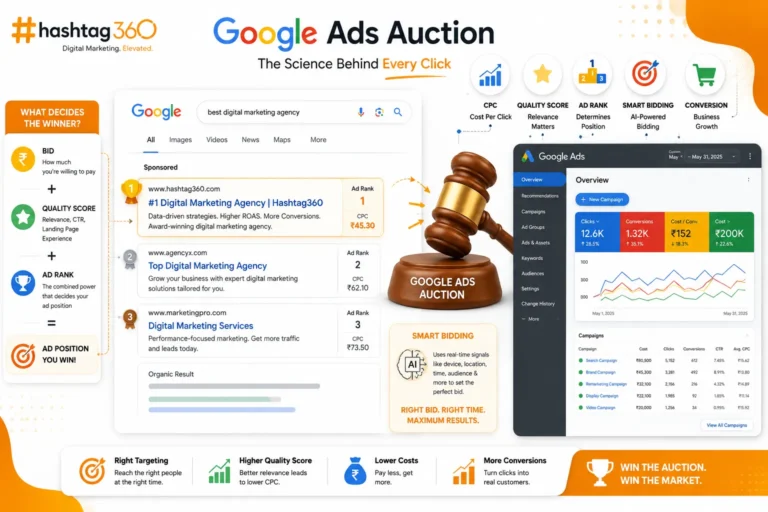
Imagine two businesses bidding on exactly the same keyword.
Both are willing to pay ₹100 per click.
Yet one advertisement appears at the top of Google Search while paying only ₹58 per click, whereas the other struggles to appear on the first page despite bidding the full ₹100.
What creates this difference?
The answer is Quality Score.
Many advertisers believe that Google Ads is simply an auction where the highest bidder always wins. That assumption is one of the biggest reasons businesses waste thousands of rupees every month.
Google doesn’t reward advertisers who spend the most.
Instead, it rewards advertisers who deliver the best experience to users.
That is exactly where Quality Score becomes one of the most powerful metrics in digital advertising.
Whether you’re a startup, an eCommerce store, a SaaS company, a healthcare provider, a real estate business, or a multinational brand, improving your Quality Score can dramatically reduce advertising costs while increasing visibility, clicks, and conversions.
At Hashtag360, we have helped businesses optimize their Google Ads campaigns by focusing on Quality Score optimization rather than increasing advertising budgets. The result is often lower Cost Per Click (CPC), higher Click-Through Rates (CTR), improved Ad Rank, and significantly better Return on Ad Spend (ROAS).
This comprehensive guide explains everything you need to know about Quality Score—from how Google calculates it to practical strategies that can transform your advertising performance.
By the end of this guide, you’ll understand why experienced PPC specialists consider Quality Score the hidden engine behind successful Google Ads campaigns.
What is Quality Score?
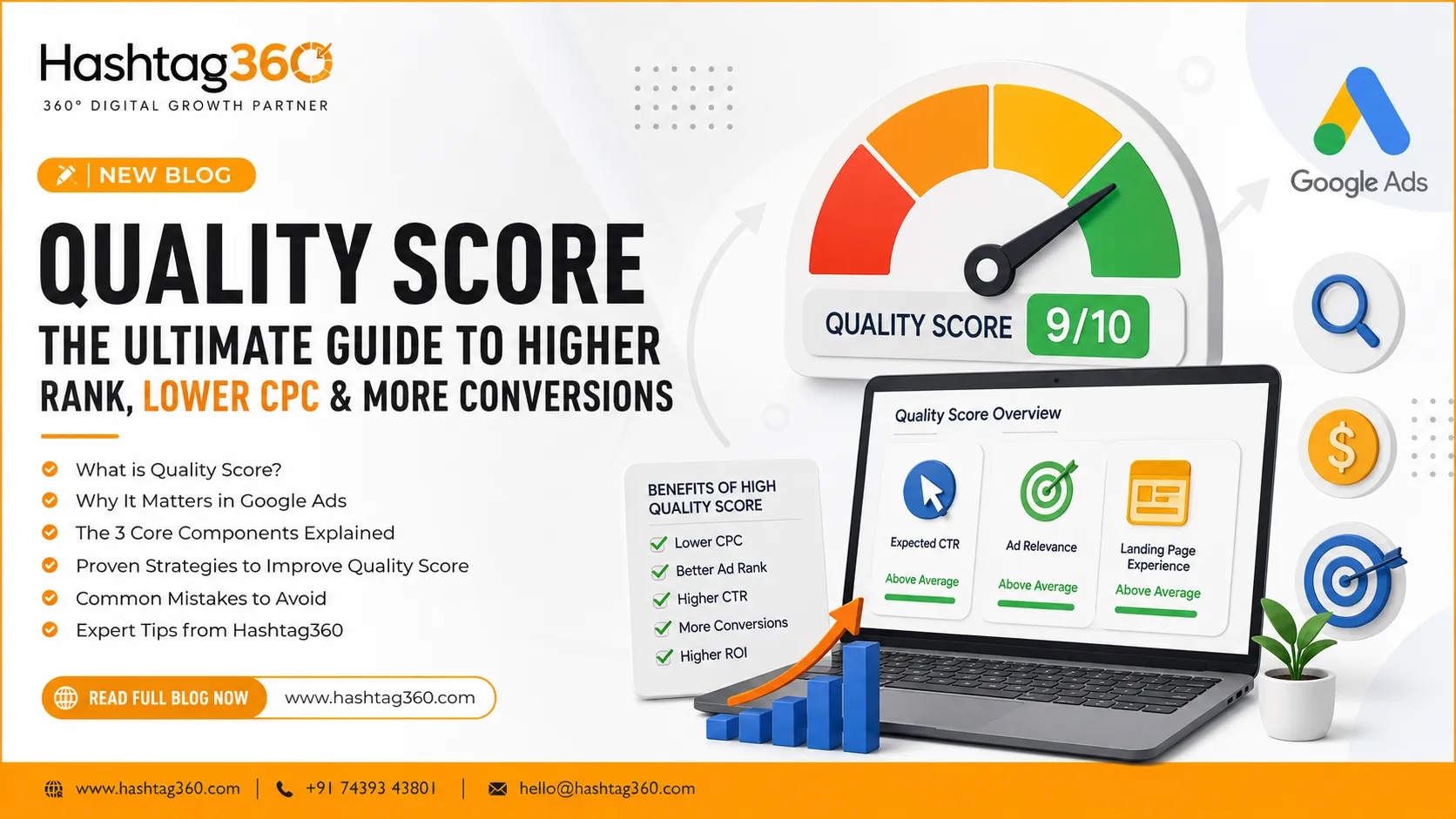
Quality Score is Google’s rating of the overall quality and relevance of your keywords, advertisements, and landing pages.
It is measured on a scale from 1 to 10, where:
| Quality Score | Meaning |
|---|---|
| 1–3 | Poor |
| 4–6 | Average |
| 7–8 | Good |
| 9–10 | Excellent |
A higher Quality Score tells Google that your advertisement provides a better experience for users searching for specific keywords.
Unlike many advertisers assume, Quality Score isn’t simply based on your bid amount.
Instead, Google evaluates whether your advertisement genuinely deserves to appear in front of users.
Think of it like a classroom.
Two students sit for the same examination.
One studies consistently, understands concepts, and writes clear answers.
The other memorizes random facts without understanding.
Both may spend the same amount of time preparing, but the first student earns better grades because of quality—not effort alone.
Google Ads works similarly.
The search engine wants users to see advertisements that are useful, trustworthy, and relevant.
Quality Score helps Google identify those advertisements.
A Simple Real-Life Example
Suppose someone searches for:
“Best Running Shoes for Men”
Advertiser A creates:
- Generic advertisement
- Generic homepage
- Slow website
- Unclear headline
Advertiser B creates:
- Keyword-specific advertisement
- Fast landing page
- Running shoe collection
- Customer reviews
- Easy navigation
- Mobile optimization
Even if Advertiser A bids more money, Google is likely to reward Advertiser B with:
- Better ranking
- Lower CPC
- More clicks
- Higher conversions
Why?
Because Advertiser B delivers a superior user experience.
That is exactly what Quality Score measures.
Why Quality Score is One of the Most Important Metrics in Google Ads
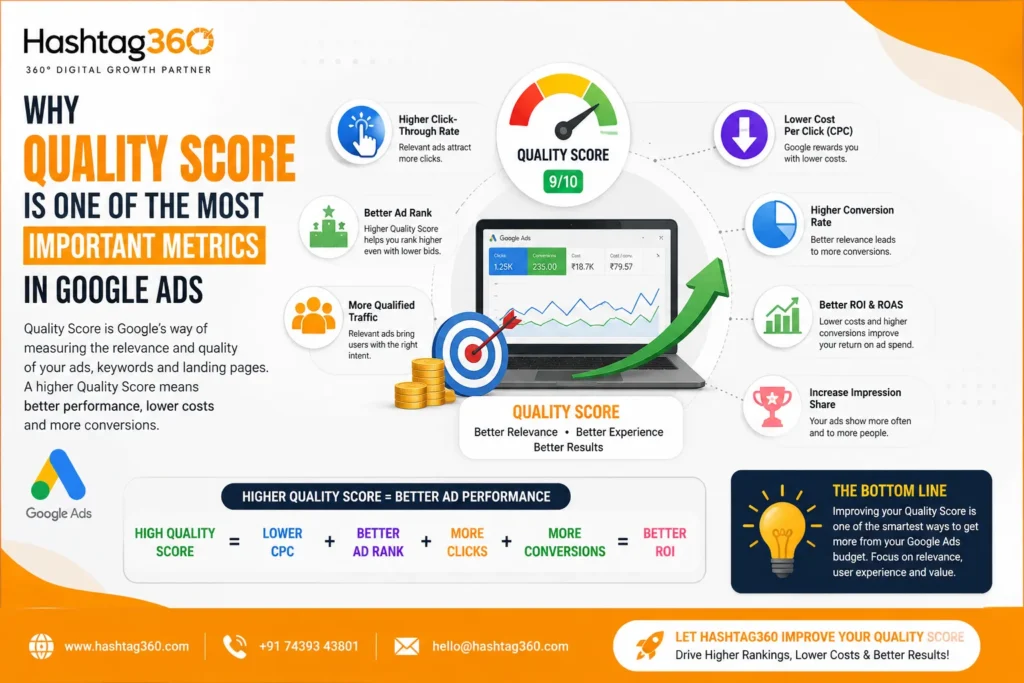
Many advertisers spend weeks optimizing bids while completely ignoring Quality Score.
This is a costly mistake.
Quality Score influences nearly every important performance metric within Google Ads.
A high Quality Score often leads to:
- Lower Cost Per Click (CPC)
- Better Ad Rank
- Higher Click-Through Rate
- More qualified traffic
- Better Conversion Rate
- Lower Cost Per Acquisition (CPA)
- Improved Return on Investment (ROI)
- Increased Impression Share
- Better campaign scalability
Instead of paying more to outrank competitors, businesses with excellent Quality Scores often pay less while achieving stronger results.
This is one reason experienced PPC agencies prioritize Quality Score optimization before increasing campaign budgets.
Lower Advertising Costs
One of the biggest benefits of improving Quality Score is reduced advertising expenses.
Google rewards advertisers who create useful experiences.
As your Quality Score increases, your actual Cost Per Click usually decreases.
This means your advertising budget stretches further.
Instead of purchasing 500 clicks, you may afford 700 or even 900 clicks with the same monthly budget.
For businesses operating with limited marketing budgets, this difference can significantly improve profitability.
Better Ad Position
Many advertisers assume higher bids automatically secure the top position.
Google’s system is much smarter.
A highly relevant advertisement with excellent Quality Score frequently outranks competitors willing to spend more money.
That means your business gains greater visibility without continuously increasing bids.
Improved User Experience
Google’s long-term success depends on users finding relevant answers quickly.
If searchers repeatedly encounter misleading advertisements, they lose trust in Google’s search engine.
Quality Score protects that user experience.
Advertisers who provide:
- Relevant content
- Helpful landing pages
- Fast websites
- Useful information
are rewarded with stronger campaign performance.
Everyone benefits.
Users receive better search results.
Businesses receive higher-quality traffic.
Google maintains trust.
Increased Conversion Opportunities
More visibility alone isn’t enough.
Businesses ultimately want conversions.
Whether your goal is:
- Sales
- Phone calls
- Form submissions
- App downloads
- Newsletter signups
- Appointment bookings
Quality Score indirectly contributes by attracting users genuinely interested in your offer.
Relevant advertisements produce qualified traffic rather than random visitors.
Understanding Google’s Advertising Philosophy
Before learning how Quality Score works, it’s important to understand Google’s business philosophy.
Google’s primary customer isn’t the advertiser.
It’s the search user.
Every search represents a question.
Google’s mission is to provide the most helpful answer possible.
Advertisements are included only when they genuinely improve the search experience.
That means Google continuously evaluates:
- Relevance
- User satisfaction
- Page quality
- Mobile experience
- Content usefulness
- Loading speed
- Trustworthiness
This explains why advertisers cannot simply “buy” the top position.
Google wants advertisements users actually want to click.
Quality Score exists to reward advertisers who align with that goal.
How Google Calculates Quality Score
One of the biggest misconceptions is that Google reveals its exact Quality Score formula.
It doesn’t.
Google uses sophisticated machine learning systems that evaluate numerous signals before assigning Quality Scores.
However, Google officially confirms that Quality Score primarily depends on three major components:
1. Expected Click-Through Rate (Expected CTR)
Google predicts how likely users are to click your advertisement when it appears.
Historical performance plays an important role.
If your advertisements consistently attract clicks, Google assumes future users will also find them valuable.
Expected CTR considers:
- Historical CTR
- Keyword performance
- User intent
- Device
- Search behavior
- Competition
- Ad performance history
Higher expected CTR usually improves Quality Score.
2. Ad Relevance
Google checks whether your advertisement closely matches the user’s search query.
For example:
Search:
Affordable SEO Agency
Good Advertisement:
Affordable SEO Services That Deliver Real Results
Poor Advertisement:
Best Digital Marketing Packages
The first advertisement clearly addresses the user’s search.
The second is broader and less relevant.
Google rewards specificity.
Keyword alignment between search query, advertisement, and landing page is extremely important.
3. Landing Page Experience
Many advertisers optimize advertisements while ignoring landing pages.
Google evaluates whether users receive a satisfying experience after clicking.
Factors include:
- Page speed
- Mobile responsiveness
- Helpful information
- Navigation
- Transparency
- Trust signals
- Original content
- User engagement
A fast, informative landing page strengthens Quality Score.
A slow, confusing, or irrelevant page damages it.
Quality Score Does Not Work Alone
Quality Score is only one part of Google’s advertising ecosystem.
Several related metrics work together to determine campaign success.
These include:
- Ad Rank
- Cost Per Click (CPC)
- Click-Through Rate (CTR)
- Impression Share
- Conversion Rate
- Cost Per Acquisition (CPA)
- Return on Ad Spend (ROAS)
- Landing Page Experience
- Keyword Relevance
- Search Intent
- Smart Bidding
- Conversion Tracking
- Google Analytics 4 (GA4)
- Google Tag Manager (GTM)
- Responsive Search Ads (RSA)
- Search Terms Report
- Negative Keywords
- Ad Extensions (Assets)
- Auction Insights
Understanding how these metrics interact helps advertisers build campaigns that consistently outperform competitors.
The Three Pillars of Quality Score Explained
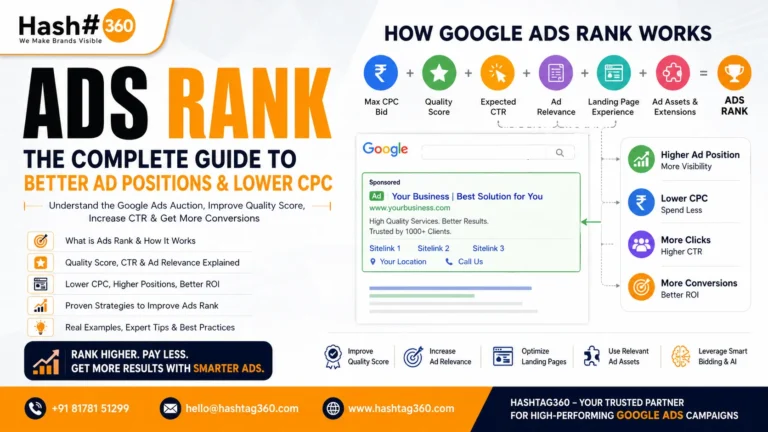
Although Google uses hundreds of signals to determine how ads perform in an auction, Quality Score is primarily based on three core components:
- Expected Click-Through Rate (Expected CTR)
- Ad Relevance
- Landing Page Experience
Think of these three factors as the legs of a tripod.
If one leg is weak, the entire structure becomes unstable.
Similarly, if one component receives a poor rating, your overall Quality Score can suffer—even if the other two perform well.
Let’s understand each component in detail.
Expected Click-Through Rate (Expected CTR)
Expected Click-Through Rate (Expected CTR) is Google’s prediction of how likely someone is to click your advertisement when it appears for a particular keyword.
Notice the word “expected.”
Google isn’t looking only at your current CTR.
Instead, it predicts future performance based on historical data, machine learning, and user behavior.
For every search query, Google asks:
“If we show this advertisement, how likely is the user to click it?”
The more confident Google is that users will click your ad, the higher your Expected CTR.
Why Expected CTR Matters
Clicks indicate relevance.
When many users choose your advertisement over competing ads, Google interprets this as a positive quality signal.
High Expected CTR often leads to:
- Higher Quality Score
- Better Ad Rank
- Lower Cost Per Click (CPC)
- Increased Impression Share
- More qualified traffic
Low Expected CTR usually results in:
- Higher CPC
- Lower ad positions
- Reduced impressions
- Poor campaign performance
- Lower return on ad spend
What Influences Expected CTR?
Google considers numerous signals, including:
Historical Account Performance
Accounts with a strong history of successful campaigns generally receive better predictions than accounts with consistently poor-performing ads.
Keyword Performance
Some keywords naturally generate higher click rates because they demonstrate stronger purchase intent.
Example:
- Buy iPhone 17 Online
- Book Dentist Appointment
- Best CRM Software
These commercial-intent keywords often produce higher CTRs than broad informational searches.
Ad Position
Advertisements appearing in higher positions generally receive more clicks.
Google accounts for this when predicting CTR.
Search Intent
Google analyzes what users are trying to accomplish.
For example:
Search:
Buy Nike Running Shoes
Users clearly want products.
An advertisement showing:
Buy Nike Running Shoes – Flat 30% Discount
is much more likely to receive clicks than:
Learn About Running Shoes
Matching user intent dramatically improves Expected CTR.
Device Type
User behavior differs across:
- Desktop
- Mobile
- Tablet
Google evaluates Expected CTR separately because mobile users often behave differently than desktop users.
How to Improve Expected CTR
Write Powerful Headlines
Strong headlines attract attention immediately.
Instead of:
Digital Marketing Services
Try:
Award-Winning Digital Marketing Agency That Delivers Results
Include Primary Keywords
Users are more likely to click advertisements that include the exact search terms they entered.
Example:
Search:
Google Ads Management
Headline:
Professional Google Ads Management Services
Google often bolds matching keywords, making advertisements more noticeable.
Use Numbers
Numbers naturally increase credibility.
Examples:
- 500+ Happy Clients
- 98% Customer Satisfaction
- 10+ Years Experience
- Save Up to 45%
- Free Consultation
Add Emotional Triggers
Power words improve engagement.
Examples include:
- Proven
- Trusted
- Certified
- Affordable
- Fast
- Premium
- Expert
- Guaranteed
- Award-Winning
- Exclusive
Use Ad Assets (Extensions)
Google Ads Assets increase visibility.
Useful assets include:
- Sitelinks
- Callouts
- Structured Snippets
- Call Extensions
- Image Assets
- Price Extensions
- Promotion Extensions
- Location Extensions
More useful information usually increases CTR.
Ad Relevance
Ad Relevance measures how closely your advertisement matches the user’s search query.
This is one of the easiest Quality Score factors to improve, yet many advertisers overlook it.
Google wants advertisements that answer the exact question the user is asking.
Good Example
Search:
Google Ads Agency Delhi
Advertisement:
Google Ads Agency in Delhi | Certified PPC Experts | Free Audit
This advertisement directly answers the user’s search.
Google considers it highly relevant.
Poor Example
Search:
Google Ads Agency Delhi
Advertisement:
Grow Your Business with Digital Marketing
Although related, it is too broad.
The advertisement fails to specifically address the user’s intent.
Why Ad Relevance Matters
Imagine searching for:
Best Gaming Laptop
Instead of laptops, you see an advertisement for smartphones.
Even if the company is excellent, the ad isn’t relevant.
Google wants to avoid such experiences.
Better relevance improves:
- User satisfaction
- CTR
- Conversion Rate
- Quality Score
- Ad Rank
Levels of Ad Relevance
Inside Google Ads, Ad Relevance is generally reported as:
- Below Average
- Average
- Above Average
Your goal should always be Above Average.
Best Practices to Improve Ad Relevance
Organize Smaller Ad Groups
Avoid placing hundreds of unrelated keywords into one ad group.
Bad Example
Ad Group:
- SEO
- Google Ads
- Facebook Ads
- Web Design
- Branding
Good Example
Ad Group 1
Google Ads Management
Ad Group 2
SEO Services
Ad Group 3
Web Design
Each ad group should focus on one topic.
Match Headlines to Keywords
Example:
Keyword
Google Ads Consultant
Headline
Certified Google Ads Consultant
This improves relevance significantly.
Match Description to Intent
Don’t simply repeat keywords.
Explain how your service solves the user’s problem.
Example:
Instead of:
We provide PPC services.
Try:
Increase qualified leads while lowering your advertising costs with certified Google Ads experts.
Match Landing Pages
If someone clicks an advertisement about Google Ads Management, don’t send them to the homepage.
Send them to a dedicated Google Ads service page.
Consistency between:
Keyword → Advertisement → Landing Page
is essential.
Landing Page Experience
Landing Page Experience measures what happens after users click your advertisement.
This component is often ignored.
Many businesses create excellent advertisements but direct users to poor landing pages.
Google notices this.
What Does Google Evaluate?
Google considers multiple usability factors, including:
- Page speed
- Mobile friendliness
- Original content
- Navigation
- Content quality
- Transparency
- Trustworthiness
- HTTPS security
- User engagement
- Bounce rate indicators
- Ease of finding information
A Good Landing Page Includes
- Clear headline
- Matching keyword
- Strong value proposition
- Fast loading speed
- Mobile optimization
- Trust badges
- Customer testimonials
- Case studies
- Frequently Asked Questions
- Clear CTA button
Poor Landing Page Signals
Google may reduce Quality Score if your page has:
- Slow loading speed
- Pop-up overload
- Broken links
- Thin content
- Keyword stuffing
- Misleading information
- Poor mobile experience
- Difficult navigation
- Hidden pricing
- Excessive advertisements
How Page Speed Affects Quality Score
Users expect websites to load almost instantly.
Every additional second increases the chance that visitors leave without interacting.
Fast websites improve:
- User experience
- Engagement
- Conversion rate
- Landing Page Experience
- Quality Score
Best practices:
- Compress images
- Enable browser caching
- Minify CSS and JavaScript
- Use a CDN
- Choose reliable hosting
- Optimize Core Web Vitals
Mobile Optimization Is No Longer Optional
Today, the majority of Google searches happen on mobile devices.
A landing page that looks perfect on desktop but fails on smartphones creates a poor experience.
Google expects:
- Responsive design
- Readable text
- Fast loading
- Large buttons
- Easy navigation
- Click-to-call functionality (when appropriate)
Mobile-first optimization directly contributes to better campaign performance.
Transparency Builds Trust
Google values trustworthy businesses.
Your landing page should clearly display:
- Business name
- Contact information
- Privacy Policy
- Terms and Conditions
- Refund Policy (if applicable)
- Secure payment methods
- Customer support details
Trust signals improve both user confidence and landing page quality.
What Is Considered a Good Quality Score?
Many advertisers ask:
“What is a good Quality Score?”
The answer depends on your industry and competition, but generally:
| Quality Score | Performance Level | Recommendation |
|---|---|---|
| 1–3 | Poor | Immediate optimization required |
| 4–5 | Below Average | Improve ads and landing pages |
| 6–7 | Good | Continue optimization |
| 8–9 | Excellent | Strong competitive advantage |
| 10 | Outstanding | Maintain and scale campaigns |
A Quality Score of 7 or higher is generally considered healthy for most Google Ads campaigns.
However, not every keyword needs a perfect score of 10.
Focus first on improving your highest-spending keywords, as even a one-point increase can reduce costs significantly.
Average Quality Score Across Different Industries
Quality Score can vary depending on the competitiveness of the industry.
Typical ranges include:
| Industry | Common Quality Score Range |
|---|---|
| Digital Marketing | 6–8 |
| SaaS | 6–8 |
| Healthcare | 5–8 |
| Legal Services | 5–7 |
| Real Estate | 5–7 |
| Education | 6–8 |
| eCommerce | 6–9 |
| Travel & Tourism | 5–8 |
| Finance | 5–7 |
| Home Services | 6–8 |
Highly competitive sectors often experience lower average Quality Scores because advertisers compete aggressively for the same high-value keywords.
How the Three Components Work Together
A strong Quality Score is achieved when all three components align perfectly:
- Expected CTR: Your ad attracts clicks because it is compelling.
- Ad Relevance: The ad closely matches the user’s search intent.
- Landing Page Experience: The page delivers exactly what the ad promises.
Think of it as a seamless journey:
User Search → Relevant Keyword → Compelling Ad → Helpful Landing Page → Conversion
When every step is optimized, Google rewards your campaign with better visibility, lower advertising costs, and higher overall performance.
15 Proven Strategies to Improve Quality Score
Improving Quality Score is not about making one big change. It is the result of consistently optimizing every stage of the user journey—from the keyword a user searches to the landing page where they finally convert.
At Hashtag360, we follow a structured optimization framework that focuses on improving all three Quality Score components while maximizing Return on Ad Spend (ROAS).
Below are some of the most effective strategies used by experienced PPC professionals.
1. Conduct Thorough Keyword Research
Every successful Google Ads campaign begins with selecting the right keywords.
Choosing broad or irrelevant keywords attracts unqualified traffic, reduces Click-Through Rate (CTR), and lowers your Quality Score.
Instead, focus on keywords with strong commercial intent.
Examples of High-Intent Keywords
- Google Ads Agency
- Google Ads Management Services
- PPC Management Company
- Google Ads Expert
- Best Google Ads Agency
- Google Ads Consultant
- Hire PPC Expert
- Google Ads Services Near Me
Use a mix of:
- Short-tail keywords
- Long-tail keywords
- Branded keywords
- Location-based keywords
- Transactional keywords
Long-tail keywords usually produce:
- Higher CTR
- Better Conversion Rate
- Lower CPC
- Higher Quality Score
2. Create Highly Focused Ad Groups
One of the biggest mistakes advertisers make is placing dozens of unrelated keywords in a single ad group.
Example of a Poor Ad Group:
- SEO Services
- Facebook Ads
- Google Ads
- Content Marketing
- Website Design
Instead, create tightly themed ad groups.
Example:
Ad Group A
Google Ads Agency
Google Ads Services
Google Ads Management
Ad Group B
SEO Agency
SEO Services
Technical SEO
Each ad group should solve one user problem.
This makes it much easier to write highly relevant advertisements.
3. Write Keyword-Rich Headlines
Your headline is the first thing users notice.
Include your primary keyword naturally.
Example:
❌ Digital Marketing Solutions
✅ Certified Google Ads Management Services
The second headline clearly matches the user’s search intent.
Additional tips:
- Include numbers
- Mention benefits
- Add trust signals
- Use action-oriented language
- Avoid vague wording
4. Improve Your Ad Copy
A compelling advertisement increases Expected CTR.
Instead of listing features, highlight outcomes.
Instead of:
“We manage Google Ads.”
Write:
“Generate More Leads While Reducing Your Cost Per Click with Certified Google Ads Experts.”
Include:
- Benefits
- Unique Selling Proposition (USP)
- Social proof
- Awards
- Guarantees
- Limited-time offers (when applicable)
5. Match Every Keyword with the Right Landing Page
Sending all traffic to your homepage is one of the fastest ways to reduce Quality Score.
Each advertisement should lead to a page specifically designed for that keyword.
Example:
Keyword:
Google Ads Management
Landing Page:
Google Ads Management Services
Not:
Homepage
This consistency increases:
- Ad Relevance
- Landing Page Experience
- Conversion Rate
6. Improve Landing Page Speed
Page speed directly affects user experience.
If users leave before your page loads, Google interprets this as a poor experience.
Optimize by:
- Compressing images
- Using WebP image format
- Reducing unnecessary scripts
- Enabling browser caching
- Using a Content Delivery Network (CDN)
- Optimizing Core Web Vitals
Even a one-second improvement can significantly increase conversions.
7. Make Landing Pages Mobile Friendly
More than half of Google searches happen on mobile devices.
A poor mobile experience often leads to:
- Higher bounce rates
- Lower engagement
- Reduced Quality Score
Checklist:
- Responsive design
- Large buttons
- Readable fonts
- Fast loading
- Easy forms
- Simple navigation
8. Use Negative Keywords
Negative keywords prevent irrelevant searches from triggering your advertisements.
Example:
If you sell premium software, add negatives like:
- Free
- Download
- Torrent
- Crack
- Job
- Internship
Benefits:
- Better CTR
- Higher relevance
- Reduced wasted spend
- Improved Quality Score
Review the Search Terms Report regularly to discover new negative keywords.
9. Improve Your Click-Through Rate (CTR)
Expected CTR is one of the strongest Quality Score signals.
Ways to increase CTR include:
- Strong headlines
- Emotional power words
- Numbers
- Pricing
- Limited offers
- Clear CTA
- Ad assets
- Keyword insertion (where appropriate)
Higher CTR often results in lower CPC over time.
10. Continuously Test Multiple Ads
Never rely on a single advertisement.
Create multiple variations.
Test:
- Headlines
- Descriptions
- CTAs
- Display paths
- Benefits
- Offers
Pause underperforming ads and scale winners.
Continuous A/B testing keeps campaigns improving.
11. Build Trust on Landing Pages
Google rewards trustworthy websites.
Include:
- Customer testimonials
- Case studies
- Client logos
- Certifications
- Awards
- Google Reviews
- Contact information
- Privacy Policy
- Secure HTTPS connection
Trust reduces hesitation and improves conversions.
12. Improve Content Quality
Landing page content should answer the visitor’s questions.
Avoid:
- Thin content
- Duplicate content
- Keyword stuffing
- AI-generated spam
- Misleading headlines
Instead provide:
- Detailed explanations
- Benefits
- FAQs
- Pricing
- Reviews
- Case studies
- Visuals
- Statistics
Helpful content creates a better Landing Page Experience.
13. Optimize Conversion Paths
A confusing conversion process hurts user experience.
Reduce unnecessary steps.
Example:
Instead of requiring:
- Name
- Phone
- Company
- Address
- Budget
- Industry
- Job Title
Start with:
- Name
- Phone
Simpler forms generally convert better.
14. Monitor Campaign Performance Weekly
Optimization isn’t a one-time activity.
Review key metrics every week:
- Quality Score
- CTR
- CPC
- Conversion Rate
- Cost Per Conversion
- Impression Share
- Search Terms
- Bounce Rate
- ROAS
Small weekly improvements compound over time.
15. Use Smart Bidding with Accurate Conversion Tracking
Google’s Smart Bidding strategies perform best when supplied with reliable conversion data.
Ensure:
- Conversion Tracking is configured correctly
- Google Analytics 4 (GA4) is linked
- Google Tag Manager (GTM) is implemented
- Primary conversions are accurately defined
Machine learning works better with high-quality data.
Common Mistakes That Lower Quality Score
Many businesses unknowingly damage their Quality Score through avoidable mistakes.
Below are some of the most common issues.
Broad Keyword Targeting
Broad keywords often trigger irrelevant searches.
Result:
- Low CTR
- Poor relevance
- Wasted budget
Ignoring Search Intent
Not every keyword has the same purpose.
Examples:
Informational:
How does Google Ads work?
Transactional:
Hire Google Ads Agency
Your advertisements should match user intent.
Sending Traffic to the Homepage
A homepage rarely satisfies every search query.
Dedicated landing pages consistently outperform generic pages.
Keyword Stuffing
Adding the same keyword repeatedly doesn’t improve Quality Score.
Instead, write naturally using semantic keywords.
Example:
- Google Ads
- PPC Advertising
- Paid Search
- Search Advertising
- Online Advertising
- Paid Marketing
Semantic SEO improves readability and relevance.
Poor Mobile Experience
Buttons that are too small, slow pages, and difficult forms frustrate users.
Google notices these engagement signals.
Weak Calls-to-Action
Avoid generic CTAs like:
Learn More
Instead use:
- Get Free Audit
- Book Your Consultation
- Request Pricing
- Talk to an Expert
- Start Your Campaign Today
Advanced Quality Score Optimization Techniques
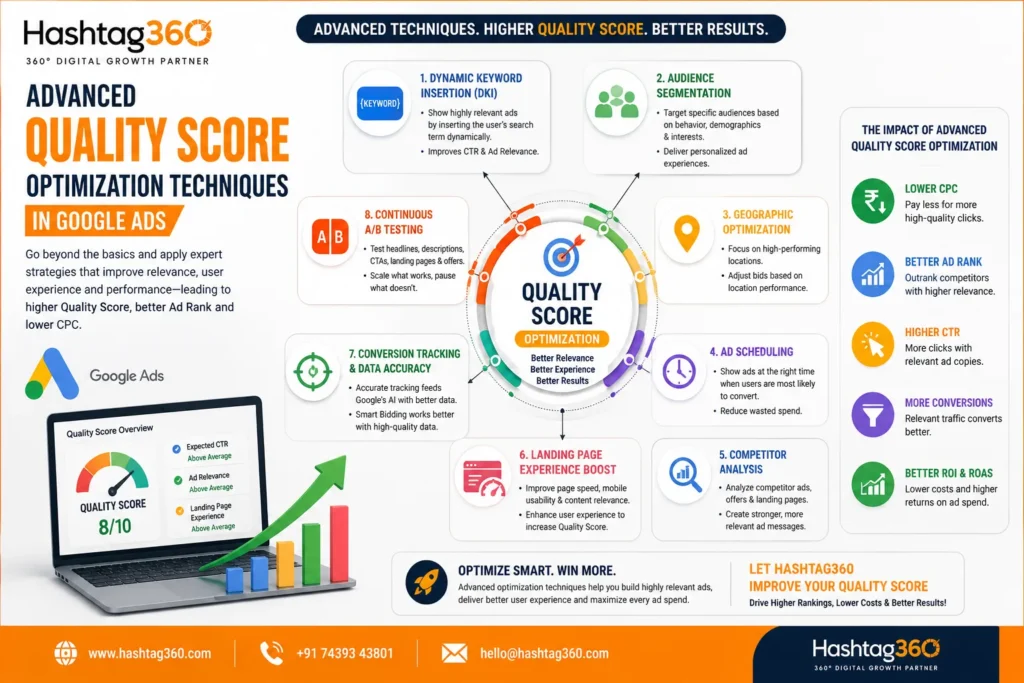
Experienced PPC specialists go beyond the basics.
Here are several advanced methods.
Dynamic Keyword Insertion
Automatically inserts the user’s search term into advertisements.
Benefits:
- Better relevance
- Higher CTR
- Improved Quality Score
Use carefully to maintain readability.
Audience Segmentation
Different audiences behave differently.
Segment campaigns by:
- Location
- Device
- Demographics
- Interests
- Remarketing audiences
Personalized ads perform better.
Geographic Optimization
Analyze which cities generate the best results.
Increase bids for high-performing regions.
Reduce bids where conversion rates are low.
Ad Scheduling
Show advertisements when customers are most likely to convert.
For B2B businesses, weekdays during business hours may outperform weekends.
Competitor Analysis
Monitor:
- Ad messaging
- Offers
- Headlines
- Pricing
- Landing pages
Differentiate your value proposition instead of copying competitors.
Quality Score Myths You Should Stop Believing
Many misconceptions surround Quality Score.
Let’s separate fact from fiction.
Myth 1: Higher Bids Automatically Increase Quality Score
False.
Increasing your bid affects Ad Rank, not Quality Score.
Quality Score depends on relevance and user experience.
Myth 2: Every Keyword Needs a Score of 10
False.
Many profitable campaigns perform exceptionally well with Quality Scores between 7 and 9.
Focus on improving important, high-volume keywords first.
Myth 3: Quality Score Directly Measures Profitability
False.
A keyword can have a Quality Score of 10 but produce very few conversions.
Always evaluate Quality Score alongside:
- Conversion Rate
- CPA
- ROAS
- Revenue
- Customer Lifetime Value
Myth 4: Quality Score Updates Instantly
False.
Google continually evaluates campaign performance.
Meaningful improvements often require time before they are reflected in Quality Score.
Patience and consistent optimization are essential.
Case Study: How Hashtag360 Improved Quality Score and Reduced CPC
A growing service-based business approached Hashtag360 after experiencing rising advertising costs and declining lead quality.
Initial Challenges
- Average Quality Score: 5/10
- Low Click-Through Rate
- Generic advertisements
- Homepage used for every campaign
- High Cost Per Click
- Poor conversion rates
Optimization Strategy
The Hashtag360 team implemented a comprehensive improvement plan:
- Reorganized keywords into tightly themed ad groups
- Rewrote all ad copy with keyword-focused messaging
- Added relevant ad assets
- Built dedicated landing pages
- Improved page speed and mobile usability
- Added negative keywords
- Enhanced conversion tracking with GA4 and GTM
- Performed ongoing A/B testing
Results After Optimization
Within a few months, the campaign showed significant improvements:
- Average Quality Score increased from 5 to 8
- Click-Through Rate improved substantially
- Cost Per Click decreased noticeably
- Ad Rank improved across high-value keywords
- Lead quality increased
- Return on Ad Spend (ROAS) improved
The biggest lesson from this campaign was clear:
Improving Quality Score often delivers better long-term results than simply increasing advertising budgets.
Frequently Asked Questions (FAQs)
What is a good Quality Score in Google Ads?
A Quality Score between 7 and 10 is generally considered good. While achieving a score of 10 is ideal, it isn’t always necessary. Most successful advertisers focus on maintaining a score above 7 for their highest-value keywords, as this often leads to lower CPC, higher Ad Rank, and improved campaign performance.
Can a low Quality Score increase my advertising costs?
Yes.
A low Quality Score usually means Google considers your ads, keywords, or landing pages less relevant. As a result, you may need to bid significantly more to achieve the same ad position as competitors with higher Quality Scores.
Does Quality Score affect SEO rankings?
No.
Quality Score only affects Google Ads campaigns.
It has no direct impact on your organic rankings in Google Search.
However, improving your landing page’s user experience, page speed, and content quality can benefit both paid advertising and SEO.
How often does Google update Quality Score?
Google evaluates auction-time signals continuously.
The visible Quality Score inside Google Ads may not update instantly after changes, but Google constantly reassesses your keywords based on user behavior, ad performance, and landing page experience.
Can I improve Quality Score without increasing my budget?
Absolutely.
Many advertisers improve Quality Score simply by:
- Writing better advertisements
- Improving landing pages
- Using relevant keywords
- Increasing CTR
- Adding negative keywords
- Organizing campaigns correctly
Better optimization is usually more effective than spending more money.
Does Smart Bidding improve Quality Score?
Not directly.
Smart Bidding optimizes bids for conversions, while Quality Score measures the quality and relevance of your ads and landing pages.
However, Smart Bidding combined with high-quality campaigns often improves overall performance.
Which Quality Score factor is most important?
Google officially states that all three components are important:
- Expected Click-Through Rate
- Ad Relevance
- Landing Page Experience
In practice, many PPC experts consider Expected CTR to have the greatest influence because it reflects how users interact with your advertisements.
Where can I see my Quality Score?
Inside your Google Ads account.
Navigate to:
Campaign → Keywords → Columns → Modify Columns → Quality Score
You can also view:
- Expected CTR
- Ad Relevance
- Landing Page Experience
These diagnostic metrics help identify which areas need improvement.
Expert Tips from Hashtag360
Over years of managing Google Ads campaigns across industries, the PPC specialists at Hashtag360 have identified several practices that consistently improve Quality Score and campaign profitability.
Tip 1: Build Campaigns Around Search Intent
Instead of grouping keywords alphabetically or by service category, organize them based on user intent.
A user searching for:
- Buy Running Shoes Online
expects a different experience than someone searching:
- Best Running Shoes for Beginners
Understanding intent improves both relevance and conversions.
Tip 2: Never Stop Testing
High-performing campaigns are constantly evolving.
Test:
- Headlines
- Descriptions
- CTAs
- Landing pages
- Offers
- Images
- Forms
Continuous experimentation leads to long-term improvement.
Tip 3: Optimize High-Spending Keywords First
Not every keyword deserves equal attention.
Prioritize keywords that generate:
- Most impressions
- Highest spend
- Most conversions
- Largest revenue
Even a small Quality Score improvement on these keywords can produce significant savings.
Tip 4: Focus on User Experience
Google’s algorithm increasingly rewards advertisers who genuinely help users.
Ask yourself:
“Would I enjoy visiting this landing page if I searched this keyword?”
If the answer is no, improvements are needed.
Tip 5: Monitor Search Terms Weekly
The Search Terms Report reveals exactly what users searched before clicking your ads.
Use this report to:
- Discover new keywords
- Add negative keywords
- Improve ad copy
- Identify new landing page opportunities
The Future of Quality Score
Google Ads continues evolving through artificial intelligence and machine learning.
Although Quality Score remains an important diagnostic metric, advertisers should expect greater emphasis on real-time auction signals.
Future campaign success will increasingly depend on:
- AI-powered bidding
- First-party data
- Audience signals
- Conversion quality
- User engagement
- Privacy-focused measurement
- Landing page experience
- Predictive optimization
Businesses that prioritize user experience over shortcuts will continue to benefit.
Quality Score Checklist Before Launching Any Google Ads Campaign
Before activating a campaign, review this checklist.
Keywords
✔ High commercial intent
✔ Proper match types
✔ Negative keywords added
✔ Organized into small ad groups
Advertisements
✔ Primary keyword in headline
✔ Strong CTA
✔ Unique value proposition
✔ Emotional trigger
✔ Ad assets enabled
Landing Page
✔ Fast loading
✔ Mobile responsive
✔ HTTPS secure
✔ Relevant headline
✔ Helpful content
✔ Trust signals
✔ Clear CTA
Tracking
✔ Google Analytics 4 connected
✔ Google Tag Manager configured
✔ Conversion Tracking verified
✔ Phone calls tracked
✔ Form submissions tracked
Performance Monitoring
✔ Weekly optimization schedule
✔ Search Terms Report reviewed
✔ CTR monitored
✔ Quality Score monitored
✔ Conversion Rate monitored
✔ ROAS monitored
Common Tools for Improving Quality Score
Professional advertisers use multiple tools to monitor and improve campaign performance.
Some of the most valuable include:
- Google Ads
- Google Analytics 4 (GA4)
- Google Tag Manager (GTM)
- Google Search Console
- Google Keyword Planner
- Google PageSpeed Insights
- Lighthouse
- Looker Studio
- Microsoft Clarity
- Hotjar
- SEMrush
- Ahrefs
- Screaming Frog SEO Spider
- Unbounce
- Instapage
Each tool contributes to a deeper understanding of user behavior and campaign optimization.
Why Businesses Choose Hashtag360 for Google Ads Management
Managing Google Ads effectively requires more than increasing bids.
It demands a strategic approach built on data, testing, and continuous optimization.
At Hashtag360, our approach focuses on:
- Comprehensive keyword research
- Search intent analysis
- High-converting ad copy
- Dedicated landing page optimization
- Continuous A/B testing
- Advanced conversion tracking
- Quality Score improvement
- Cost Per Click reduction
- Return on Ad Spend optimization
- Transparent reporting
Rather than relying on guesswork, every campaign decision is driven by measurable performance data.
Whether you’re a startup, local business, eCommerce store, healthcare provider, educational institution, or enterprise brand, our team works to create campaigns that deliver sustainable growth—not just short-term clicks.
Final Thoughts
Quality Score is much more than a number displayed in your Google Ads account.
It represents Google’s assessment of how effectively your advertisements satisfy user intent.
A strong Quality Score can help your business:
- Lower Cost Per Click (CPC)
- Improve Ad Rank
- Increase Click-Through Rate (CTR)
- Generate higher-quality leads
- Improve Conversion Rate
- Maximize Return on Ad Spend (ROAS)
- Build long-term advertising efficiency
The businesses that consistently outperform competitors are not always those with the largest budgets—they are the ones that create the most relevant ads, provide exceptional landing page experiences, and continually optimize based on data.
Instead of asking, “How can I spend more?”, successful advertisers ask, “How can I deliver a better experience to the user?”
That mindset is the foundation of every high-performing Google Ads campaign.
Call to Action
Ready to improve your Quality Score and reduce your Google Ads costs?
At Hashtag360, we specialize in building data-driven PPC campaigns that increase visibility, lower advertising expenses, and maximize conversions. From keyword research and ad creation to landing page optimization and ongoing campaign management, our certified experts help businesses achieve measurable results.
Contact Hashtag360 today for a comprehensive Google Ads audit and discover how a higher Quality Score can transform your advertising performance.