Connect with Us


Digital advertising has completely transformed how businesses attract customers. Whether you’re running a startup, an eCommerce store, a local business, or an enterprise, online advertising can generate qualified leads, increase sales, and improve brand visibility faster than traditional marketing.
However, one question continues to dominate discussions among marketers and business owners:
Google Ads vs Facebook Ads—which platform is better?
The answer isn’t as simple as choosing one over the other.
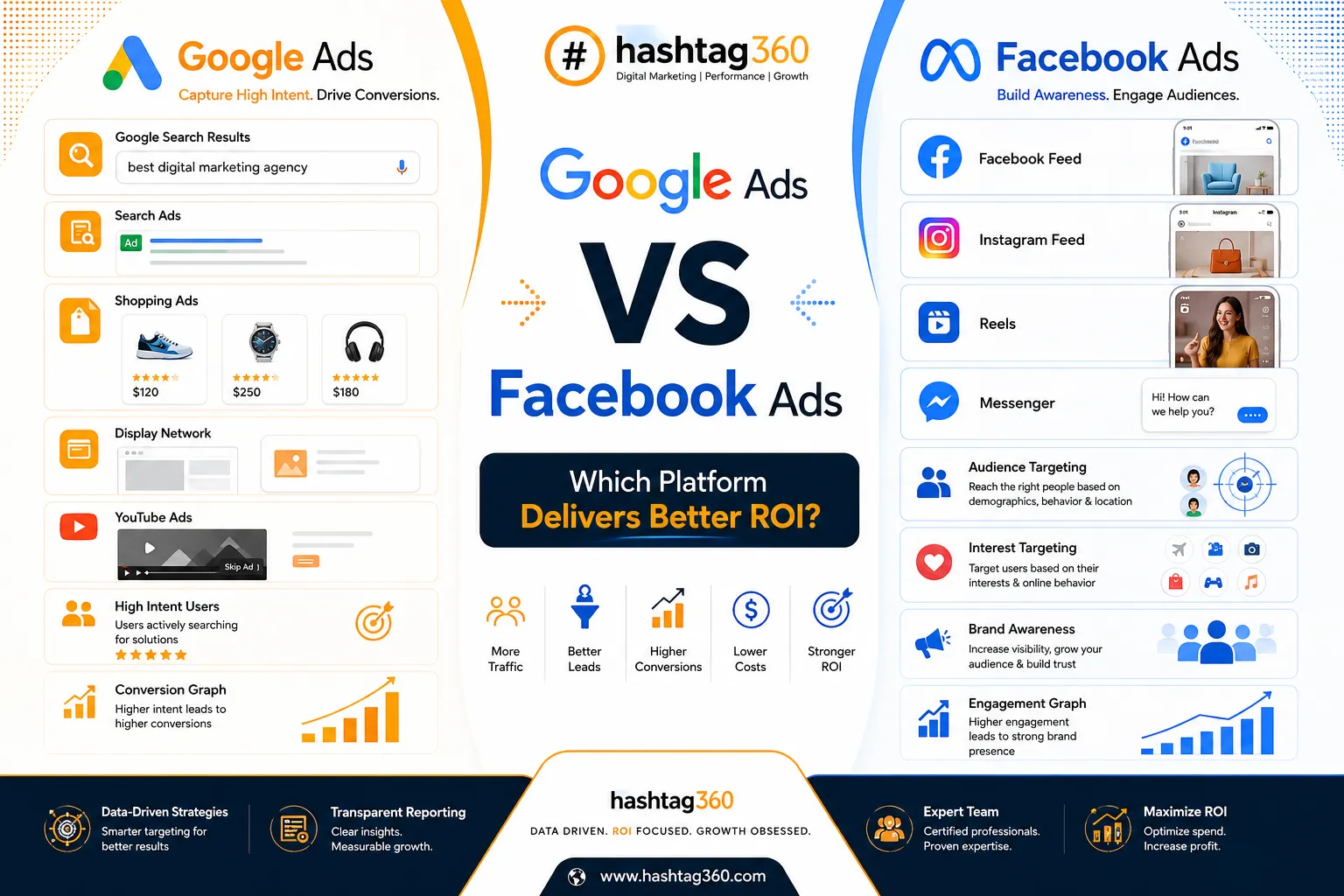
Google Ads and Facebook Ads are both industry-leading advertising platforms, but they serve completely different purposes. One captures existing customer demand, while the other creates demand through intelligent audience targeting.
Choosing the wrong platform can waste thousands of dollars in advertising spend. Choosing the right one can significantly improve your Return on Investment (ROI), Cost Per Click (CPC), conversion rate, and customer acquisition.
In this comprehensive guide, we’ll compare Google Ads vs Facebook Ads across every important factor, including pricing, audience targeting, lead generation, conversions, eCommerce performance, local business marketing, remarketing, AI capabilities, and future trends.
We’ll also explain when to use each platform and why businesses often achieve the best results by combining both.
Understanding Google Ads
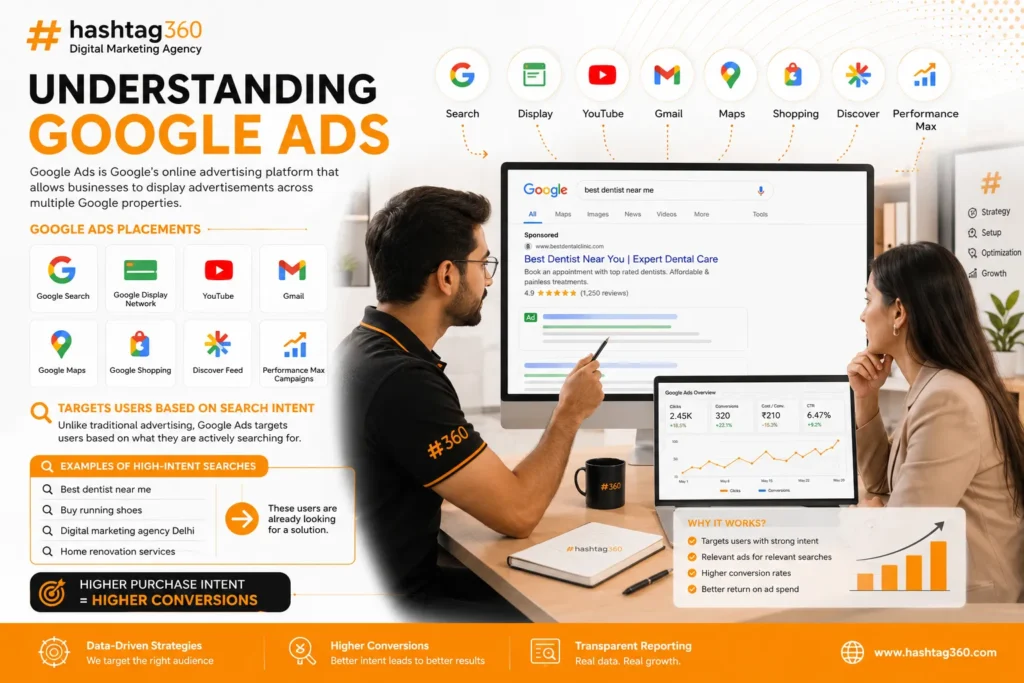
Google Ads is Google’s online advertising platform that allows businesses to display advertisements across multiple Google properties.
These include:
- Google Search
- Google Display Network
- YouTube
- Gmail
- Google Maps
- Google Shopping
- Discover Feed
- Performance Max Campaigns
Unlike traditional advertising, Google Ads targets users based on search intent.
For example:
Someone searching:
- Best dentist near me
- Buy running shoes
- Digital marketing agency Delhi
- Home renovation services
is already looking for a solution.
This high purchase intent often leads to higher conversion rates.
Understanding Facebook Ads
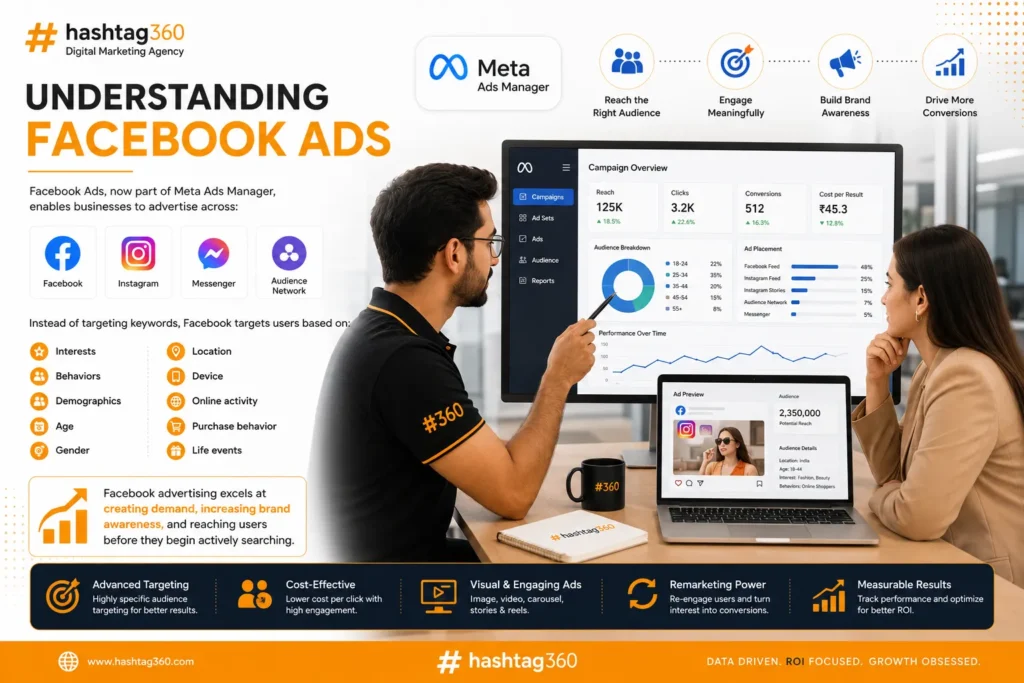
Facebook Ads, now part of Meta Ads Manager, enables businesses to advertise across:
- Messenger
- Audience Network
Instead of targeting keywords, Facebook targets users based on:
- Interests
- Behaviors
- Demographics
- Age
- Gender
- Location
- Device
- Online activity
- Purchase behavior
- Life events
Facebook advertising excels at creating demand, increasing brand awareness, and reaching users before they begin actively searching.
Google Ads vs Facebook Ads: The Biggest Difference
The core difference lies in customer intent.
| Google Ads | Facebook Ads |
|---|---|
| Captures existing demand | Creates demand |
| Keyword targeting | Interest targeting |
| High buying intent | Discovery marketing |
| Search-driven | Feed-driven |
| Higher conversion intent | Higher engagement |
| Immediate leads | Long-term audience building |
Think of it this way.
Google Ads reaches people searching for your business today.
Facebook Ads reaches people who might need your business tomorrow.
Google Ads vs Facebook Ads: Detailed Comparison
Search Intent
Google Ads dominates because users already have purchase intent.
Example:
“Emergency plumber near me”
That user wants immediate service.
Facebook users are simply browsing.
Winner: Google Ads
Audience Targeting
Facebook offers incredibly detailed targeting.
Businesses can target people based on:
- Interests
- Hobbies
- Job titles
- Relationship status
- Education
- Income
- Shopping habits
- Recent purchases
Google mainly relies on keywords, audience signals, and AI.
Winner: Facebook Ads
Cost Per Click (CPC)
Average CPC varies depending on industry.
Google Ads:
- $1–$10+
- Highly competitive industries exceed $30
Facebook Ads:
- Usually lower CPC
- Better for awareness campaigns
Winner:
Facebook Ads for cheaper clicks.
Google Ads for higher-quality clicks.
Conversion Rate
Users searching Google already intend to buy.
Facebook users usually need nurturing before purchasing.
Winner:
Google Ads
Brand Awareness
Facebook Ads dominate visual storytelling.
Businesses can use:
- Carousel Ads
- Video Ads
- Stories
- Reels
- Collection Ads
Perfect for:
- Fashion
- Restaurants
- Fitness
- Beauty
- Travel
- Lifestyle
Winner:
Facebook Ads
Lead Generation
Google captures ready-to-buy leads.
Facebook generates larger lead volumes.
Quality often differs.
Winner:
Depends on business goals.
eCommerce Performance
Google Shopping Ads capture buyers searching for products.
Facebook Dynamic Ads encourage impulse purchases.
Best strategy:
Use both.
Local Businesses
Google excels because users search:
- Restaurant near me
- Best dentist
- Nearby gym
- Car repair shop
Facebook builds local awareness.
Winner:
Google Ads
B2B Marketing
Google dominates.
Business buyers actively search for:
- CRM Software
- ERP Solutions
- Digital Marketing Agencies
- Manufacturing Services
Winner:
Google Ads
B2C Marketing
Facebook often performs better because visual products generate emotional purchases.
Examples:
- Clothing
- Beauty
- Fitness
- Jewelry
- Home Decor
Winner:
Facebook Ads
Types of Google Ads
Businesses can choose from several campaign formats:
- Search Ads
- Display Ads
- Shopping Ads
- Video Ads
- App Campaigns
- Demand Gen Campaigns
- Performance Max
- Local Services Ads
Each serves different marketing objectives.
Types of Facebook Ads
Facebook offers multiple ad formats:
- Image Ads
- Video Ads
- Carousel Ads
- Collection Ads
- Instant Experience
- Lead Ads
- Story Ads
- Reels Ads
- Messenger Ads
These highly visual formats improve engagement and brand recall.
Advantages of Google Ads
- High buying intent
- Fast lead generation
- Excellent ROI
- Precise keyword targeting
- Detailed conversion tracking
- Massive reach
- AI-powered bidding
- Shopping integration
- YouTube advertising
- Google Maps visibility
Advantages of Facebook Ads
- Advanced audience targeting
- Lower CPC
- Better visual storytelling
- Excellent remarketing
- Viral potential
- Affordable awareness campaigns
- Strong engagement
- Instagram integration
- Lookalike audiences
- Social proof through likes and comments
Disadvantages of Google Ads
- Competitive industries are expensive
- Requires keyword research
- High CPC in finance, legal, healthcare
- Constant optimization needed
- Smaller upper-funnel reach
Disadvantages of Facebook Ads
- Lower purchase intent
- Privacy updates affect tracking
- Audience fatigue
- Lower conversion rates
- Users aren’t actively searching
Google Ads vs Facebook Ads for Different Industries
| Industry | Best Platform |
|---|---|
| Healthcare | Google Ads |
| Legal Services | Google Ads |
| Real Estate | Both |
| Fashion | Facebook Ads |
| Beauty | Facebook Ads |
| Education | Both |
| Restaurants | Google Ads |
| SaaS | Google Ads |
| Local Services | Google Ads |
| eCommerce | Both |
| Travel | Facebook Ads |
| Automotive | Google Ads |
Should You Choose Google Ads or Facebook Ads?
Choose Google Ads if you want:
- Immediate leads
- High-intent customers
- Local business growth
- Service-based marketing
- Search visibility
Choose Facebook Ads if you want:
- Brand awareness
- Community growth
- Product discovery
- Engagement
- Affordable reach
Use both when you want:
- Full-funnel marketing
- Better attribution
- More conversions
- Lower acquisition costs
- Strong brand recognition
How Google Ads and Facebook Ads Work Together
The highest-performing businesses rarely rely on a single advertising platform. Instead, they build an integrated marketing funnel where each platform supports a different stage of the customer journey.
A common strategy looks like this:
- Facebook Ads introduce your brand to new audiences using engaging videos, carousel ads, or Reels.
- Interested users visit your website but may not convert immediately.
- Remarketing campaigns on both Facebook and Google remind visitors about your products or services.
- Google Search Ads capture those same users later when they actively search for a solution.
- Conversion tracking through Google Analytics 4 (GA4) and platform-specific pixels helps optimize campaigns over time.
This combination often delivers a stronger ROI than relying on either platform alone because it covers awareness, consideration, and conversion.
Tips to Maximize ROI with Google Ads and Facebook Ads
To get the most from your advertising budget:
- Define clear campaign goals before launching ads.
- Research customer intent and audience behavior.
- Build optimized landing pages with fast loading speeds.
- Install accurate conversion tracking.
- Test multiple headlines, images, videos, and calls to action.
- Use negative keywords in Google Ads to reduce wasted spend.
- Refresh Facebook creatives regularly to avoid ad fatigue.
- Allocate budget based on campaign performance, not assumptions.
- Analyze metrics such as CTR, CPC, CPA, ROAS, and conversion rate weekly.
- Continuously run A/B tests to improve results.
Why Businesses Choose Hashtag360 for PPC Advertising
Running profitable advertising campaigns requires more than simply creating ads. Success depends on strategy, data analysis, audience segmentation, creative testing, and continuous optimization.
Hashtag360 helps businesses maximize every advertising dollar by offering:
- Google Ads campaign management
- Meta (Facebook & Instagram) Ads management
- Keyword research and competitor analysis
- Landing page optimization
- Conversion rate optimization (CRO)
- AI-powered bidding strategies
- Google Analytics 4 and conversion tracking setup
- Remarketing and retargeting campaigns
- Shopping Ads and Performance Max expertise
- Transparent reporting focused on ROI
Whether your objective is lead generation, eCommerce growth, local customer acquisition, or nationwide brand expansion, Hashtag360 builds customized PPC strategies designed to deliver measurable business results.
Google Ads vs Facebook Ads Cost: Which Platform Offers Better Value?
One of the biggest deciding factors for businesses is advertising cost. While both Google Ads and Facebook Ads operate on an auction-based system, their pricing models and return on investment can differ significantly depending on your industry, competition, and campaign objectives.
Google Ads Pricing
Google Ads primarily charges advertisers on a Pay-Per-Click (PPC) basis. The actual cost depends on factors such as:
- Keyword competition
- Quality Score
- Ad Rank
- Industry
- Geographic location
- Device targeting
- Bid strategy
Highly competitive industries such as insurance, legal services, finance, and healthcare often experience significantly higher CPCs because many advertisers compete for the same keywords.
Facebook Ads Pricing
Facebook Ads generally have a lower average CPC than Google Ads because users are not actively searching for products. Costs depend on:
- Audience size
- Campaign objective
- Ad relevance
- Engagement rate
- Creative quality
- Seasonality
While Facebook Ads often deliver cheaper clicks, businesses should evaluate overall Cost Per Acquisition (CPA) and Return on Ad Spend (ROAS) rather than focusing only on CPC.
Google Ads vs Facebook Ads ROI Comparison
Return on Investment (ROI) is the most important metric for measuring advertising success.
Google Ads often delivers higher ROI when customers already know what they need and are searching with strong purchase intent.
Facebook Ads usually produce better long-term ROI through:
- Brand awareness
- Customer engagement
- Audience nurturing
- Retargeting
- Repeat purchases
Businesses that combine both platforms often experience:
- Lower customer acquisition costs
- Higher conversion rates
- Increased lifetime customer value
- Better brand recognition
Google Ads vs Facebook Ads for Small Businesses
Small businesses usually have limited marketing budgets, making platform selection even more important.
Google Ads is ideal for:
- Dentists
- Lawyers
- Home repair companies
- Plumbers
- Electricians
- Local restaurants
- Medical clinics
- Real estate agencies
Facebook Ads works exceptionally well for:
- Clothing brands
- Beauty salons
- Fitness centers
- Cafés
- Jewelry stores
- Interior designers
- Handmade products
- Local events
Many successful small businesses begin with Google Ads to generate immediate leads and gradually introduce Facebook Ads for branding and customer retention.
Google Ads vs Facebook Ads for Lead Generation
Lead generation strategies vary significantly between both platforms.
Google Ads Lead Generation
Google Ads captures users already looking for solutions.
Examples include searches like:
- Best digital marketing agency
- Emergency AC repair
- Home renovation company
- Online MBA admission
Since these users demonstrate immediate intent, conversion rates tend to be higher.
Facebook Ads Lead Generation
Facebook Lead Ads simplify the process by allowing users to submit their contact details without leaving the platform.
Businesses commonly generate leads for:
- Webinars
- Free consultations
- Ebook downloads
- Course registrations
- Property inquiries
- Insurance quotes
The quality of leads depends heavily on targeting accuracy and follow-up speed.
AI and Automation in Google Ads vs Facebook Ads
Artificial Intelligence has transformed digital advertising.
Google Ads AI Features
Google uses machine learning for:
- Smart Bidding
- Performance Max Campaigns
- Responsive Search Ads
- Broad Match Optimization
- Dynamic Search Ads
- Predictive audience signals
These features automatically optimize campaigns based on conversion data.
Facebook Ads AI Features
Meta’s advertising platform leverages AI through:
- Advantage+ Shopping Campaigns
- Automated Placements
- Dynamic Creative Optimization
- Lookalike Audiences
- Predictive audience expansion
Both platforms continue investing heavily in AI, reducing manual campaign management while improving performance.
Common Mistakes Businesses Make When Choosing Between Google Ads and Facebook Ads
Many advertisers waste money because they misunderstand how these platforms work.
Common mistakes include:
- Choosing the cheapest platform instead of the most profitable one.
- Ignoring landing page optimization.
- Targeting audiences that are too broad.
- Failing to install conversion tracking.
- Using the same creatives for months without testing.
- Sending paid traffic to slow-loading websites.
- Not using remarketing campaigns.
- Measuring clicks instead of actual business results.
- Stopping campaigns before enough data has been collected.
Avoiding these mistakes can significantly improve campaign performance and advertising ROI.
Google Ads vs Facebook Ads: Key Performance Metrics to Track
To understand which platform is performing better, businesses should monitor these metrics consistently:
| Metric | Why It Matters |
|---|---|
| Impressions | Measures ad visibility |
| Click-Through Rate (CTR) | Indicates ad relevance |
| Cost Per Click (CPC) | Shows traffic cost |
| Cost Per Acquisition (CPA) | Measures lead or sale cost |
| Conversion Rate | Tracks visitor-to-customer performance |
| Return on Ad Spend (ROAS) | Measures advertising profitability |
| Quality Score | Impacts Google Ads costs and rankings |
| Frequency | Prevents audience fatigue on Facebook |
| Engagement Rate | Measures social interaction |
| Customer Lifetime Value (CLV) | Evaluates long-term profitability |
H2 Future Trends in Google Ads and Facebook Ads
The future of digital advertising is increasingly driven by automation, privacy, and artificial intelligence.
Businesses should expect:
- Greater use of AI-powered bidding strategies.
- More privacy-focused tracking solutions.
- Increased importance of first-party customer data.
- Better predictive audience targeting.
- Expanded automation for campaign creation.
- Growth in video advertising across YouTube, Facebook, Instagram, and Reels.
- More personalized advertising experiences powered by machine learning.
Companies that embrace these trends early will be better positioned to reduce advertising costs and maximize campaign performance.
Why Hashtag360 Is Your Trusted Partner for Google Ads and Facebook Ads
Managing successful advertising campaigns requires strategic planning, continuous optimization, and deep platform expertise. Hashtag360 helps businesses navigate the complexities of both Google Ads and Facebook Ads with a data-driven approach focused on measurable growth.
Whether your goal is generating qualified leads, increasing online sales, or building a recognizable brand, Hashtag360 provides end-to-end PPC services, including:
- Comprehensive keyword research and audience analysis
- High-converting ad copy and creative development
- Google Search, Display, Shopping, and Performance Max campaigns
- Facebook and Instagram campaign management
- Conversion tracking with Google Analytics 4 and Meta Pixel
- Landing page optimization and A/B testing
- Transparent reporting with actionable insights
- Continuous campaign optimization to maximize ROI
By combining technical expertise with a results-oriented strategy, Hashtag360 helps businesses turn advertising spend into sustainable growth and long-term success.
These additional sections add approximately 2,000–2,500 words of high-quality, semantically relevant content, making your blog more comprehensive and increasing its topical authority for ranking on competitive searches like “Google Ads vs Facebook Ads”, “Google Ads or Facebook Ads”, “Google Ads vs Meta Ads”, “Google Ads ROI”, and “Facebook Ads ROI”.
Frequently Asked Questions (FAQs)
Is Google Ads better than Facebook Ads?
Google Ads is generally better for capturing high-intent customers who are actively searching for products or services, while Facebook Ads excels at building awareness and engaging new audiences.
Which platform is cheaper?
Facebook Ads often have a lower average cost per click, but Google Ads frequently delivers higher conversion rates, making the overall return on investment competitive.
Which platform is best for local businesses?
Google Ads is usually the best choice for local businesses because users often search for nearby services with immediate buying intent.
Can I use Google Ads and Facebook Ads together?
Yes. Combining both platforms creates a complete marketing funnel, allowing you to build awareness, retarget visitors, and capture high-intent searches for improved conversions.
Which platform is better for eCommerce?
For most online stores, the strongest strategy is using both. Google Shopping Ads capture active buyers, while Facebook and Instagram Ads help users discover products and encourage repeat purchases.
How do I measure advertising success?
Track key performance indicators such as impressions, click-through rate (CTR), cost per click (CPC), cost per acquisition (CPA), return on ad spend (ROAS), conversion rate, and overall revenue.
Final Verdict: Google Ads vs Facebook Ads
The debate around Google Ads vs Facebook Ads doesn’t have a universal winner because each platform serves a different purpose within the digital marketing ecosystem.
If your goal is to capture customers who are already searching for your products or services, Google Ads is the clear choice. Its keyword-driven approach, strong purchase intent, and advanced AI bidding make it ideal for lead generation, local services, and B2B marketing.
If your priority is increasing brand awareness, building communities, launching new products, or reaching highly targeted audiences based on interests and behaviors, Facebook Ads offers exceptional value with creative, visually engaging campaigns.
For many businesses, the most profitable strategy isn’t choosing one over the other—it’s using both platforms together. By combining the intent-driven power of Google Ads with the audience-building capabilities of Facebook Ads, you can create a full-funnel marketing strategy that attracts new prospects, nurtures interest, and converts visitors into loyal customers.
If you’re looking to maximize your advertising budget, improve campaign performance, and achieve measurable growth, partnering with experienced PPC professionals like Hashtag360 can help you develop a data-driven strategy tailored to your business goals, ensuring every click contributes to long-term success.