
Connect with Us


Running successful Google Ads campaigns isn’t just about choosing the right keywords—it’s equally important to know which keywords not to target. Many advertisers spend thousands of dollars on irrelevant clicks because they overlook one of the most powerful optimization tools available in Google Ads: negative keywords.
Negative keywords help prevent your ads from appearing for search queries that are unrelated to your products or services. By filtering out irrelevant traffic, businesses can significantly reduce wasted ad spend, improve click-through rates (CTR), increase conversion rates, and maximize return on investment (ROI).
Whether you’re managing campaigns for an eCommerce store, SaaS company, local business, or enterprise brand, understanding how to use negative keywords effectively can dramatically improve campaign performance.
In this comprehensive guide by Hashtag360, you’ll learn everything you need to know about negative keywords—from their definition and benefits to advanced optimization strategies and best practices.
Table of Contents
What Are Negative Keywords?
Negative keywords are search terms that tell Google Ads not to display your advertisements when those terms appear in a user’s search query.
Unlike regular keywords that trigger your ads, negative keywords block your ads from showing for irrelevant searches.
Example
Suppose you own a company that sells premium office chairs.
Your target keyword might be:
- Office chairs
Without negative keywords, your ads may appear for searches like:
- Free office chairs
- Office chair repair
- Used office chairs
- DIY office chairs
- Cheap office chairs under ₹500
If these searches don’t match your business goals, users clicking these ads are unlikely to convert.
By adding words like:
- Free
- Used
- Repair
- DIY
as negative keywords, your ads stop showing for these irrelevant searches.
The result?
- Higher-quality traffic
- Better conversion rates
- Lower advertising costs
Why Are Negative Keywords Important?
Many advertisers focus heavily on keyword research but ignore search intent.
Even if your keyword targeting is excellent, Google may match your ads with searches that aren’t valuable.
Negative keywords solve this problem.
Benefits of Negative Keywords
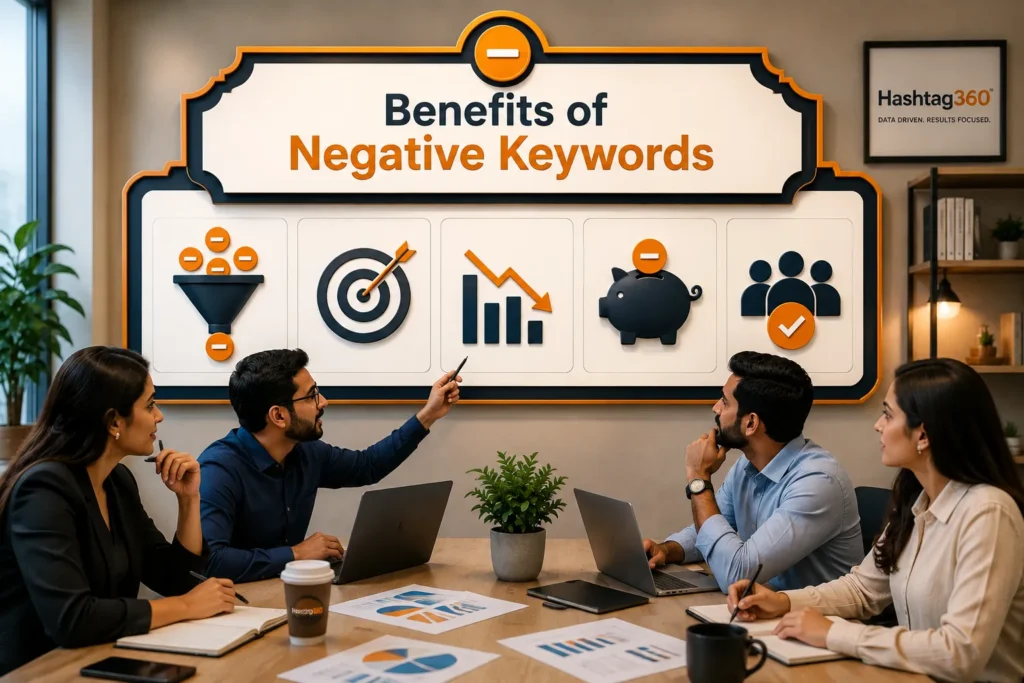
1. Reduce Wasted Ad Spend
Every irrelevant click costs money.
Negative keywords prevent paying for users who have no intention of purchasing your products or services.
2. Improve Click-Through Rate (CTR)
Showing ads only to relevant audiences naturally increases CTR.
Higher CTR also contributes to better Quality Scores.
3. Increase Conversion Rates
When irrelevant traffic decreases, your conversion rate improves because only qualified visitors reach your landing pages.
4. Improve Quality Score
Google rewards relevant campaigns.
Higher relevance often leads to:
- Better Quality Scores
- Lower Cost Per Click (CPC)
- Higher Ad Rank
5. Better Budget Allocation
Instead of wasting budget on low-intent users, your budget goes toward valuable searches that generate leads and sales.
The Hidden Cost of Not Using Negative Keywords
Many advertisers believe that poor campaign performance is due to weak ad copy or ineffective landing pages. While these factors certainly influence results, one of the biggest hidden reasons for underperforming campaigns is the absence of a well-maintained negative keyword strategy.
When irrelevant users click on your ads, several problems occur simultaneously:
- Advertising budget is consumed without generating meaningful business outcomes.
- Your click-through rate (CTR) may decrease because your ads are reaching people who aren’t interested in your offering.
- Conversion rates decline as low-intent visitors fail to take action.
- Google’s machine learning receives poor-quality conversion signals, making automated bidding strategies less effective.
- Future optimization becomes more difficult because campaign data is diluted by irrelevant traffic.
Imagine spending ₹2,000 every day on Google Ads. If even 20% of your clicks are irrelevant, you’re wasting approximately ₹400 daily. Over a month, that equals ₹12,000, and over a year, nearly ₹1.5 lakh in unnecessary ad spend.
For agencies managing multiple client accounts, this inefficiency multiplies quickly. That’s why experienced PPC professionals treat negative keyword management as an ongoing optimization process rather than a one-time task
Types of Negative Keywords
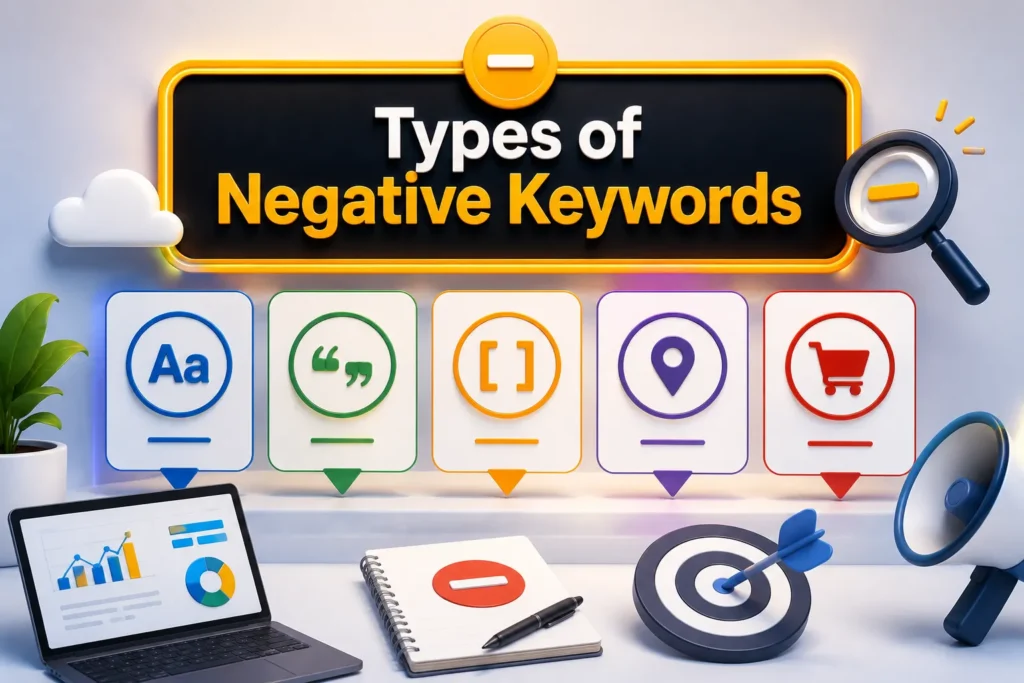
Google Ads supports three different negative keyword match types.
Understanding each one is essential for accurate targeting.
Negative Broad Match
This is the default option.
Your ad won’t appear if the search contains all the negative keyword terms, regardless of order.
Example
Negative keyword:
- Running shoes
Blocked searches:
- Buy running shoes
- Running shoes online
- Shoes for running
Negative Phrase Match
Your ad won’t appear if the exact phrase appears in the search query in the same order.
Example:
Negative phrase:
Blocked:
- Cheap running shoes
Not blocked:
- Shoes for running
Negative Exact Match
Only blocks searches that exactly match your negative keyword.
Example:
Negative exact:
[running shoes]
Blocked:
- Running shoes
Not blocked:
- Buy running shoes
- Best running shoes
Understanding Search Intent Before Choosing Negative Keywords
Successful PPC campaigns are built around understanding search intent. Every keyword reflects what a user hopes to accomplish, and negative keywords help ensure your ads appear only for searches aligned with your business goals.
Search intent generally falls into four categories:
Informational Intent
Users are seeking knowledge rather than making a purchase.
Examples:
- What are negative keywords?
- How does Google Ads work?
- Learn PPC
These searches are valuable for blogs but often unsuitable for sales-focused campaigns.
Navigational Intent
Users are looking for a specific website or brand.
Examples:
- Google Ads login
- Hashtag360
- Google Keyword Planner
Unless you’re bidding on branded terms, many navigational searches may not deliver quality leads.
Commercial Investigation
Users are comparing products or services before making a decision.
Examples:
- Best PPC agency
- Google Ads pricing
- Compare Google Ads management companies
These users often represent high-value opportunities and should generally not be excluded.
Transactional Intent
These users are ready to take action.
Examples:
- Hire Google Ads expert
- PPC agency near me
- Google Ads management services
These keywords typically produce the highest conversion rates.
Understanding these intent categories helps marketers build smarter negative keyword lists while preserving valuable traffic.
Common Categories of Negative Keywords
Depending on your business, you may want to exclude searches related to:
Free
- Free
- Download
- Trial
- Sample
Jobs
- Careers
- Recruitment
- Internship
- Hiring
- Salary
Education
- Course
- Training
- Certification
- Tutorial
DIY
- Homemade
- DIY
- How to make
- Template
Cheap Buyers
- Cheapest
- Low cost
- Under ₹100
- Discount
Competitor Terms (when appropriate)
Some advertisers exclude competitor names if they don’t want to compete on branded searches.
How to Find Negative Keywords?
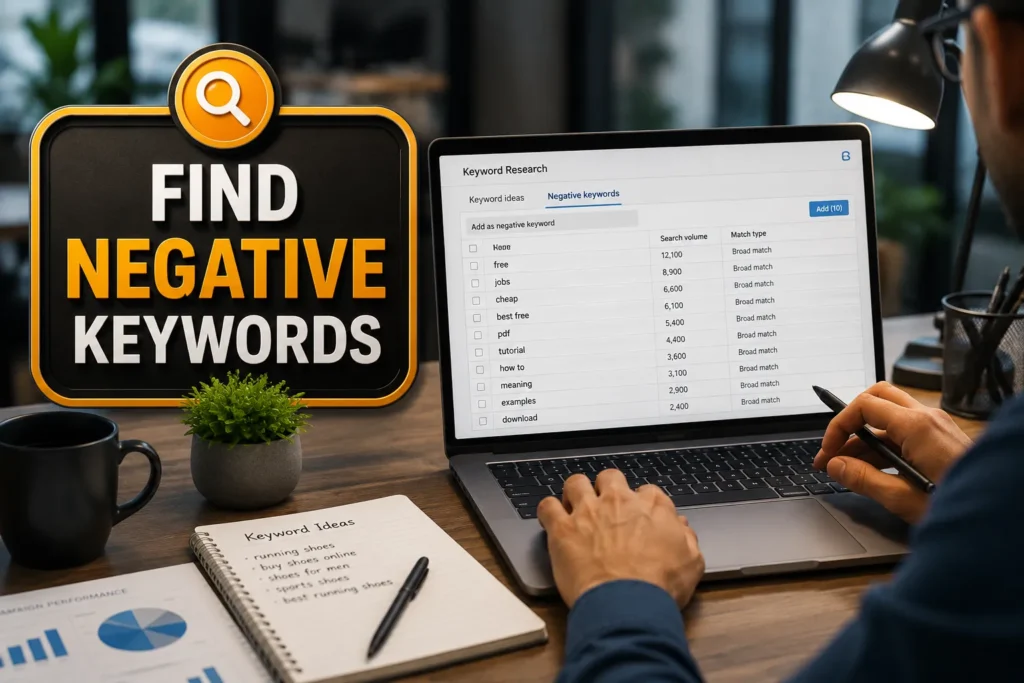
Analyze Search Terms Report
The Search Terms Report is one of the best sources for discovering irrelevant queries.
Look for searches that:
- Have many clicks
- No conversions
- High spending
- Poor engagement
These are excellent candidates for negative keywords.
Use Google Keyword Planner
Keyword Planner often reveals search variations that aren’t relevant to your business.
Analyze Website Search Data
If visitors search irrelevant terms on your website, those keywords may also need to be excluded from campaigns.
Use Google Search Suggestions
Start typing your target keyword into Google and review autocomplete suggestions.
You’ll often discover irrelevant search intent.
Competitor Research
Tools like SEMrush, Ahrefs, and SpyFu can reveal keywords competitors target—and those they deliberately exclude.
Tools That Help Discover Negative Keywords
Professional PPC managers rarely rely on guesswork. Instead, they use specialized tools to identify search queries that should be excluded.
Google Ads Search Terms Report
This remains the most valuable source of negative keyword ideas because it shows the actual queries users typed before clicking your ads.
Look for searches with:
- High impressions but no clicks
- High clicks but no conversions
- High spend and low ROI
- Irrelevant search intent
Google Keyword Planner
Although primarily designed for keyword research, Keyword Planner also reveals search variations that may not match your target audience.
Google Search Console
For businesses running both SEO and PPC campaigns, Search Console provides insights into organic search behavior, helping identify informational queries that may not be suitable for paid advertising.
SEMrush
SEMrush enables marketers to analyze competitors, uncover keyword gaps, and discover irrelevant search terms affecting campaign efficiency.
Ahrefs
Ahrefs offers valuable keyword data, search intent insights, and competitive intelligence that can inform your negative keyword strategy.
SpyFu
SpyFu specializes in PPC intelligence, allowing advertisers to understand competitor keyword strategies and identify opportunities to refine campaign targeting.
Best Practices for Using Negative Keywords

Create Shared Negative Keyword Lists
Instead of adding negatives individually to every campaign, build shared lists.
Examples:
- Job seekers
- Students
- Free users
- DIY searches
This keeps campaigns organized and consistent.
Review Search Terms Weekly
New search queries appear constantly.
Regular audits help maintain campaign efficiency.
Don’t Overuse Negative Keywords
Adding too many negatives can accidentally block valuable traffic.
Always verify before excluding a keyword.
Segment by Campaign
Different campaigns often require different exclusions.
For example:
Brand campaign:
May allow branded searches.
Generic campaign:
May exclude brand terms.
Use Conversion Data
Don’t rely only on impressions or clicks.
Focus on search queries that spend money without producing conversions.
Every industry requires a unique negative keyword strategy because customer search behavior differs significantly.
Industry-Specific Negative Keyword Examples
Every industry requires a unique negative keyword strategy because customer search behavior differs significantly.
Healthcare
Common negative keywords:
- Free
- Home remedies
- DIY
- Symptoms
- Wikipedia
Healthcare providers usually want appointment bookings rather than informational traffic.
Real Estate
Useful exclusions include:
- Rent
- Free
- Floor plans
- Government housing
- Internship
These help focus campaigns on serious buyers rather than researchers.
SaaS Companies
Potential negative keywords:
- Crack
- Torrent
- Free download
- Open source
- GitHub
SaaS businesses often aim to reach users interested in legitimate software subscriptions.
Education
Schools and training providers may exclude:
- Jobs
- Salary
- Free certificate
- Answers
- PDF notes
This ensures campaigns attract prospective students rather than individuals seeking free resources.
E-commerce
Online retailers frequently exclude:
- Manual
- Repair
- Used
- Wholesale
- Rental
- Second hand
Doing so improves the likelihood of reaching shoppers ready to purchase new products.
Negative Keywords vs Regular Keywords
| Regular Keywords | Negative Keywords |
|---|---|
| Trigger ads | Prevent ads |
| Increase visibility | Reduce irrelevant visibility |
| Attract traffic | Filter traffic |
| Focus on growth | Focus on efficiency |
| Increase impressions | Improve relevance |
Common Mistakes to Avoid

Ignoring Search Intent
Many advertisers only focus on volume instead of relevance.
Never Reviewing Search Terms
Campaigns evolve over time.
Regular monitoring is essential.
Using Only Broad Negatives
Broad negatives may unintentionally block valuable searches.
Use phrase and exact match strategically.
Forgetting Seasonal Updates
During festivals or sales, user behavior changes.
Review negative keyword lists before major campaigns.
Not Using Shared Lists
Managing hundreds of campaigns individually increases the risk of inconsistency.
Real-World Case Study: How Negative Keywords Improved Campaign Performance
Consider a fictional digital marketing agency managing Google Ads for an online furniture retailer.
Initial Campaign Performance
Monthly budget: ₹3,00,000
Average CPC: ₹40
Conversion rate: 2.3%
CPA: ₹1,700
During campaign analysis, the agency discovered ads were appearing for searches such as:
- Free furniture
- Furniture repair
- Used furniture
- DIY furniture
- Furniture manufacturing jobs
None of these searches aligned with the retailer’s objectives.
Optimization Process
The team:
- Audited the Search Terms Report.
- Added more than 250 negative keywords.
- Created shared negative keyword lists.
- Segmented campaigns based on user intent.
- Reviewed search terms every week.
Results After Three Months
- 27% reduction in wasted ad spend
- 18% increase in CTR
- 24% improvement in Quality Score
- 31% increase in conversion rate
- 22% lower Cost Per Acquisition
- 37% higher Return on Ad Spend (ROAS)
While every campaign is different, this example demonstrates how strategic negative keyword optimization can substantially improve advertising performance.
Advanced Strategies for Marketing Professionals
Experienced PPC managers can use negative keywords to improve campaign structure.
Funnel-Based Exclusions
Different funnel stages require different keyword sets.
For example:
Top Funnel
Exclude:
- Buy
- Pricing
Middle Funnel
Exclude:
- Free
- Tutorial
Bottom Funnel
Exclude:
- Research
- Definition
This improves audience targeting throughout the buyer journey.
Cross-Campaign Negative Keywords
Prevent internal competition by excluding keywords between campaigns.
Example:
Campaign A:
Targets “running shoes”
Campaign B:
Targets “sports shoes”
Negative keywords help ensure the right campaign wins the auction.
Geo-Based Negative Keywords
Businesses serving specific regions can exclude unrelated cities or countries.
Example:
A Delhi-only service can exclude:
- Mumbai
- Bangalore
- Chennai
Measuring the Impact of Negative Keywords
Monitor these metrics before and after implementation:
- Click-Through Rate (CTR)
- Cost Per Click (CPC)
- Cost Per Acquisition (CPA)
- Conversion Rate
- Quality Score
- Return on Ad Spend (ROAS)
- Impression Share
Consistent improvements in these metrics indicate that your negative keyword strategy is working effectively.
Creating a Negative Keyword Workflow for Agencies
Marketing agencies managing dozens of accounts should implement a standardized workflow.
A recommended monthly process includes:
Week 1
Analyze Search Terms Reports.
Review search queries generating significant spend without conversions.
Week 2
Identify recurring irrelevant themes.
Create new shared negative keyword lists where applicable.
Week 3
Review campaign segmentation.
Ensure brand, competitor, generic, and remarketing campaigns have appropriate exclusions.
Week 4
Measure performance changes.
Compare CTR, CPA, ROAS, and Quality Score against the previous month.
This structured approach helps agencies continuously improve campaign efficiency while maintaining consistency across client accounts.
Frequently Overlooked Negative Keywords
Even experienced advertisers sometimes forget to exclude terms that rarely convert.
Examples include:
- Meaning
- Definition
- Example
- Wikipedia
- Quora
- PPT
- Slides
- Notes
- Assignment
- Internship
- Resume
- Salary
- Career
- Hiring
- Vacancy
- Coupon
- Discount code
- Torrent
- Crack
- APK
- Download
- Free trial (if unavailable)
- Cheap
- DIY
- Homemade
- Used
- Rental
Not every business should exclude these terms, but they provide an excellent starting point for campaign analysis.
Future Trends: How AI Is Changing Negative Keyword Management
Artificial intelligence is transforming paid advertising, and negative keyword management is evolving alongside it.
Modern Google Ads campaigns increasingly rely on automation through Smart Bidding, Performance Max, and AI-driven audience targeting. However, automation does not eliminate the need for human oversight.
Experienced marketers still play a crucial role by:
- Reviewing Search Terms Reports regularly.
- Identifying patterns AI may overlook.
- Protecting budgets from irrelevant traffic.
- Refining campaigns based on business objectives rather than automated assumptions.
As AI capabilities continue to improve, negative keyword strategies will become even more focused on interpreting user intent rather than simply filtering individual words. Advertisers who combine automation with strategic human analysis will be best positioned to achieve sustainable, long-term PPC success.
Expert Tips from Hashtag360
To maximize campaign performance, keep these practical recommendations in mind:
- Review Search Terms Reports every week instead of waiting until the end of the month.
- Build separate shared negative keyword lists for different industries or client categories.
- Always analyze conversion data before adding a new negative keyword to avoid blocking profitable searches.
- Coordinate SEO and PPC teams so informational keywords support organic content while paid campaigns focus on commercial and transactional intent.
- Revisit negative keyword lists before seasonal promotions, new product launches, or geographic expansions.
- Document every major negative keyword update to understand its impact on campaign performance over time.
A disciplined optimization process often delivers better long-term results than simply increasing advertising budgets.
Final Takeaway
Negative keywords are not merely a campaign setting—they are a strategic tool for improving targeting, controlling costs, and increasing profitability. Businesses that invest time in building, reviewing, and refining their negative keyword lists consistently outperform those that rely solely on keyword expansion.
For marketing professionals, mastering negative keywords is essential to creating efficient, scalable Google Ads campaigns. Combined with compelling ad copy, optimized landing pages, and data-driven bidding strategies, a robust negative keyword framework can significantly enhance campaign performance and deliver measurable business growth.
By partnering with Hashtag360, businesses gain access to experienced PPC specialists who continuously optimise campaigns, eliminate wasted spend, and implement advanced keyword strategies that drive qualified traffic and maximi return on investment.
Frequently Asked Questions (FAQs)
What are negative keywords in Google Ads?
Negative keywords are terms that prevent your ads from appearing for irrelevant search queries, helping improve campaign efficiency and reduce wasted ad spend.
How often should I update my negative keyword list?
Review your Search Terms Report at least once a week. High-budget accounts may benefit from daily reviews.
Can negative keywords improve Quality Score?
Yes. By increasing ad relevance and improving CTR, negative keywords can contribute to a higher Quality Score.
Should every campaign have different negative keywords?
Not necessarily. Use shared negative keyword lists for common exclusions, and add campaign-specific negatives where needed.
Do negative keywords affect SEO?
No. Negative keywords are a Google Ads feature and do not influence your website’s organic search rankings.
Conclusion
Negative keywords are one of the most effective yet underutilized tools in Google Ads. While many advertisers focus on expanding keyword lists, successful PPC professionals understand that eliminating irrelevant traffic is just as important as attracting qualified visitors.
By implementing a well-planned negative keyword strategy, businesses can reduce wasted ad spend, improve campaign relevance, increase Quality Scores, boost conversion rates, and achieve a stronger return on investment.
Regularly reviewing search terms, creating shared negative keyword lists, and refining campaigns based on performance data are essential practices for long-term PPC success.
At Hashtag360, we specialize in creating data-driven Google Ads strategies that maximize every advertising dollar. Whether you’re launching a new campaign or optimizing an existing one, our team can help you build high-performing campaigns that deliver measurable business growth.
If you’re ready to improve your Google Ads performance with smarter keyword targeting and advanced PPC optimization, connect with Hashtag360 today and take your digital advertising strategy to the next level.
I