Connect with Us


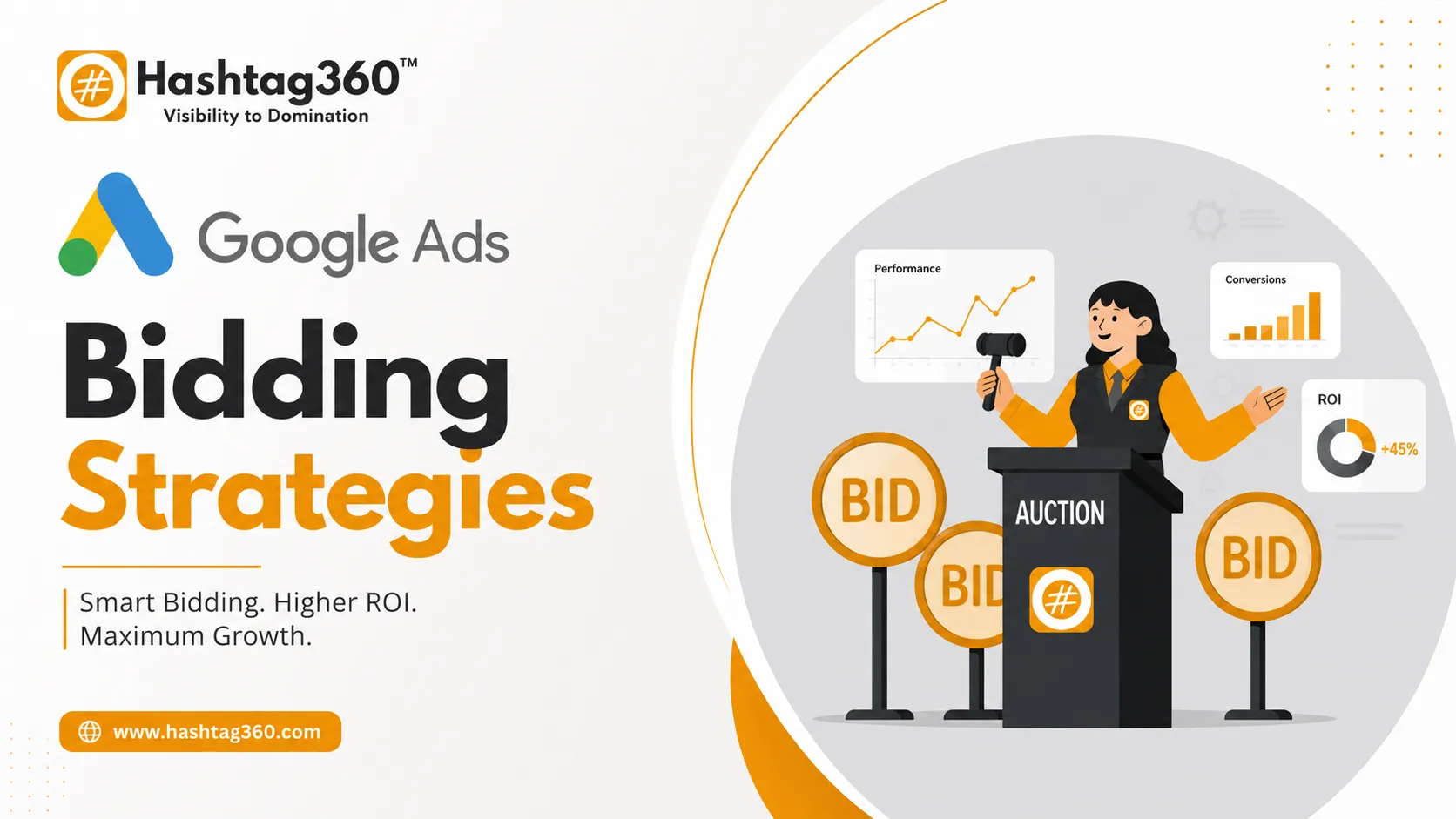
Imagine this: you launch a Google Ads campaign, carefully choose your keywords, write compelling ad copy, and design a high-converting landing page. You expect leads and sales to start flowing in. Instead, your budget disappears within days, clicks increase, but conversions remain disappointingly low.
This is one of the most common challenges businesses face with Google Ads—and in many cases, the root cause isn’t the keywords or the ad copy. It’s the bidding strategy.
Google Ads is one of the most powerful advertising platforms in the world, processing billions of searches every day. Every time someone searches for a product, service, or solution, Google runs an instant auction to determine which ads appear, in what order, and how much each advertiser pays. Your bidding strategy plays a major role in determining whether your ads succeed or struggle in this competitive environment.
Choosing the right bidding strategy isn’t simply about paying the highest amount. Google’s advertising system considers several factors, including your bid, ad relevance, expected click-through rate (CTR), landing page experience, and Quality Score. A well-planned bidding strategy helps you maximize your advertising budget while reaching the right audience at the right time.
Today’s advertisers have access to a wide range of bidding options. Some strategies allow complete manual control over bids, while others use Google’s advanced artificial intelligence and machine learning to optimize bids automatically for every auction. Each strategy is designed to achieve a different business objective, whether that’s increasing website traffic, generating leads, boosting online sales, or improving brand awareness.
In this comprehensive guide, you’ll learn:
- What Google Ads bidding strategies are
- How the Google Ads auction works
- The difference between manual and automated bidding
- How Google determines your ad position
- Why bidding strategy directly affects ROI
- Which bidding strategy is best for different business goals
- Expert insights to help improve campaign performance
Whether you’re a beginner launching your first campaign or a marketing professional managing large advertising budgets, understanding Google Ads bidding strategies will help you make smarter decisions and achieve better results.
Table of Contents
What Are Google Ads Bidding Strategies?
A Google Ads bidding strategy is the method Google uses—or allows you to use—to determine how much you’re willing to pay when someone interacts with your advertisement.
Whenever a user performs a search on Google, advertisers compete in a real-time auction for available ad placements. Your bidding strategy tells Google how aggressively it should compete on your behalf.
Depending on your selected strategy, Google may optimize your bids to achieve one of several goals, including:
- Increasing website traffic
- Generating more leads
- Maximizing online sales
- Improving return on ad spend (ROAS)
- Increasing brand visibility
- Getting more phone calls
- Driving app installs
- Maximizing conversions
Think of your bid as one part of a much larger system. While your maximum bid matters, Google also evaluates the quality and relevance of your ads before deciding which advertiser wins the auction.
This means a business with a lower bid can often outrank competitors spending significantly more—provided its ads are more relevant and offer a better user experience.
Why Bidding Strategies Matter
Many businesses believe that increasing their advertising budget automatically improves results. In reality, spending more without the right bidding strategy often leads to wasted clicks and poor returns.
The right bidding strategy helps you:
- Control advertising costs
- Reach customers with higher purchase intent
- Increase conversion rates
- Improve click-through rates (CTR)
- Reduce wasted ad spend
- Maximize return on investment (ROI)
- Scale campaigns efficiently
On the other hand, using the wrong strategy can result in:
- High cost per click (CPC)
- Low conversion rates
- Poor ad rankings
- Budget exhaustion early in the day
- Reduced visibility
- Lower profitability
A successful Google Ads campaign is not about spending the most money—it’s about spending your budget wisely.
Understanding the Google Ads Auction
Every single search performed on Google triggers an incredibly fast auction. This auction determines which advertisements appear on the search results page and in what order.
The entire process takes place in a fraction of a second.
Here’s a simplified breakdown of how it works.
Step 1: A User Searches on Google
Suppose someone searches for:
“Best Digital Marketing Agency in Noida”
Google immediately scans its advertising database to identify businesses targeting relevant keywords.
Step 2: Eligible Ads Are Selected
Only advertisers targeting matching keywords are entered into the auction.
For example:
- Agency A
- Agency B
- Agency C
- Hashtag360
Each advertiser has different:
- Maximum bids
- Ad quality
- Landing pages
- Historical performance
- Extensions
- Audience signals
Step 3: Google Calculates Ad Rank
Google doesn’t simply award the top position to the advertiser with the highest bid.
Instead, it calculates something called Ad Rank.
Ad Rank is influenced by several important factors:
- Maximum CPC Bid
- Quality Score
- Expected Click-Through Rate
- Ad Relevance
- Landing Page Experience
- Ad Extensions
- Context of the Search
- User Signals (device, location, time, intent)
This means advertisers offering highly relevant ads can outperform competitors with much larger budgets.
Step 4: Ads Are Ranked
After calculating Ad Rank, Google sorts advertisers from highest to lowest.
The highest-ranked advertisements appear in the most visible positions.
Typically:
- Top Position
- Second Position
- Third Position
- Fourth Position
Better positions usually receive more clicks—but only if the ads are relevant to what users are searching for.
Step 5: User Clicks an Advertisement
If a user clicks your advertisement, you pay according to your bidding strategy.
Depending on your campaign settings, you may pay for:
- Clicks
- Conversions
- Impressions
- Viewable impressions
- Video views
This payment model makes Google Ads highly flexible for businesses with different marketing objectives.
What Is Ad Rank?
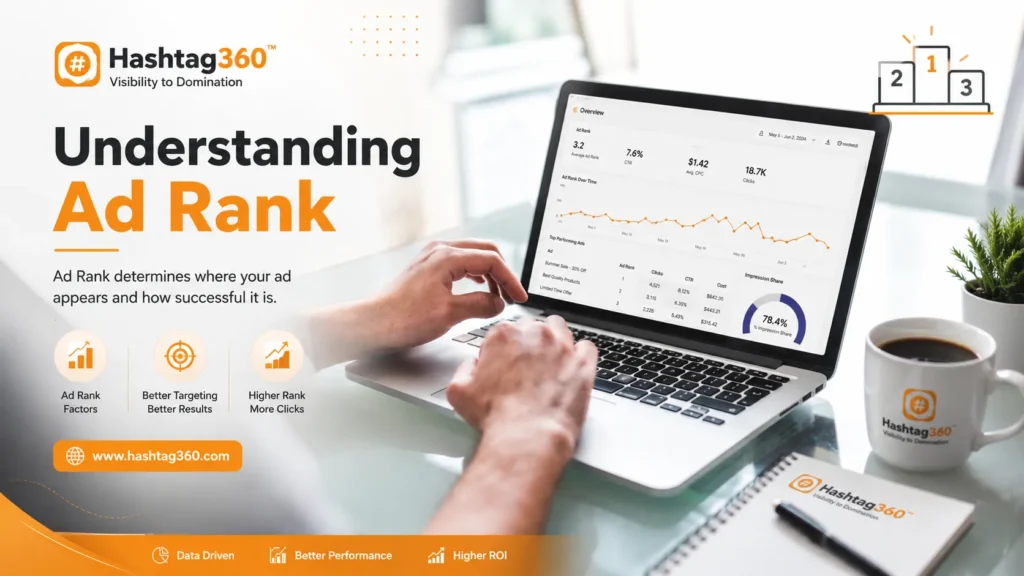
Ad Rank is Google’s internal value that determines whether your ad is eligible to appear and where it will be placed.
Many new advertisers assume that increasing their bid guarantees the top position. In reality, Google rewards quality just as much as budget.
A simplified way to think about Ad Rank is:
Ad Rank ≈ Bid × Quality Signals
Although Google’s actual algorithm is more sophisticated, this concept highlights an important truth: higher-quality ads can often outrank higher bids.
For example:
| Advertiser | Maximum Bid | Ad Quality | Likely Result |
|---|---|---|---|
| Advertiser A | $6.00 | Average | Lower position |
| Advertiser B | $4.50 | Excellent | Higher position |
Even though Advertiser A is willing to pay more, Advertiser B may achieve a better position because Google predicts a better experience for users.
This approach benefits both advertisers and searchers by rewarding relevant, useful advertisements.
Understanding Quality Score
Quality Score is Google’s estimate of how relevant and useful your ads are to users.
While it isn’t the only factor in Ad Rank, it provides valuable insight into campaign health.
Quality Score is primarily influenced by:
1. Expected Click-Through Rate (CTR)
Google predicts how likely users are to click your ad.
Higher CTR generally indicates greater relevance.
2. Ad Relevance
Your ad should closely match the user’s search intent.
For example, if someone searches for “Google Ads Management Services,” an ad specifically mentioning Google Ads management is more relevant than a generic digital marketing ad.
3. Landing Page Experience
After clicking your ad, users should land on a page that:
- Loads quickly
- Matches the ad’s promise
- Is mobile-friendly
- Provides valuable information
- Makes it easy to take action
Poor landing pages can reduce Quality Score and increase advertising costs.
Why Higher Quality Scores Save Money
One of the biggest advantages of improving Quality Score is cost efficiency.
A higher Quality Score can help you:
- Pay less per click
- Achieve higher ad positions
- Improve conversion rates
- Increase impression share
- Maximize return on ad spend
Instead of constantly increasing your bids, many successful advertisers focus on improving ad relevance, keyword targeting, and landing page experience.
This often leads to stronger campaign performance while keeping costs under control.
The Relationship Between Bidding Strategy and Business Goals
Choosing a bidding strategy should always start with one question:
What is the primary objective of your campaign?
Different businesses have different goals, and Google Ads offers bidding strategies tailored to each one.
For example:
- A new blog may prioritize website traffic, making a click-focused strategy more appropriate.
- A local service business typically values qualified leads, so a conversion-focused strategy is often the better choice.
- An eCommerce store cares most about revenue and return on ad spend, making value-based bidding strategies more effective.
- A well-known brand launching a new product may focus on visibility and impressions rather than immediate sales.
Selecting a bidding strategy that aligns with your business objective ensures your advertising budget is optimized for outcomes that actually matter—not just vanity metrics.
Types of Google Ads Bidding Strategies
Now that you understand how the Google Ads auction works and why bidding strategies matter, it’s time to explore each bidding strategy in detail.
Google Ads broadly divides bidding strategies into two categories:
1. Manual Bidding
You decide how much you’re willing to pay for each click or interaction. This approach gives advertisers complete control but requires regular monitoring and optimization.
2. Automated (Smart) Bidding
Google uses machine learning and millions of real-time signals to adjust bids automatically for every auction. These strategies are designed to maximize campaign performance based on your chosen objective.
Neither category is universally better. The right choice depends on your campaign goals, budget, historical data, and level of experience.
1. Manual CPC (Manual Cost-Per-Click)
What is Manual CPC?
Manual CPC is the most traditional Google Ads bidding strategy. Instead of allowing Google to decide your bids, you manually set the maximum amount you’re willing to pay for each click.
For example, if you decide your maximum CPC is $2.00, Google will never intentionally bid above that amount for a click.
This strategy gives advertisers the highest level of control over spending and is often recommended for businesses that want to learn how Google Ads works before moving to automation.
How Manual CPC Works
Let’s assume you own a digital marketing agency and target these keywords:
| Keyword | Max CPC |
|---|---|
| Google Ads Agency | $3.50 |
| SEO Services | $2.80 |
| PPC Management | $4.20 |
Each keyword can have a different bid depending on its value to your business.
Google enters the auction using your manually assigned bids.
Advantages of Manual CPC
✔ Complete control over bids
✔ Easy to understand
✔ Ideal for testing campaigns
✔ Good for limited budgets
✔ Better keyword-level optimization
Disadvantages
✖ Requires continuous monitoring
✖ Time-consuming
✖ Doesn’t automatically adapt to user intent
✖ Can miss valuable opportunities
Best For
- New advertisers
- Small businesses
- Local businesses
- Learning Google Ads
- Campaigns with limited budgets
Example
Suppose you’re promoting Google Ads management services.
Daily Budget: $30
Maximum CPC: $2
Expected Clicks:
Approximately 15 clicks per day.
Since you’re controlling every bid, you can increase bids for high-performing keywords while reducing bids for expensive keywords with poor conversion rates.
2. Enhanced CPC (ECPC)
What is Enhanced CPC?
Enhanced CPC (ECPC) is a hybrid bidding strategy that combines manual bidding with Google’s machine learning.
You still set your manual bids, but Google is allowed to slightly increase or decrease them when it predicts a higher or lower chance of conversion.
Think of ECPC as “Manual CPC with AI assistance.”
How ECPC Works
Suppose your manual bid is:
Maximum CPC = $3.00
If Google believes a particular search is highly likely to convert, it may raise your effective bid.
If the search appears less valuable, Google may reduce the bid to help save budget.
The goal is to generate more conversions without completely removing your control over bidding.
Advantages
✔ More conversions than Manual CPC
✔ Uses Google’s machine learning
✔ Still offers advertiser control
✔ Smooth transition toward automation
Disadvantages
✖ Less predictable than Manual CPC
✖ Not as advanced as Smart Bidding
✖ Performance depends on conversion tracking
Best For
- Businesses moving toward automation
- Advertisers with some conversion history
- Growing campaigns
3. Maximize Clicks
What is Maximize Clicks?
Maximize Clicks is an automated bidding strategy focused on driving as many website visitors as possible within your budget.
Instead of optimizing for conversions or revenue, Google automatically adjusts bids to obtain the highest number of clicks.
When Should You Use It?
Maximize Clicks works best when your goal is increasing website traffic rather than immediate sales.
Examples include:
- New blogs
- Product launches
- Brand awareness campaigns
- Content marketing
- Landing page testing
Example
Daily Budget: $100
Google continuously adjusts bids throughout the day to maximize the number of clicks your budget can buy.
You might receive:
- 300 clicks instead of 220
- Better overall traffic volume
- More exposure
However, higher traffic doesn’t necessarily mean higher conversions.
Advantages
✔ Generates high traffic
✔ Fully automated
✔ Easy to set up
✔ Excellent for awareness campaigns
Disadvantages
✖ Click quality may vary
✖ Doesn’t prioritize conversions
✖ Can spend budget on low-intent users
Best For
- Bloggers
- News websites
- New businesses
- Brand awareness campaigns
- Businesses collecting remarketing audiences
4. Maximize Conversions
What is Maximize Conversions?
Maximize Conversions is one of Google’s Smart Bidding strategies designed to generate as many conversions as possible within your available budget.
Instead of focusing on clicks, Google analyzes millions of signals to identify users who are most likely to complete a valuable action.
Conversions may include:
- Contact form submissions
- Phone calls
- Purchases
- Appointment bookings
- Newsletter sign-ups
- Quote requests
How It Works
Google evaluates real-time signals such as:
- Device type
- User location
- Browser
- Time of day
- Search intent
- Previous behavior
- Audience characteristics
- Historical conversion data
It then automatically adjusts bids for every auction.
Advantages
✔ Maximizes lead generation
✔ Uses advanced machine learning
✔ Reduces manual work
✔ Continuously improves with more data
Disadvantages
✖ Requires accurate conversion tracking
✖ May spend the full daily budget
✖ Less control over individual bids
Best For
- Service businesses
- SaaS companies
- Healthcare providers
- Real estate agencies
- Education providers
- Digital marketing agencies
Example
Imagine your campaign has a daily budget of $80.
Rather than trying to generate the most clicks, Google focuses on users most likely to request a consultation or submit a lead form.
As a result, you may receive fewer clicks than with Maximize Clicks, but a higher percentage of those visitors are likely to convert.
5. Target CPA (Cost Per Acquisition)
What is Target CPA?
Target CPA is an automated bidding strategy where you tell Google the average amount you’re willing to pay for one conversion.
Google then adjusts bids to achieve conversions at or around your desired cost.
Formula
Cost Per Acquisition (CPA) = Total Ad Spend ÷ Total Conversions
Example:
Advertising Spend = $600
Conversions = 30
CPA = $20
If your target CPA is $20, Google attempts to acquire future conversions at approximately that cost.
When Should You Use Target CPA?
Target CPA is ideal when:
- You know the value of each lead.
- Your campaign already has consistent conversion data.
- You want predictable acquisition costs.
Advantages
✔ Predictable lead costs
✔ Fully automated
✔ Optimized for conversions
✔ Saves management time
Disadvantages
✖ Needs sufficient historical conversion data
✖ Unrealistically low targets can limit traffic
✖ Learning phase may temporarily fluctuate
Best For
- Lead generation campaigns
- Local service businesses
- Law firms
- Home services
- Insurance companies
- B2B companies
6. Target ROAS (Return on Ad Spend)
What is Target ROAS?
Target ROAS is designed for businesses that care about revenue, not just conversions.
Instead of asking, “How many leads can I generate?” this strategy asks, “How much revenue can I generate from my advertising budget?”
Google automatically adjusts bids to maximize conversion value while aiming to achieve your desired return on ad spend.
Formula
ROAS = Revenue ÷ Advertising Cost × 100
Example:
Advertising Spend = $2,000
Revenue Generated = $10,000
ROAS = 500%
This means every $1 spent on advertising generated $5 in revenue.
Example
Suppose your online store sells electronics.
Some products cost $40, while others cost $1,200.
Instead of treating every sale equally, Target ROAS prioritizes customers who are more likely to purchase higher-value products, helping maximize total revenue.
Advantages
✔ Focuses on revenue growth
✔ Excellent for eCommerce
✔ AI-driven optimization
✔ Maximizes profitability
Disadvantages
✖ Requires accurate revenue tracking
✖ Not suitable for brand-new campaigns
✖ Needs consistent conversion history
Best For
- eCommerce websites
- Shopify stores
- WooCommerce stores
- Retail businesses
- Fashion brands
- Electronics stores
7. Maximize Conversion Value
What is Maximize Conversion Value?
Maximize Conversion Value is another Smart Bidding strategy that focuses on generating the highest possible total conversion value within your campaign budget.
Unlike Maximize Conversions, which treats every conversion equally, this strategy considers the monetary value assigned to each conversion.
For example, if you sell products priced at $50, $200, and $1,000, Google will prioritize users who are more likely to purchase the higher-value items when appropriate.
This strategy is especially useful for businesses with products or services that vary significantly in price.
Advantages
- Maximizes total revenue rather than just the number of conversions.
- Automatically prioritizes high-value customers.
- Uses Google’s machine learning to optimize bids in real time.
Best For
- Online retailers
- Luxury brands
- Businesses with multiple product price points
- Companies tracking conversion values accurately
8. Target Impression Share
What is Target Impression Share?
Not every Google Ads campaign is focused on generating immediate leads or sales. Sometimes, the primary objective is simply to ensure that your brand is seen by as many relevant users as possible. This is where Target Impression Share becomes valuable.
Target Impression Share is an automated bidding strategy that helps your ads appear in a specific position on the Google Search results page. Instead of optimizing for clicks or conversions, Google automatically adjusts your bids to maximize your visibility based on your chosen placement goal.
You can choose where you want your ads to appear:
- Absolute Top of the Page – The very first ad above all organic search results.
- Top of the Page – Anywhere among the ads shown above the organic listings.
- Anywhere on the Page – Any eligible position on the search results page.
For example, if your business is launching a new product or expanding into a competitive market, appearing consistently at the top of search results can significantly improve brand recognition and trust.
Advantages
- Excellent for increasing brand visibility.
- Automatically adjusts bids to maintain your desired impression share.
- Helps businesses dominate branded keyword searches.
- Ideal for highly competitive industries.
Disadvantages
- Focuses on visibility rather than conversions.
- Can become expensive in highly competitive auctions.
- Requires careful budget monitoring.
Best For
- Brand awareness campaigns
- New product launches
- Franchise businesses
- Local businesses wanting maximum visibility
- Companies protecting their branded keywords
9. Target CPM (Cost Per Thousand Impressions)
What is Target CPM?
Target CPM (Cost Per Mille) is designed primarily for Display and Video campaigns. Instead of paying for clicks, advertisers pay based on the number of times their ads are shown.
“Mille” is the Latin word for one thousand.
This means you pay for every 1,000 impressions, regardless of whether users click your advertisement.
For example:
If your Target CPM is $8, you’ll pay approximately $8 for every 1,000 times your ad is displayed.
This strategy is useful when your objective is to build brand awareness rather than generate immediate website traffic.
Advantages
- Broad audience reach.
- Predictable impression costs.
- Effective for visual branding campaigns.
- Works well with Display and YouTube advertising.
Disadvantages
- Doesn’t guarantee clicks.
- Doesn’t optimize for conversions.
- Less suitable for direct response campaigns.
Best For
- Display advertising
- YouTube campaigns
- Product launches
- Brand awareness initiatives
- Large-scale marketing campaigns
10. Viewable CPM (vCPM)
What is Viewable CPM?
With standard CPM, advertisers pay whenever an ad is served, even if users never actually see it.
Viewable CPM (vCPM) solves this problem by charging advertisers only when an advertisement becomes viewable according to Google’s standards.
Generally, a display ad is considered viewable when:
- At least 50% of the ad is visible on screen.
- It remains visible for at least one continuous second (or longer for video ads).
This ensures advertisers pay only for impressions that have a realistic chance of being noticed.
Advantages
- Better advertising efficiency.
- Higher-quality impressions.
- Improved brand exposure.
- Reduced wasted spend.
Best For
- Premium branding campaigns
- Display advertising
- Video advertising
- Large enterprises
- Awareness-focused marketing
Complete Google Ads Bidding Strategy Comparison
| Bidding Strategy | Primary Goal | Automation Level | Best For |
|---|---|---|---|
| Manual CPC | Control over bids | Low | Beginners & small businesses |
| Enhanced CPC | More conversions with partial automation | Medium | Growing campaigns |
| Maximize Clicks | Increase website traffic | High | Blogs, awareness campaigns |
| Maximize Conversions | Generate more leads | High | Service businesses |
| Target CPA | Lower cost per lead | High | Lead generation |
| Target ROAS | Increase revenue | High | eCommerce stores |
| Maximize Conversion Value | Maximize total sales value | High | Businesses selling products with different prices |
| Target Impression Share | Increase visibility | High | Branding campaigns |
| Target CPM | Maximize impressions | High | Display & YouTube ads |
| Viewable CPM | Improve viewable impressions | High | Premium branding |
Which Google Ads Bidding Strategy Should You Choose?
There is no universal “best” bidding strategy. The ideal choice depends on your campaign objective, available budget, conversion history, and business model.
Choose Manual CPC if:
- You’re new to Google Ads.
- You want complete control over your bids.
- You’re testing new campaigns.
- Your advertising budget is limited.
Choose Maximize Clicks if:
- Your priority is increasing website traffic.
- You’re building brand awareness.
- You’re promoting blog content or resources.
- You’re collecting remarketing audiences.
Choose Maximize Conversions if:
- You want more inquiries, calls, or form submissions.
- Your conversion tracking is already configured.
- You want Google’s AI to optimize bids automatically.
Choose Target CPA if:
- You know the value of each lead.
- You want consistent acquisition costs.
- You have enough historical conversion data.
Choose Target ROAS if:
- You run an online store.
- Revenue matters more than conversion count.
- You sell products with varying prices.
Choose Maximize Conversion Value if:
- You want to maximize total revenue.
- Your products or services have different profit margins.
- You track conversion values accurately.
Choose Target Impression Share if:
- Brand visibility is your top priority.
- You’re launching a new product or service.
- You want to dominate searches for your brand name.
Choose CPM or vCPM if:
- Your objective is awareness rather than immediate conversions.
- You’re running Display or YouTube campaigns.
- You want to maximize exposure.
Common Google Ads Bidding Mistakes
Even experienced advertisers can make bidding mistakes that increase costs and reduce campaign performance. Here are some of the most common issues to avoid.
1. Choosing the Wrong Campaign Objective
Selecting a traffic-focused bidding strategy for a lead generation campaign often results in plenty of visitors but very few qualified leads.
Always align your bidding strategy with your business goals.
2. Ignoring Conversion Tracking
Without accurate conversion tracking, Google’s Smart Bidding cannot optimize effectively. Install and verify conversion tracking before relying on automated strategies.
3. Changing Bidding Strategies Too Frequently
Smart Bidding strategies require time to learn. Constantly switching strategies resets the learning phase and can hurt performance.
Allow campaigns enough time to gather meaningful data before making major changes.
4. Focusing Only on Clicks
High click volumes may look impressive, but they don’t always translate into business growth.
Track meaningful metrics such as:
- Conversion Rate
- Cost Per Acquisition (CPA)
- Return on Ad Spend (ROAS)
- Revenue
- Lead Quality
5. Ignoring Quality Score
A poor Quality Score often leads to:
- Higher CPC
- Lower Ad Rank
- Reduced visibility
- Higher advertising costs
Improve Quality Score by optimizing keywords, ad copy, and landing pages.
6. Setting Unrealistic CPA or ROAS Targets
Setting targets that are too aggressive can limit Google’s ability to participate in auctions, reducing traffic and conversions.
Start with realistic goals based on historical performance and refine them over time.
Expert Tips to Improve Google Ads Bidding Performance
Whether you’re using Manual CPC or Smart Bidding, these best practices can help you improve results:
- Track conversions accurately. Smart Bidding is only as effective as the data it receives.
- Improve Quality Score. Relevant keywords, compelling ad copy, and fast, user-friendly landing pages can lower costs and improve ad positions.
- Give Smart Bidding time to learn. Avoid making significant changes during the learning phase unless necessary.
- Review search terms regularly. Add negative keywords to reduce wasted spend.
- Segment campaigns by objective. Different goals often require different bidding strategies.
- Test multiple ad variations. Better ad relevance can improve CTR and Quality Score.
- Monitor key metrics consistently. Evaluate CPA, ROAS, conversion rate, impression share, and search impression lost due to budget or rank.
- Optimize landing pages. A strong post-click experience can improve both conversion rates and Quality Score.
Successful Google Ads campaigns combine automation with regular human analysis. Google’s AI can optimize bids, but marketers still need to monitor performance, interpret results, and refine strategy.
How Artificial Intelligence Has Changed Google Ads Bidding
Google Ads has evolved significantly over the past decade. Earlier campaigns relied heavily on manual bid adjustments and historical performance. Today, machine learning enables Google to evaluate billions of auction combinations in real time.
Modern Smart Bidding considers signals such as:
- User location
- Device type
- Operating system
- Browser
- Time of day
- Language
- Search intent
- Previous browsing behavior
- Audience segments
- Demographics (where appropriate)
- Historical conversion patterns
By analyzing these signals instantly, Google can adjust bids for each auction to better match the likelihood of achieving your campaign objective.
While automation has made campaign management more efficient, human expertise remains essential. Businesses still need to define goals, structure campaigns correctly, create persuasive ad copy, develop high-quality landing pages, and interpret performance data.
Why Choose Hashtag360 for Google Ads Management?
Running successful Google Ads campaigns requires more than selecting a bidding strategy. It demands continuous optimization, strategic planning, and data-driven decision-making.
At Hashtag360, we help businesses build campaigns that focus on measurable growth rather than just increasing clicks. Our approach includes:
- In-depth keyword research
- Campaign planning based on business objectives
- Selection of the most suitable bidding strategy
- Accurate conversion tracking setup
- Audience targeting and segmentation
- Landing page recommendations
- Ongoing bid optimization
- Performance analysis and reporting
Whether your goal is generating qualified leads, increasing eCommerce revenue, or improving brand visibility, choosing the right bidding strategy is a critical step toward long-term success.
Frequently Asked Questions (FAQs)
1. What is the best Google Ads bidding strategy?
There is no single best strategy. The right choice depends on your objective. For traffic, Maximize Clicks is effective. For lead generation, Maximize Conversions or Target CPA often performs well. For eCommerce, Target ROAS is commonly preferred.
2. Is Smart Bidding better than Manual CPC?
Smart Bidding can outperform manual bidding when campaigns have reliable conversion data and clearly defined goals. However, Manual CPC remains useful for testing, learning, and maintaining precise control over bids.
3. How long does Smart Bidding take to optimize?
Most Smart Bidding strategies require a learning period after significant changes. Performance may fluctuate initially, so avoid making frequent adjustments during this phase.
4. Can I change my bidding strategy later?
Yes. Google Ads allows you to change bidding strategies at any time. However, make changes thoughtfully and monitor performance after each adjustment.
5. Which bidding strategy is best for eCommerce?
Businesses focused on maximizing revenue often benefit from Target ROAS or Maximize Conversion Value, provided they have accurate conversion value tracking in place.
6. Why is conversion tracking important?
Conversion tracking tells Google which clicks lead to valuable actions, enabling Smart Bidding to optimize for the outcomes that matter most to your business.
Conclusion
Google Ads bidding strategies are far more than a technical setting—they are the foundation of every successful advertising campaign. The strategy you choose influences where your ads appear, how much you pay, the quality of traffic you attract, and ultimately the return on your advertising investment.
Manual bidding offers greater control and is well suited to advertisers who want to fine-tune campaigns themselves. Smart Bidding leverages Google’s machine learning to optimize bids in real time, helping businesses pursue goals such as increased traffic, lead generation, revenue growth, or greater brand visibility. Neither approach is inherently superior; the most effective choice depends on your objectives, available data, and campaign maturity.
As your campaigns grow, don’t be afraid to test, measure, and refine your bidding strategy. Continuous optimization—supported by accurate conversion tracking, high-quality ad creatives, relevant landing pages, and ongoing performance analysis—is what separates average campaigns from exceptional ones.
If you’re looking to improve your Google Ads performance, reduce wasted ad spend, and maximize return on investment, the team at Hashtag360 can help you develop a bidding strategy tailored to your business goals. With the right combination of expertise, data, and optimization, your advertising budget can become a powerful driver of sustainable business growth.