Connect with Us


Digital marketing has evolved dramatically over the last decade, but one platform has consistently remained at the center of online advertising—Google Ads. Whether you’re a local business owner trying to attract nearby customers, an eCommerce brand scaling online sales, or a B2B company generating qualified leads, understanding what Google Ads is can be the difference between unpredictable marketing and a consistent stream of customers.
Every day, billions of searches happen on Google. Behind many of those search results are businesses competing for attention through paid advertising. That’s where the Google Ads platform comes into play. It allows businesses of every size to place their products and services in front of people who are actively searching for what they offer. Unlike traditional advertising, where you hope the right audience sees your message, Google Ads focuses on reaching users based on their intent.
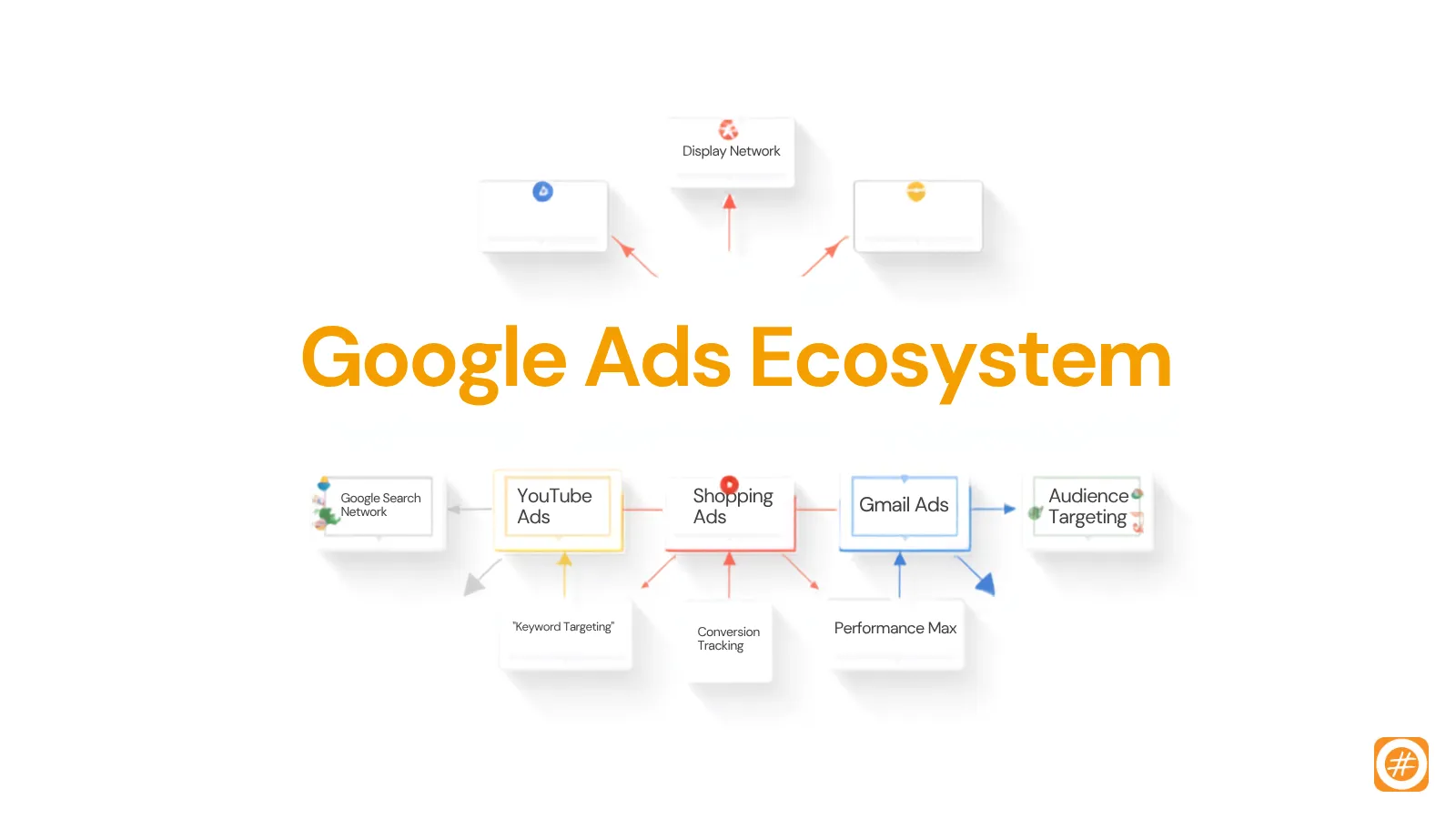
The platform has become far more sophisticated than simply displaying text ads on search results. Today, advertisers can run campaigns across the Google Search Network, Google Display Network, YouTube, Google Shopping, Gmail, mobile apps, and millions of partner websites. With advanced audience targeting, AI-powered bidding strategies, conversion tracking, and detailed reporting, businesses can optimize campaigns with remarkable precision.
Yet, despite its popularity, many business owners still ask the same question: What is Google Ads, and how does it actually work?
The answer isn’t just about placing ads on Google. It’s about understanding an intelligent advertising ecosystem built around relevance, user intent, quality, and measurable results.
After managing campaigns across multiple industries, one lesson becomes clear: successful advertisers don’t simply spend more—they spend smarter. That’s exactly the philosophy followed by Hashtag360, where every campaign is built around measurable ROI, strategic optimization, and sustainable business growth rather than vanity metrics.
Let’s explore the platform in depth.
What Is Google Ads? Understanding the World’s Largest Pay-Per-Click Advertising Platform
At its core, Google Ads is Google’s online advertising platform that enables businesses to promote products, services, websites, apps, and brands across Google’s ecosystem.
Formerly known as Google AdWords, the platform was launched in 2000 with only a few hundred advertisers. Today, it serves millions of businesses worldwide and processes advertising for billions of searches every single day.
Unlike traditional media advertising, Google Ads primarily operates on a Pay-Per-Click (PPC) advertising model. This means advertisers typically pay only when someone clicks on their advertisement, although certain campaign types also support Cost-Per-Thousand Impressions (CPM), Cost-Per-View (CPV), and Cost-Per-Acquisition (CPA) bidding models.
Imagine opening a coffee shop in a busy city.
You could print thousands of flyers hoping someone notices them.
Or…
You could appear at the exact moment someone searches “best coffee near me.”
Google Ads chooses the second approach.
Instead of interrupting people, it reaches users precisely when they’re expressing interest through search behavior.
This makes Google Ads one of the highest-intent advertising platforms available today.
Businesses commonly use Google Ads for:
- Lead generation
- Online sales
- Local business promotion
- Brand awareness
- App downloads
- Website traffic
- Appointment bookings
- Product launches
- Event registrations
Because every click, impression, conversion, and dollar spent can be measured, advertisers gain far greater control than with traditional advertising channels like television, newspapers, or billboards.
How Google Ads Works: Understanding the Auction Behind Every Search
Many people assume that whoever spends the most money automatically appears at the top of Google.
That isn’t how the system works.
Every search triggers an incredibly fast auction—typically completed within milliseconds.
Suppose someone searches:
Emergency plumber near me
Within that fraction of a second, Google evaluates advertisers competing for that keyword.
The auction considers multiple factors simultaneously:
- Maximum bid
- Ad relevance
- Expected CTR (Click-Through Rate)
- Landing page experience
- Quality Score
- User location
- Device type
- Search intent
- Ad extensions
- Historical performance
Rather than rewarding the highest bidder alone, Google aims to provide users with the most relevant advertisements.
Think of it like a university entrance exam.
Money cannot buy the highest rank.
Performance matters.
Similarly, Google rewards advertisers who create useful ads and excellent user experiences.
The result is known as Ad Rank, which determines where advertisements appear.
This system benefits both users and advertisers.
Users see relevant ads.
Businesses with well-optimized campaigns often pay less than competitors while appearing higher in search results.
That’s why campaign optimization is far more important than simply increasing budgets.
The Google Ads Platform: More Than Just Search Results
One of the biggest misconceptions is that Google Ads only displays text advertisements on Google Search.
In reality, it’s an entire advertising ecosystem.
Businesses can reach customers across multiple Google-owned properties and partner networks depending on campaign objectives.
Google Search Network
The Google Search Network is where most businesses begin.
Advertisements appear above and below organic search results whenever users search relevant keywords.
These campaigns capture high purchase intent because people are actively looking for products or services.
For example:
- Dentist near me
- Best CRM software
- Buy running shoes
- Digital marketing agency
- Emergency electrician
Search campaigns generally produce some of the strongest conversion rates because user intent is already established.
Google Display Network
The Google Display Network (GDN) reaches users while they browse websites, read blogs, watch news, or use mobile applications.
Instead of text-only ads, advertisers can display:
- Banner ads
- Image ads
- Interactive advertisements
- Responsive display ads
With access to millions of websites, GDN excels at brand awareness, remarketing, and audience expansion.
YouTube Ads
As the world’s second-largest search engine, YouTube offers enormous advertising potential.
Businesses can create:
- Skippable in-stream ads
- Non-skippable ads
- Shorts ads
- Discovery ads
- Bumper ads
Video advertising is especially effective for storytelling, product demonstrations, testimonials, and educational content.
Google Shopping Ads
For eCommerce businesses, Google Shopping Ads showcase products directly within search results.
Instead of simple text ads, shoppers immediately see:
- Product image
- Price
- Store name
- Customer ratings
- Product title
Shopping campaigns often generate highly qualified traffic because buyers already know what they’re purchasing before clicking.
Gmail Sponsored Promotions
Google Ads also allows businesses to place promotional messages inside Gmail.
These advertisements resemble regular emails until opened, making them highly effective for nurturing audiences and remarketing campaigns.
Performance Max Campaigns
One of Google’s newest innovations is Performance Max.
Rather than manually creating separate campaigns for Search, Display, YouTube, Gmail, Discover, and Maps, advertisers upload creative assets once.
Google’s AI automatically distributes advertisements across every available channel based on predicted performance.
Performance Max has become increasingly popular because it combines machine learning with audience signals to maximize conversions.
Why Businesses Invest in Google Ads Instead of Waiting for SEO Alone
Search Engine Optimization (SEO) remains one of the most valuable long-term marketing investments.
However, SEO takes time.
Sometimes several months.
Occasionally more than a year in competitive industries.
Google Ads provides immediate visibility.
Imagine opening a new dental clinic.
Would you rather wait eight months to appear organically…
Or begin receiving appointment requests this week?
That’s why successful businesses often combine SEO and PPC rather than choosing one over the other.
Google Ads excels when businesses need:
- Immediate leads
- Product launches
- Seasonal campaigns
- Local customer acquisition
- Rapid testing
- Brand visibility
- Sales growth
- Market expansion
Furthermore, Google Ads provides valuable keyword data that can strengthen long-term SEO strategies.
Instead of guessing what customers search, businesses obtain real performance insights directly from advertising campaigns.
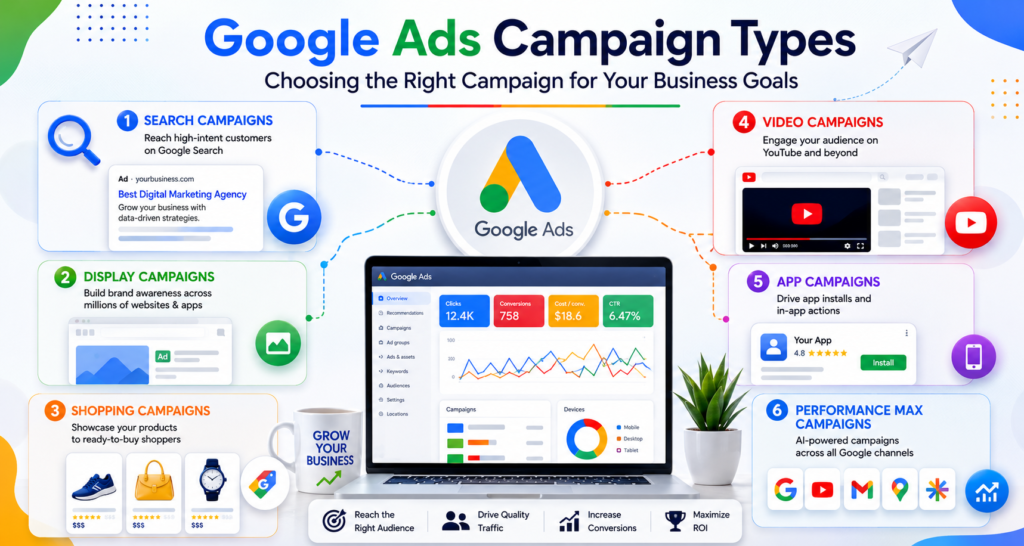
Google Ads Campaign Types Explained: Choosing the Right Campaign for Your Business Goals
One of the biggest advantages of the Google Ads platform is its versatility. Whether your objective is generating leads, increasing eCommerce sales, driving app installs, or building brand awareness, Google offers a campaign type designed for that specific goal.
Choosing the wrong campaign type can drain your advertising budget. Choosing the right one, on the other hand, can dramatically improve your CTR (Click-Through Rate), lower your CPC (Cost-Per-Click), and maximize your Return on Investment (ROI).
Let’s examine each campaign type and where it performs best.
1. Search Campaigns
Search campaigns are the foundation of pay-per-click (PPC) advertising. These ads appear on the Google Search Network when users actively search for products or services.
For example, if someone searches:
- “best digital marketing agency”
- “Google Ads expert near me”
- “emergency dentist”
- “buy office chairs online”
Google may display sponsored text ads above the organic search results.
Search campaigns work exceptionally well because they target high-intent users—people already looking for a solution. This often results in stronger conversion rates than interruptive advertising channels.
Best for:
- Lead generation
- Local businesses
- Professional services
- Appointment bookings
- High-intent sales
2. Display Campaigns
Unlike Search campaigns, Display campaigns reach users while they browse websites, read news, watch blogs, or use mobile apps across the Google Display Network (GDN).
Display ads are visual rather than text-based and can include:
- Static banners
- Responsive image ads
- Animated creatives
- Interactive display ads
These campaigns are excellent for building brand awareness and keeping your business visible throughout the customer journey.
A software company, for instance, might show banner ads to visitors who previously explored its pricing page but left without signing up.
Best for:
- Brand awareness
- Remarketing
- Audience expansion
- Product launches
3. Google Shopping Campaigns
For online retailers, Google Shopping Ads are often among the highest-performing campaign types.
Instead of showing plain text, Shopping ads display:
- Product image
- Product title
- Price
- Merchant name
- Reviews
- Promotions
This gives potential customers more information before they even click, resulting in highly qualified traffic.
Imagine searching for “wireless headphones.” Shopping ads allow users to compare products instantly, making purchase decisions faster.
Best for:
- eCommerce stores
- Retail businesses
- Consumer products
- Online shopping
4. Video Campaigns (YouTube Ads)
With billions of monthly users, YouTube has become one of the most influential advertising platforms in the world.
Google Ads enables businesses to create various video formats, including:
- Skippable in-stream ads
- Non-skippable ads
- Bumper ads
- In-feed video ads
- Shorts ads
Video campaigns help brands demonstrate products, educate customers, and build trust through storytelling.
A fitness company, for example, can showcase transformation stories before users watch workout videos, creating a strong emotional connection.
Best for:
- Brand storytelling
- Product demonstrations
- Educational content
- Awareness campaigns
5. App Campaigns
If your business has a mobile application, App campaigns simplify promotion across Google’s ecosystem.
Google automatically displays ads on:
- Google Search
- Google Play Store
- YouTube
- Discover
- Google Display Network
Machine learning continuously optimizes placements to maximize app installs and in-app actions.
Best for:
- Mobile apps
- SaaS products
- Gaming companies
6. Performance Max Campaigns
Performance Max represents Google’s AI-driven future of advertising.
Rather than manually creating separate campaigns, advertisers provide creative assets, audience signals, and business objectives.
Google’s machine learning automatically serves ads across:
- Search
- Display
- YouTube
- Gmail
- Discover
- Google Maps
- Shopping
Performance Max continuously adjusts bids, placements, and audiences based on real-time performance.
When managed correctly, it can significantly improve conversion volume while reducing manual workload.
Understanding Quality Score: Google’s Secret to Lower Advertising Costs
Ask experienced PPC professionals what separates profitable advertisers from everyone else, and one term consistently comes up:
Quality Score.
Quality Score is Google’s rating of your advertisement’s relevance and overall quality. It influences both your ad position and the amount you pay for each click.
Many businesses believe increasing their bid is the only way to rank higher. In reality, advertisers with excellent Quality Scores often achieve better positions while paying less.
Google calculates Quality Score using three primary factors:
- Expected Click-Through Rate (CTR)
- Ad Relevance
- Landing Page Experience
Let’s explore each one.
Expected Click-Through Rate (CTR)
Google estimates how likely users are to click your ad based on historical performance.
Higher CTRs indicate that your ads are useful and relevant.
Improving your headlines, descriptions, and calls-to-action can significantly increase CTR over time.
Ad Relevance
Google compares the user’s search query with your keywords and advertisement.
If someone searches for “affordable accounting software” but your ad primarily discusses general business consulting, relevance decreases.
Relevant ads consistently outperform generic advertisements.
Landing Page Experience
Many advertisers overlook the destination after the click.
Google doesn’t.
A landing page should:
- Match the advertisement
- Load quickly
- Be mobile-friendly
- Provide valuable information
- Include a clear call-to-action
- Offer easy navigation
Poor landing pages increase bounce rates and reduce Quality Scores.
Think of your advertisement as an invitation and your landing page as the event itself. Even the best invitation cannot compensate for a disappointing experience.
Bidding Strategies: How Google Decides What You Pay
The Google Ads auction is not simply about spending the most money. Strategic bidding plays a crucial role in maximizing campaign performance.
Google provides several bidding strategies, each suited to different business objectives.
Manual CPC
Manual Cost-Per-Click gives advertisers complete control over keyword bids.
Experienced PPC managers often prefer this strategy when launching new campaigns or testing keywords because it provides granular control.
Enhanced CPC (ECPC)
Enhanced CPC builds upon Manual CPC by allowing Google’s machine learning to automatically adjust bids when a conversion appears more or less likely.
It combines human control with AI optimization.
Maximize Clicks
Businesses seeking website traffic often begin with Maximize Clicks.
Google automatically bids to generate as many clicks as possible within the available budget.
This strategy works well for awareness campaigns but should eventually transition toward conversion-focused bidding.
Target CPA (Cost Per Acquisition)
Rather than optimizing for clicks, Target CPA focuses on acquiring conversions at a predetermined cost.
For example:
If a business wants new leads at ₹800 each, Google continuously adjusts bids to achieve that average acquisition cost.
This strategy is ideal once campaigns have accumulated sufficient conversion data.
Target ROAS (Return on Ad Spend)
eCommerce businesses frequently rely on Target ROAS.
Instead of optimizing for leads, Google aims to maximize revenue relative to advertising spend.
If your target ROAS is 500%, Google’s algorithm attempts to generate ₹5 in revenue for every ₹1 spent.
Maximize Conversions
This strategy instructs Google to obtain as many conversions as possible within the allocated budget.
It’s particularly effective for businesses with reliable conversion tracking and sufficient historical data.
Keyword Research: The Foundation of Every Successful Google Ads Campaign
Keywords determine when and where your advertisements appear.
Selecting the right keywords is far more important than simply targeting those with the highest search volume.
Experienced advertisers focus on search intent.
Consider these examples:
- “What is digital marketing?” → Informational intent
- “Best Google Ads agency” → Commercial intent
- “Hire Google Ads expert today” → Transactional intent
Commercial and transactional keywords generally produce the strongest ROI because users are closer to making a purchasing decision.
Effective keyword research combines:
- High-intent commercial keywords
- Long-tail keywords
- Branded keywords
- Local keywords
- Competitor research
- Negative keywords
Professional agencies like hashtag360 invest significant time in keyword research before launching campaigns because even the best advertisements cannot succeed if they target the wrong audience.
Audience Targeting: Reaching the Right People at the Right Time
Modern Google Ads goes far beyond keyword targeting.
Advertisers can now build sophisticated audiences based on:
- Demographics
- Interests
- Purchase intent
- Previous website visitors
- Customer lists
- Life events
- Geographic locations
- Devices
- Languages
For example, a luxury travel company may target affluent users researching international vacations, while excluding audiences unlikely to convert.
This level of precision reduces wasted spend and improves campaign efficiency.
Campaign Structure and Budget Allocation
Successful advertisers don’t place every keyword into one campaign.
Instead, campaigns are organized into logical groups.
A typical structure includes:
- Campaign
- Ad Group 1
- Ad Group 2
- Ad Group 3
Each ad group contains tightly related keywords and advertisements.
This organization improves relevance, Quality Score, and reporting accuracy.
Budget allocation should also reflect business priorities.
Rather than distributing funds equally, experienced PPC managers invest more heavily in campaigns delivering the highest ROI while continuously testing new opportunities.
Businesses that regularly analyze performance data and reallocate budgets often outperform competitors—even with smaller advertising budgets.
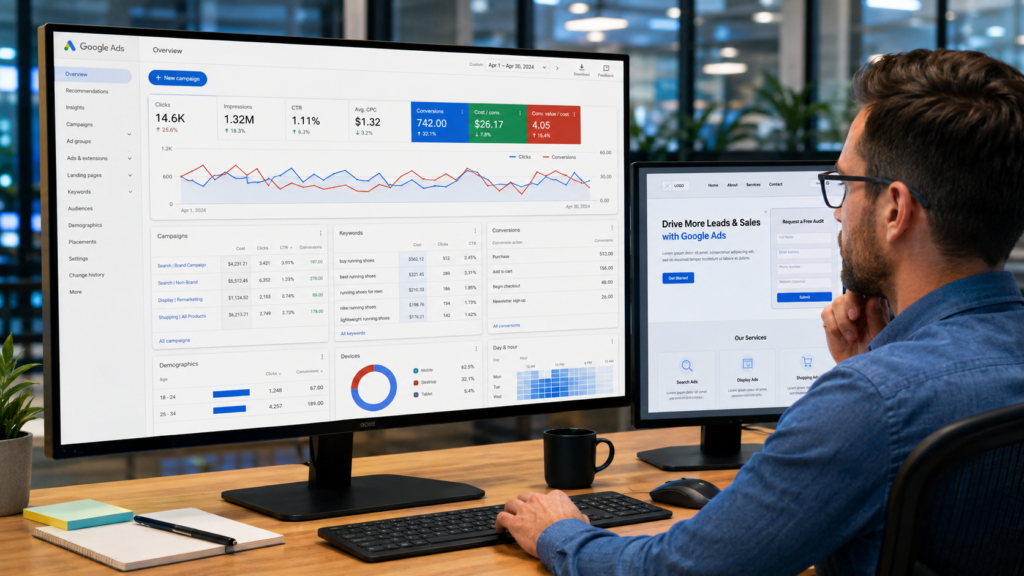
Conversion Tracking: Measuring What Truly Matters
Launching a campaign is only the beginning. The real value of Google Ads lies in understanding what happens after someone clicks your advertisement. A click alone doesn’t generate revenue—meaningful actions do.
This is where Conversion Tracking becomes one of the most powerful features of the Google Ads platform.
A conversion is any action that aligns with your business goals. Depending on your business model, that could include:
- Online purchases
- Lead form submissions
- Phone calls
- Appointment bookings
- Newsletter sign-ups
- App installs
- PDF downloads
- Quote requests
Without conversion tracking, you’re essentially navigating without a compass. You might know how many visitors reached your website, but you won’t know which campaigns actually generated customers.
For example, imagine two campaigns:
- Campaign A: 2,000 clicks, 15 conversions
- Campaign B: 800 clicks, 65 conversions
At first glance, Campaign A appears more successful because it generated more traffic. However, Campaign B delivers significantly better business results. Without conversion tracking, that insight would be impossible.
Google Ads integrates seamlessly with Google Analytics 4 (GA4), enabling advertisers to monitor the complete customer journey—from the first click to the final conversion. Businesses that leverage accurate tracking make decisions based on real performance data rather than assumptions, resulting in more efficient budget allocation and higher long-term ROI.
Writing High-Converting Ad Copy and Landing Pages
An effective campaign doesn’t stop at targeting the right audience. The messaging must inspire action, and the destination page must fulfill the promise made in the ad.
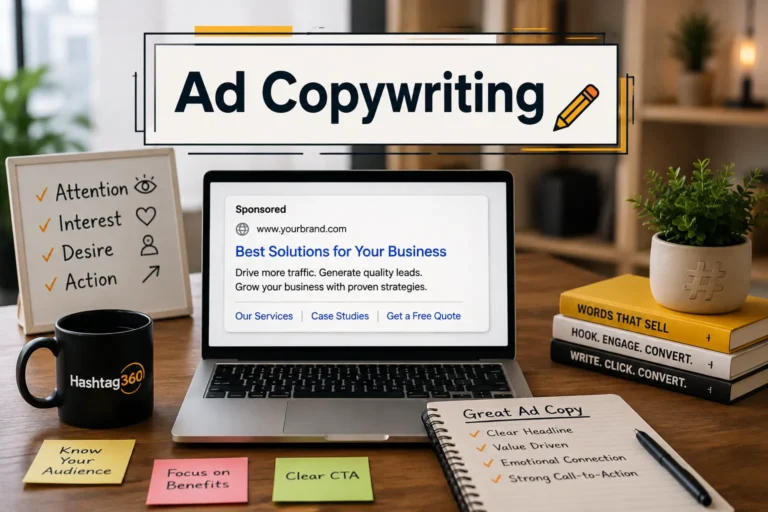
Crafting Compelling Ad Copy
Strong ad copy focuses on solving a problem rather than simply describing a product or service. Every headline and description should answer one question: Why should someone choose you over the competition?
High-performing ads typically include:
- A clear value proposition
- Relevant keywords
- Emotional and logical benefits
- Strong calls-to-action (CTAs)
- Trust indicators such as awards, certifications, or reviews
Compare these two examples:
❌ Generic Ad
We offer digital marketing services. Contact us today.
✅ Optimized Ad
Increase Your Leads with Google Ads Experts | Certified PPC Specialists | Free Campaign Audit
The second version communicates expertise, value, and a compelling reason to click.
Optimizing the Landing Page Experience
Even the best advertisement can underperform if it leads users to an ineffective landing page.
A high-converting landing page should:
- Match the user’s search intent
- Load in under three seconds
- Be fully responsive on mobile devices
- Feature a compelling headline
- Highlight benefits over features
- Display testimonials or case studies
- Include trust signals (certifications, reviews, awards)
- Present a clear and visible CTA
Imagine advertising “Free Google Ads Audit” and directing visitors to a generic homepage. Most users will leave because they expected a dedicated page addressing that specific offer.
Consistency between the ad and the landing page not only improves conversions but also contributes to a stronger Quality Score, reducing advertising costs over time.
A/B Testing: Small Improvements That Deliver Significant Results
One of the greatest advantages of digital advertising is the ability to test and optimize continuously.
A/B testing, also known as split testing, involves comparing two versions of an advertisement or landing page to determine which performs better.
Businesses can experiment with:
- Headlines
- Descriptions
- Calls-to-action
- Images
- Landing page layouts
- Button colors
- Form lengths
- Promotional offers
Consider a software company testing two headlines:
- Version A: Start Your Free Trial Today
- Version B: Save 30% on Your First Year
Even a modest increase in conversion rate can translate into hundreds of additional leads over time. Successful advertisers rarely assume they have the perfect campaign—they rely on testing to uncover opportunities for improvement.
The Most Common Google Ads Mistakes Businesses Make
Google Ads is incredibly powerful, but it’s also unforgiving when campaigns are poorly managed. Some of the most expensive mistakes include:
1. Targeting Broad Keywords
Using broad, generic keywords often attracts irrelevant traffic, increasing costs without improving results.
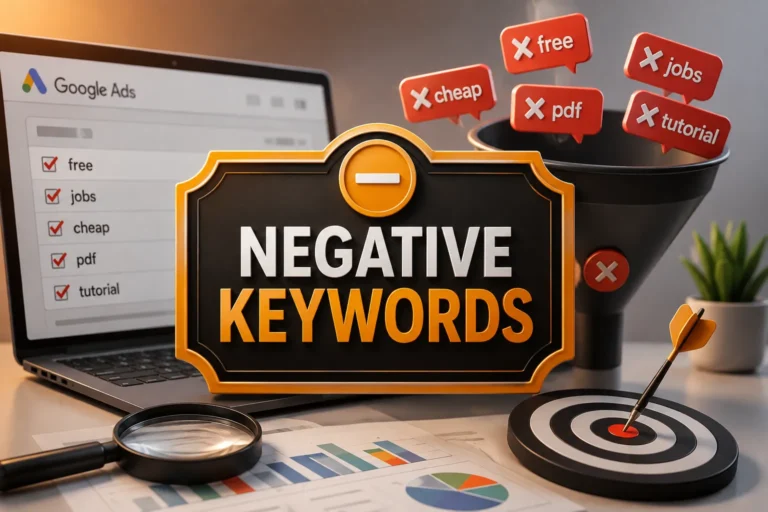
2. Ignoring Negative Keywords
Failing to exclude irrelevant searches can result in wasted clicks from users who have no intention of becoming customers.
3. Poor Mobile Experience
With the majority of searches occurring on mobile devices, slow-loading or difficult-to-navigate websites lead to high bounce rates and lost opportunities.
4. Sending All Traffic to the Homepage
Users expect landing pages tailored to their specific search intent. Generic homepages rarely convert as effectively as dedicated campaign pages.
5. Failing to Monitor Campaign Performance
Successful campaigns require ongoing optimization. Reviewing search terms, adjusting bids, refining audiences, and testing creatives should be part of a continuous improvement process.
Google Ads vs. Organic SEO: Which Strategy Is Better?
This is one of the most frequently asked questions in digital marketing, but it presents a false choice. Google Ads and Search Engine Optimization (SEO) are complementary strategies rather than competing ones.
| Google Ads | Organic SEO |
|---|---|
| Immediate visibility | Long-term growth |
| Paid traffic | Free organic traffic |
| Instant testing | Gradual authority building |
| Precise audience targeting | Broad search visibility |
| Highly measurable | Sustainable results |
A newly launched business may use Google Ads to generate leads while building its SEO presence. Over time, strong organic rankings reduce dependence on paid traffic, while Google Ads continues to support product launches, seasonal promotions, and competitive keywords.
The most resilient marketing strategies combine both channels.
Google Ads vs. Other Advertising Platforms
No advertising platform is universally superior. The right choice depends on your objectives, audience, and buying journey.
Google Ads
Best for capturing existing demand. Users are actively searching for products or services, making it ideal for lead generation and high-intent sales.
Facebook Ads
Excellent for building awareness, engaging audiences, and promoting visually appealing products. Facebook excels at demand generation rather than demand capture.
Microsoft Ads
Often overlooked, Microsoft Ads can provide lower CPCs and less competition, particularly in B2B industries.
LinkedIn Ads
Ideal for B2B companies targeting professionals based on job title, industry, or company size. While CPCs are generally higher, lead quality can justify the investment.
Amazon Ads
Designed for eCommerce businesses selling products directly on Amazon. Buyers are typically closer to making a purchase, making the platform highly effective for retail brands.
Many successful businesses use multiple advertising platforms simultaneously, selecting each one based on the stage of the customer journey they want to influence.
What ROI Can Businesses Realistically Expect?
One of the greatest misconceptions surrounding Google Ads is the expectation of overnight success.
While some campaigns generate immediate leads, sustainable profitability usually requires ongoing testing, optimization, and data analysis.
Factors influencing ROI include:
- Industry competition
- Keyword selection
- Landing page quality
- Budget
- Offer strength
- Audience targeting
- Campaign optimization
- Conversion tracking accuracy
Businesses that consistently review performance metrics and refine their campaigns often see significant improvements over time. The objective isn’t simply to reduce advertising costs—it’s to maximize the value generated from every dollar invested.
This is where experienced agencies like hashtag360 make a measurable difference. By combining strategic planning, advanced analytics, and continuous optimization, they help businesses transform advertising budgets into predictable growth engines rather than uncertain expenses.
Advanced Features Shaping the Future of Google Ads
Google continues to enhance its advertising platform through artificial intelligence and automation.
Modern capabilities include:
- AI-powered Smart Bidding
- Performance Max campaigns
- Audience Signals
- Predictive remarketing
- Responsive Search Ads
- Enhanced Conversion Tracking
- Consent Mode
- Broad Match optimization with machine learning
- Demand Gen campaigns
- Automated asset creation
These innovations enable advertisers to scale campaigns more efficiently while maintaining strong performance. However, automation is most effective when paired with a thoughtful strategy, accurate data, and experienced oversight.
Why Partner with hashtag360 for Google Ads Management?
Google Ads offers extraordinary opportunities, but unlocking its full potential requires more than launching a few campaigns. It demands strategic planning, continuous optimization, and a deep understanding of user behavior.
At hashtag360, we help businesses move beyond basic campaign management by building data-driven advertising strategies tailored to measurable business goals. From comprehensive keyword research and compelling ad copy to conversion tracking, landing page optimization, and ROI-focused reporting, every aspect of our approach is designed to maximize advertising performance.
Whether you’re launching your first campaign or looking to improve the results of existing ones, our team provides the expertise needed to generate qualified leads, reduce wasted spend, and accelerate sustainable growth.
Ready to transform your Google Ads performance? Contact hashtag360 today for a comprehensive Google Ads audit and discover how strategic PPC management can help your business attract more customers, increase conversions, and maximize return on investment.
Frequently Asked Questions
What is Google Ads?
Google Ads is Google’s online advertising platform that allows businesses to promote products and services across Google Search, YouTube, the Display Network, Gmail, Shopping, and more using various bidding models, including PPC.
How does Google Ads work?
Google Ads uses a real-time auction system that considers factors such as bids, Quality Score, ad relevance, landing page experience, and expected CTR to determine which ads appear and in what order.
Is Google Ads better than SEO?
Not necessarily. Google Ads provides immediate visibility and measurable results, while SEO builds long-term organic authority. The most effective digital marketing strategies typically combine both.
How much should I spend on Google Ads?
Budgets vary depending on your industry, competition, and goals. Rather than focusing solely on spend, businesses should prioritize ROI and optimize campaigns based on performance data.
Can small businesses benefit from Google Ads?
Absolutely. With precise targeting, flexible budgets, and measurable results, Google Ads allows small businesses to compete effectively with larger competitors.
Conclusion
Google Ads has evolved into one of the most sophisticated digital advertising platforms available, giving businesses the ability to connect with customers at the exact moment they’re searching for solutions. From Search and Shopping campaigns to YouTube advertising, Performance Max, and AI-powered bidding, the platform offers exceptional opportunities to drive traffic, generate leads, and increase revenue.
Success, however, isn’t determined by budget alone. It depends on choosing the right keywords, creating compelling ad copy, delivering a seamless landing page experience, tracking conversions accurately, and optimizing campaigns continuously.
For businesses serious about maximizing their advertising investment, partnering with experienced specialists can make all the difference. Hashtag360 combines strategic expertise, advanced analytics, and performance-focused campaign management to help brands achieve sustainable growth and stronger returns from Google Ads.
Whether you’re just beginning your PPC journey or refining an established advertising strategy, mastering Google Ads is one of the smartest investments you can make in your digital marketing success.