Connect with Us

Search Campaigns: The Complete Guide to Driving High-Intent Traffic and Maximizing ROI

In today’s highly competitive digital landscape, businesses need marketing strategies that deliver measurable results. While social media and display advertising help build brand awareness, Search Campaigns stand out because they connect businesses with customers who are actively searching for products or services.
Whether you’re a startup looking for your first customers or an established business aiming to increase conversions, Search Campaigns offer one of the highest returns on investment (ROI) in digital marketing.
In this comprehensive guide, we’ll explore what Search Campaigns are, how they work, their benefits, best practices, and why they remain one of the most effective advertising solutions for businesses of all sizes.
Table of Contents
What Are Search Campaigns?
Search Campaigns are a form of Pay-Per-Click (PPC) advertising that display text ads on search engine results pages (SERPs) when users search for relevant keywords.
These ads typically appear at the top and bottom of search results and are marked as “Sponsored” or “Ad.” Businesses bid on keywords related to their products or services, and when users search for those terms, their ads become eligible to appear.
Unlike traditional advertising, Search Campaigns target users with high purchase intent, making them incredibly effective for generating qualified leads and conversions.
How Do Search Campaigns Work?
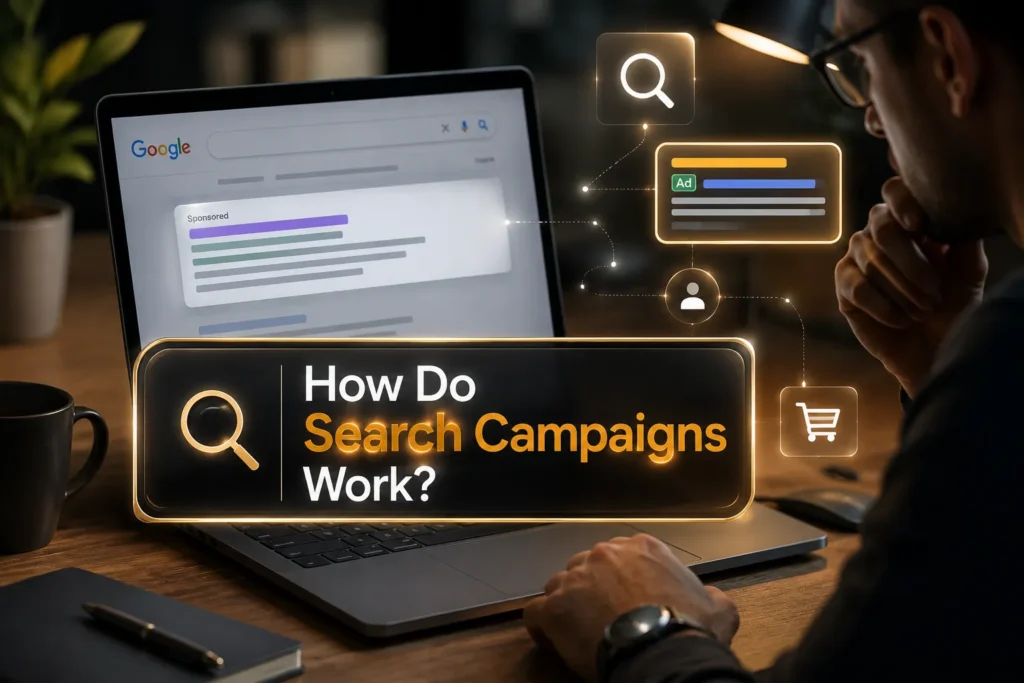
Search Campaigns operate through an auction-based system. Every time someone enters a search query, the advertising platform evaluates all advertisers bidding on relevant keywords.
The auction considers multiple factors, including:
Keyword Relevance
Businesses select keywords that closely match what their target audience is searching for.
For example:
- Digital marketing agency
- SEO services
- Google Ads expert
- Website design company
Choosing relevant keywords ensures your ads appear for users who are genuinely interested in your offerings.
Bid Amount
Advertisers specify the maximum amount they’re willing to pay when someone clicks their advertisement.
Higher bids may improve visibility, but they are not the only determining factor.
Quality Score
Search engines reward advertisers that create valuable experiences for users.
Quality Score is influenced by:
- Expected click-through rate (CTR)
- Ad relevance
- Landing page quality
- User experience
A high Quality Score often results in lower advertising costs and better ad placements.
Ad Rank
Ad Rank determines where your advertisement appears on the search results page.
It depends on a combination of:
- Bid amount
- Quality Score
- Ad extensions
- Expected impact of the advertisement
Why Are Search Campaigns Important?
Businesses invest heavily in Search Campaigns because they connect with customers precisely when they’re searching for solutions.
Some key reasons include:
Reach Customers with High Intent
Unlike display or social media advertising, Search Campaigns target people who are already looking for products or services.
This significantly increases the likelihood of generating leads and sales.
Immediate Visibility
SEO can take months to generate results.
Search Campaigns can place your business at the top of search results almost immediately after launch.
Measurable Results
Every aspect of a campaign can be tracked, including:
- Clicks
- Impressions
- Conversion rate
- Cost per click (CPC)
- Cost per acquisition (CPA)
- Return on ad spend (ROAS)
This allows businesses to optimize campaigns based on real data.
Budget Flexibility
Businesses can control:
- Daily budget
- Monthly budget
- Maximum bid
- Geographic targeting
- Device targeting
This makes Search Campaigns suitable for businesses of every size.
Key Components of a Successful Search Campaign
Keyword Research
Effective campaigns begin with detailed keyword research.
Businesses should focus on:
High-intent keywords
Examples:
- Buy laptops online
- Best digital marketing agency
- Local plumber near me
Long-tail keywords
Long-tail keywords generally have lower competition and higher conversion rates.
Example:
Affordable SEO services for small businesses
Negative Keywords
Negative keywords prevent ads from appearing for irrelevant searches.
Example:
If you sell premium software, you might exclude:
- Free
- Download
- Crack
This improves campaign efficiency and reduces wasted spending.
Writing High-Converting Ad Copy
Great advertisements encourage users to click.
Effective ad copy should include:
- Target keyword
- Clear value proposition
- Unique selling point (USP)
- Strong call-to-action (CTA)
Example:
Headline
Professional Digital Marketing Services
Description
Grow your business with data-driven marketing strategies. Contact Hashtag360 today for expert solutions.
Landing Page Optimization
Driving traffic is only half the battle.
The landing page should:
- Load quickly
- Be mobile-friendly
- Match the ad message
- Include a clear CTA
- Build trust through testimonials and reviews
A well-optimized landing page significantly improves conversion rates.
Audience Targeting Options
Modern Search Campaigns offer advanced targeting capabilities.
Businesses can target users based on:
Geographic Location
Display ads in:
- Specific cities
- States
- Countries
- Radius around a business
Device Targeting
Customize bids for:
- Mobile users
- Desktop users
- Tablets
Time Scheduling
Ads can appear only during:
- Business hours
- Peak shopping periods
- High-converting time slots
Ad Extensions That Improve Performance
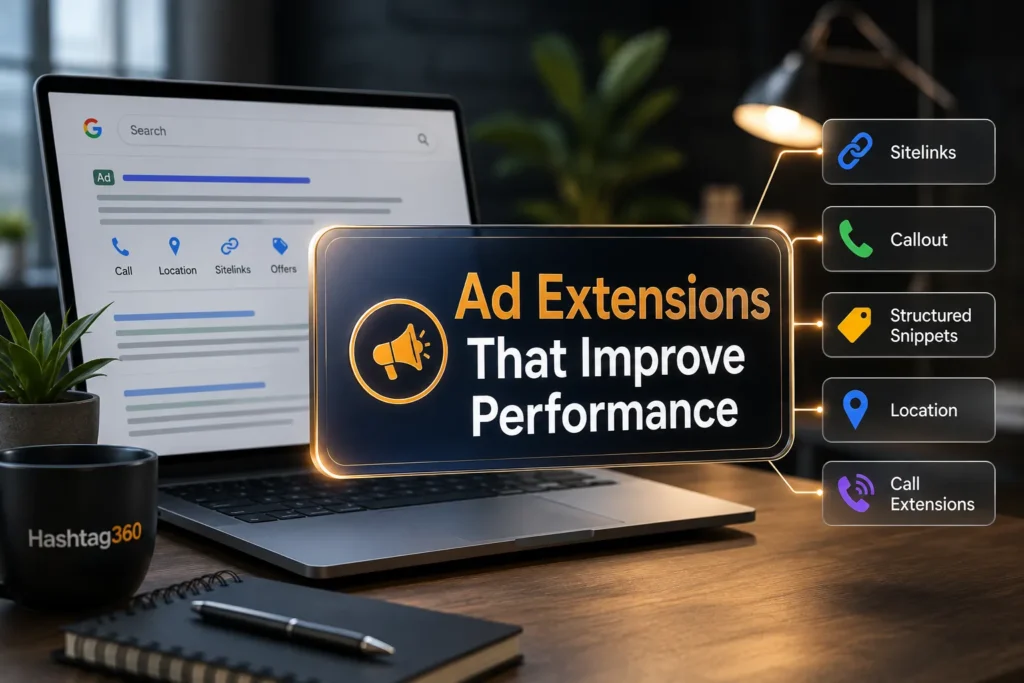
Ad extensions make advertisements larger and more informative.
Popular extensions include:
Sitelink Extensions
Provide additional links to:
- Services
- Pricing
- Contact page
- About Us
Call Extensions
Allow users to call directly from search results.
Ideal for service-based businesses.
Location Extensions
Help local customers find nearby business locations.
Callout Extensions
Highlight unique benefits like:
- Free Consultation
- 24/7 Support
- Certified Experts
- No Hidden Charges
Best Practices for Search Campaign Success

Focus on Search Intent
Understand what users are trying to accomplish before selecting keywords.
Organize Ad Groups Properly
Group similar keywords together for highly relevant advertisements.
Test Multiple Ads
Create different versions of headlines and descriptions.
Analyze which combinations generate the best CTR and conversions.
Monitor Performance Regularly
Review campaign metrics weekly to identify opportunities for optimization.
Improve Quality Score
Higher Quality Scores often lead to:
- Lower CPC
- Better ad positions
- Improved ROI
Common Mistakes to Avoid
Many businesses waste advertising budgets because of avoidable mistakes.
Common issues include:
- Targeting overly broad keywords
- Ignoring negative keywords
- Sending traffic to poor landing pages
- Not tracking conversions
- Writing generic advertisements
- Failing to optimize campaigns regularly
Avoiding these mistakes can dramatically improve campaign performance.
Search Campaigns vs SEO
Although Search Campaigns and SEO both generate traffic from search engines, they serve different purposes.
| Search Campaigns | SEO |
|---|---|
| Immediate results | Long-term growth |
| Paid traffic | Organic traffic |
| Budget controlled | Time-intensive |
| Instant visibility | Gradual rankings |
| Easy testing | Long optimization cycle |
The strongest digital marketing strategies combine both approaches for maximum online visibility.
Measuring Campaign Success
Businesses should monitor important performance metrics such as:
- Click-Through Rate (CTR)
- Conversion Rate
- Cost Per Click (CPC)
- Cost Per Conversion
- Return on Ad Spend (ROAS)
- Quality Score
- Impression Share
Analyzing these metrics helps improve campaign performance over time.
Types of Search Campaigns
Not all Search Campaigns are designed to achieve the same objective. Depending on your business goals, budget, and target audience, you can choose from several campaign types that help you connect with users at different stages of the buying journey.
Branded Search Campaigns
Branded Search Campaigns focus on keywords that include your company’s name or branded products and services.
For example, if your company is Hashtag360, users may search for:
Although these users already know your brand, running branded campaigns helps ensure your website appears prominently in search results while preventing competitors from capturing your potential customers.
Non-Branded Search Campaigns
Non-branded campaigns target users searching for services without mentioning a specific company.
Examples include:
- Best digital marketing agency
- SEO company near me
- PPC management services
- Google Ads experts
These campaigns are excellent for attracting new customers who are still researching their options.
Local Search Campaigns
Local Search Campaigns are ideal for businesses that serve customers within a specific geographic location.
These campaigns often include keywords like:
- Digital marketing agency in Delhi
- Dentist near me
- Best restaurant in Mumbai
- Real estate agent in Bangalore
By targeting local intent, businesses can generate more qualified leads from nearby customers.
Competitor Campaigns
Competitor campaigns involve bidding on keywords related to competing businesses. While these campaigns require careful planning and compliance with advertising policies, they can help businesses reach customers who are evaluating different providers.
However, success depends on offering a compelling value proposition that encourages users to consider your business over competitors.
Understanding Search Intent
One of the biggest factors that determines the success of a Search Campaign is understanding user intent.
Search intent refers to the reason behind a user’s search query. By aligning your ads and landing pages with that intent, you increase the likelihood of generating clicks and conversions.
Informational Intent
Users are seeking knowledge rather than making a purchase.
Examples include:
- What is PPC?
- How does Google Ads work?
- Benefits of SEO
These keywords are excellent for content marketing but may not always lead to immediate conversions.
Navigational Intent
Users are trying to reach a specific website or brand.
Examples:
- Hashtag360 website
- Google Ads login
- Google Analytics
These searches typically have high click-through rates because users already know where they want to go.
Commercial Investigation
Users are comparing products or services before making a purchase.
Examples include:
- Best PPC agency
- SEO vs Google Ads
- Top digital marketing companies
This audience is closer to making a buying decision, making these keywords highly valuable.
Transactional Intent
These users are ready to take action.
Examples:
- Hire PPC agency
- Buy marketing software
- Book SEO consultation
These keywords often deliver the highest conversion rates.
The Role of AI in Modern Search Campaigns

Artificial Intelligence has transformed the way Search Campaigns are managed. Rather than relying solely on manual adjustments, advertisers can now leverage AI-powered tools to improve campaign performance.
Smart Bidding
AI analyzes thousands of signals in real time, including:
- Device type
- User location
- Search history
- Time of day
- Browser
- Operating system
Based on these signals, the platform automatically adjusts bids to maximize conversions or achieve a target return on ad spend.
Responsive Search Ads
Instead of creating one static advertisement, advertisers can provide multiple headlines and descriptions.
The platform then automatically tests different combinations to determine which performs best for different users.
This automation often improves click-through rates while reducing manual optimization.
Predictive Optimization
Machine learning identifies patterns in campaign performance and recommends improvements before performance declines.
Examples include:
- Budget adjustments
- Keyword opportunities
- Audience recommendations
- Bid optimizations
These insights help businesses make data-driven decisions more efficiently.
Creating a High-Converting Landing Page
A Search Campaign is only as effective as the landing page it directs users to. Even the best advertisement cannot compensate for a poorly designed destination page.
Keep Messaging Consistent
The headline on the landing page should closely match the ad copy. Consistent messaging reassures visitors that they have landed on the right page.
Highlight Your Unique Value Proposition
Clearly explain why customers should choose your business. Focus on benefits rather than just features.
For example:
- Certified professionals
- Transparent pricing
- Proven results
- Personalized strategies
- Dedicated support
Use Trust Signals
Trust-building elements encourage users to take action.
Examples include:
- Customer testimonials
- Case studies
- Industry certifications
- Awards and recognitions
- Client logos
- Star ratings
Optimize for Mobile
Since a significant portion of search traffic comes from smartphones, your landing page should load quickly and display perfectly on smaller screens.
A/B Testing for Better Results
Successful advertisers continuously test different elements of their campaigns rather than assuming one version will always perform best.
Elements worth testing include:
- Headlines
- Descriptions
- Display URLs
- Call-to-action buttons
- Landing page layouts
- Contact forms
- Images
- Offers
Even small improvements in click-through rate or conversion rate can significantly increase overall return on investment.
Budgeting Strategies for Search Campaigns
Many businesses believe they need a massive advertising budget to compete effectively. In reality, strategic budgeting often outperforms simply spending more money.
Start Small
Begin with a manageable daily budget while collecting performance data. This allows you to identify high-performing keywords before scaling.
Prioritize High-Converting Keywords
Allocate a larger portion of your budget toward keywords that consistently generate leads or sales rather than evenly distributing spending across all keywords.
Monitor Cost Per Acquisition
Instead of focusing only on clicks, evaluate how much it costs to acquire a customer. Lowering acquisition costs often has a greater impact on profitability than increasing traffic.
Future Trends in Search Campaigns
Search advertising continues to evolve rapidly as technology and user behavior change.
Some trends shaping the future include:
Voice Search
As smart speakers and voice assistants become more popular, conversational search queries are increasing.
Advertisers should optimize for natural language keywords such as:
- Where can I find the best digital marketing agency near me?
- Which PPC agency has the best reviews?
AI-Powered Personalization
Advertising platforms are increasingly delivering personalized experiences based on user preferences and intent.
This enables businesses to present more relevant ads, improving engagement and conversions.
Privacy-Focused Advertising
With increasing privacy regulations and changes to third-party cookies, advertisers must rely more on first-party data, consent-based marketing, and privacy-compliant measurement strategies.
Automation with Human Oversight
Automation simplifies campaign management, but human expertise remains essential for strategy, creative messaging, audience understanding, and business decision-making.
The most successful advertisers combine AI-driven automation with experienced professionals who continually analyze results and refine campaign strategies.
Frequently Asked Questions (FAQs)
How long does it take for a Search Campaign to deliver results?
Search Campaigns can begin generating traffic almost immediately after approval. However, meaningful optimization usually takes several weeks as enough performance data is collected.
Are Search Campaigns suitable for small businesses?
Yes. Small businesses can start with modest budgets, target highly relevant keywords, and scale their campaigns based on measurable performance.
What is a good Click-Through Rate (CTR)?
CTR varies by industry, but a higher CTR generally indicates that your ads are relevant and compelling to your target audience.
Should businesses invest in SEO or Search Campaigns?
Both strategies complement each other. Search Campaigns provide immediate visibility and lead generation, while SEO builds sustainable, long-term organic traffic.
How often should Search Campaigns be optimized?
Campaigns should be monitored regularly. Weekly reviews are a good starting point, while high-budget or high-volume campaigns may require daily optimization to maximize performance and control costs.
Industries That Benefit Most from Search Campaigns
Search Campaigns are effective across numerous industries, including:
- Healthcare
- Real Estate
- Education
- E-commerce
- Legal Services
- Financial Services
- Home Improvement
- Travel & Hospitality
- SaaS Companies
- Digital Marketing Agencies
Regardless of the industry, businesses can reach customers who are actively searching for their products or services.
Why Choose Hashtag360 for Search Campaign Management?
Managing Search Campaigns requires strategic planning, continuous optimization, and data-driven decision-making. At Hashtag360, we help businesses maximize their advertising investment by creating customized campaigns that align with their goals.
Our Search Campaign services include:
- Comprehensive keyword research
- Competitor analysis
- Campaign setup and management
- High-converting ad copy creation
- Landing page recommendations
- Conversion tracking implementation
- Bid optimization
- Performance monitoring and reporting
- Continuous campaign optimization
Our team focuses on driving qualified traffic, improving conversions, and delivering measurable business growth through intelligent search advertising strategies.
Conclusion
Search Campaigns remain one of the most effective digital marketing channels for businesses looking to generate immediate visibility, attract high-intent customers, and achieve measurable results. By combining strategic keyword research, compelling ad copy, optimized landing pages, and continuous performance analysis, businesses can maximize their return on investment and stay ahead of the competition.
Whether you’re launching your first campaign or refining an existing strategy, investing in well-managed Search Campaigns can significantly accelerate your business growth. At Hashtag360, we specialize in creating data-driven Search Campaigns that deliver qualified leads, increase conversions, and help businesses achieve sustainable success in an increasingly competitive online marketplace.