
Connect with Us

Google Ads Auction Explained: How It Works & How to Win More Clicks (2026 Guide)

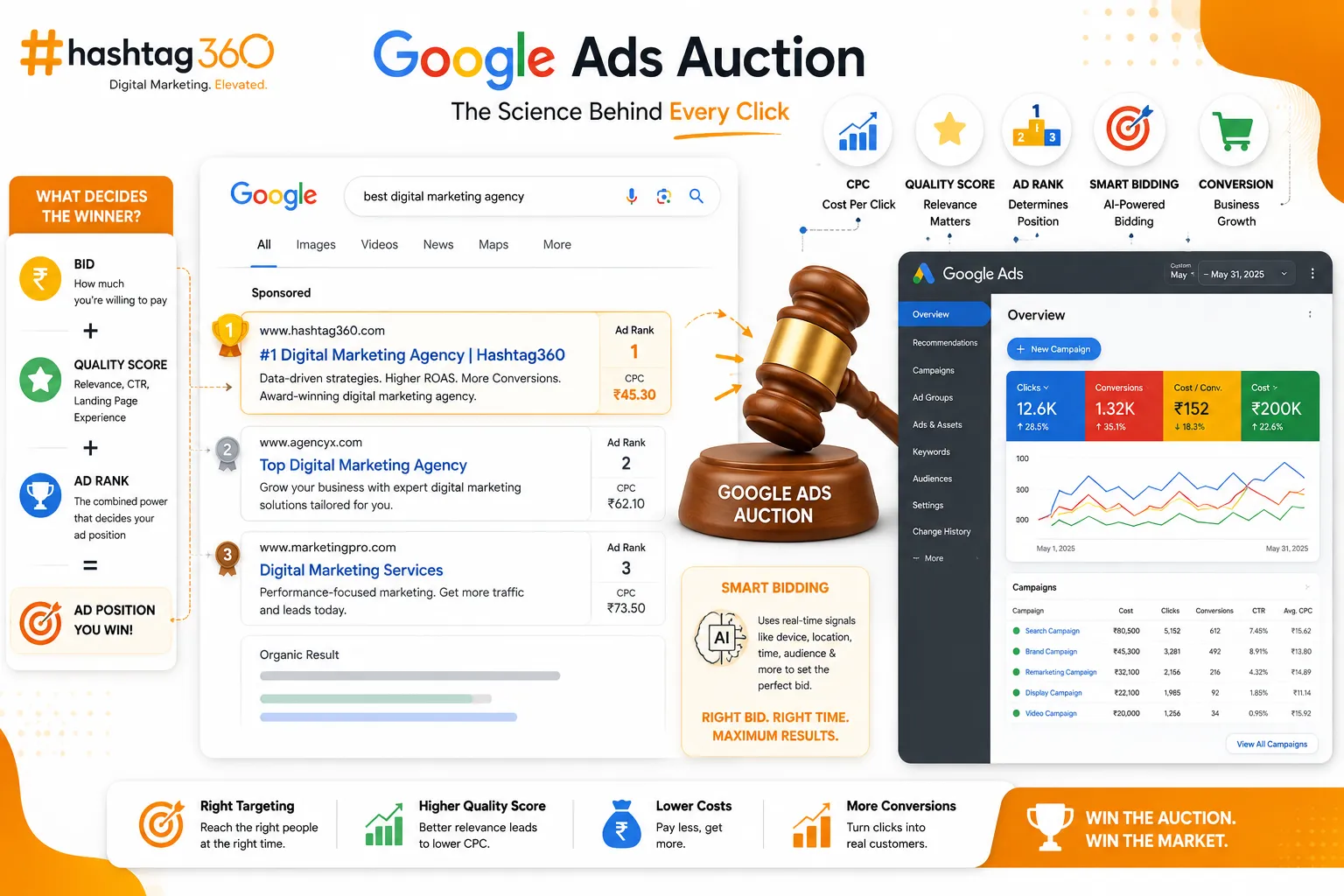
If you have ever run a Google Ads campaign and wondered why your competitor’s ad shows up above yours even though you are bidding more, the answer lies in one place: the Google Ads Auction. It is the invisible engine that decides which ads appear, in what order, and how much each advertiser actually pays per click.
Many advertisers assume that the Google Ads Auction is simply about who bids the highest amount. That assumption costs businesses thousands of rupees or dollars every month in wasted ad spend. In reality, Google’s auction system is a sophisticated, real-time process that blends your bid with ad quality, expected impact, and relevance to the searcher’s intent. Understanding this system is not optional if you want to run profitable campaigns in 2026 — it is the foundation of every successful paid search strategy.
In this guide, we will break down exactly how the Google Ads Auction works, the role of Ad Rank and Quality Score, how bidding strategies and Smart Bidding influence outcomes, the common mistakes advertisers make, and the advanced strategies that help businesses consistently win valuable ad placements without overspending. Whether you are a small business owner managing your own account or a marketer looking to sharpen your understanding, this guide will give you a complete, practical picture of how the auction actually works.
What Is the Google Ads Auction?
The Google Ads Auction is the automated process Google runs every single time someone types a search query into Google Search. Within a fraction of a second, Google evaluates every advertiser who has bid on a matching keyword and decides three things: whether their ad is eligible to show at all, where it will be positioned on the page, and how much that advertiser will actually be charged if their ad gets clicked.
This happens continuously, billions of times a day, across Google Search, the Google Display Network, YouTube, and Google Shopping. Each auction is unique because it depends on the specific search query, the searcher’s location, device, time of day, and past behavior, as well as the pool of advertisers competing for that particular moment. No two auctions are ever identical, even if the same keyword is searched twice in a row.
It is important to understand that the Google Ads Auction is not a traditional auction where the highest bidder automatically wins. Instead, it is closer to a merit-based system. Google’s stated goal is to show the most relevant, useful ads to searchers while still running a fair and competitive marketplace for advertisers. This is why an advertiser with a lower bid but a highly relevant, well-optimized ad can outrank a competitor who is bidding significantly more money but offering a poor user experience.
Why the Google Ads Auction Matters for Your Business
Understanding the mechanics of the auction is not just a technical exercise — it has direct, measurable consequences for your marketing budget and business growth.
It determines your cost per click. The auction does not simply charge you your maximum bid. It calculates the minimum amount you need to pay to beat the advertiser ranked just below you. This means two advertisers targeting the same keyword can pay very different prices depending on how well their accounts are optimized.
It determines whether you show up at all. Even with an unlimited budget, an ad with poor relevance, a low-quality landing page, or policy violations may not be eligible to enter the auction, no matter how much is bid.
It rewards efficiency over raw spending power. Businesses that invest time in improving Quality Score, ad relevance, and landing page experience can often outperform larger competitors who are simply throwing money at the problem. This levels the playing field for small and mid-sized businesses competing against larger brands with bigger budgets.
It directly impacts your return on ad spend (ROAS). Since the auction determines both your position and your cost, mastering it means you get more clicks, more conversions, and a lower cost per acquisition from the same budget — which is exactly what makes the difference between a campaign that drains your budget and one that consistently drives profitable growth.
At Hashtag360, we have seen firsthand how businesses that understand and optimize for the Google Ads Auction consistently outperform competitors who focus on bidding alone. In the sections that follow, we will walk through exactly how the auction works step by step, and how you can use that knowledge to win more clicks at a lower cost.
It is also worth noting how much the auction landscape has evolved heading into 2026. Rising competition across nearly every industry, combined with the growing sophistication of Google’s machine learning systems behind Smart Bidding, means that manual, bid-only strategies are becoming less effective by the year. Advertisers who continue to treat the auction as a simple bidding war are increasingly losing ground to competitors who invest in relevance, first-party data, and structured account optimization. This shift makes a solid grasp of auction mechanics more valuable today than at almost any point in the history of Google Ads.
How the Google Ads Auction Works: Step-by-Step
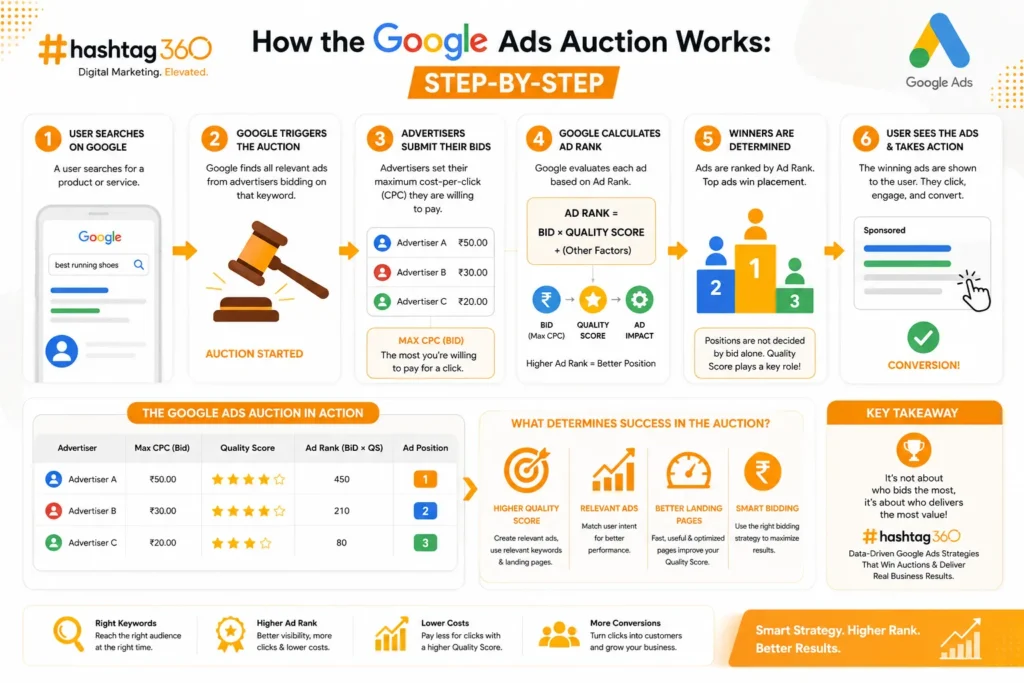
To really understand how to win in the Google Ads Auction, it helps to walk through exactly what happens between the moment a user types a search query and the moment ads appear on the results page. This entire sequence happens in real time, in a fraction of a second, but breaking it into steps makes the logic much easier to grasp.
Step 1: A User Enters a Search Query
The auction process begins the instant someone searches on Google. Say a user types “best CRM software for small business.” Google immediately scans its system for every advertiser who has that keyword, or a close variant of it, in their active campaigns.
Step 2: Google Checks Ad Eligibility
Before any ranking happens, Google filters out ads that are not eligible to participate. This includes ads that violate Google’s advertising policies, ads with disapproved content, ads targeting the wrong location or language, or campaigns that have exhausted their daily budget. Only ads that pass this eligibility check move forward into the actual competition.
Step 3: Google Calculates Ad Rank for Each Eligible Ad
This is the heart of the auction. For every eligible ad, Google calculates a value called Ad Rank. Ad Rank is not just your bid amount — it is a composite score built from several factors, which we will explore in depth in the next section. In simple terms, Ad Rank combines your maximum bid, your Quality Score (relevance, expected click-through rate, and landing page experience), the expected impact of ad extensions and formats, and the competitiveness of the auction itself.
Step 4: Ads Are Ranked in Order
Once Ad Rank is calculated for every eligible advertiser, Google arranges the ads in descending order. The advertiser with the highest Ad Rank gets the top position, the second highest gets the next position, and so on. This determines not just whether your ad appears, but exactly where it appears on the page — top of search, middle, or further down.
Step 5: Google Determines the Actual Cost Per Click (CPC)
Here is where many advertisers are surprised. Google does not charge you your maximum bid. Instead, it uses a formula to calculate the lowest amount you would need to bid to maintain your position above the advertiser ranked just below you. This is often referred to as the “second-price auction” concept, adapted for Ad Rank.
The simplified formula looks like this:
Your Actual CPC = (Ad Rank of the advertiser below you ÷ Your Quality Score) + $0.01
This means if your Quality Score is high, you can often pay less than a competitor with a lower Quality Score, even if that competitor placed a higher maximum bid. This single mechanic is why two businesses bidding on the same keyword can pay dramatically different prices for the same click.
Step 6: The Ad Is Served (or Not)
If your Ad Rank clears the necessary thresholds, your ad is served to the user in its designated position. If it does not meet the minimum Ad Rank threshold for that auction, your ad simply will not appear for that particular search, even if you have an active budget.
Step 7: The Cycle Repeats for Every Single Search
This entire process — eligibility check, Ad Rank calculation, ranking, and pricing — happens again from scratch for every single search query, every single time. Your position and cost per click on one search are not guaranteed to be the same for the next search, even seconds later, because the competitive landscape (who else is bidding, their budgets, their Quality Scores) is constantly shifting.
Understanding this cycle makes one thing clear: winning the Google Ads Auction consistently is not about placing one high bid and walking away. It requires ongoing optimization of every factor that feeds into Ad Rank — which is exactly what we will break down next.
A Simple Example to Make This Concrete
Imagine three advertisers — A, B, and C — all bidding on the keyword “affordable web design services.” Advertiser A bids $6 but has a mediocre Quality Score of 4. Advertiser B bids $4 with a strong Quality Score of 9. Advertiser C bids $5 with an average Quality Score of 6.
When Google calculates Ad Rank for each of them, Advertiser B’s high Quality Score can push their effective Ad Rank above Advertiser A’s, despite bidding two dollars less. Advertiser C lands somewhere in between. The final order might end up being B, then C, then A — the exact opposite of what a simple “highest bid wins” model would predict.
More importantly, when it comes time to calculate actual cost per click, Advertiser B — because of that strong Quality Score — may end up paying noticeably less per click than Advertiser A, even while sitting in a higher ad position. This single example captures why so much of effective Google Ads management is about earning a strong Quality Score rather than simply outbidding competitors.
Why the Auction Runs Independently Every Time
It is worth emphasizing again just how dynamic this process is. Two people sitting next to each other, searching the exact same term at the exact same moment, could technically see slightly different ad orders and pricing if their devices, locations, or personalization signals differ even slightly. This is why advertisers sometimes see fluctuating average positions and costs in their reporting dashboards even when they have not changed a single setting — the competitive landscape itself is what is shifting underneath them.
Ad Rank, Quality Score, CPC, Bidding Strategies, Smart Bidding, Keywords & Match Types
Now that you understand the sequence of the auction, let’s dig into each of the individual components that determine who wins and who pays what. These are the levers you actually control as an advertiser.
Understanding Ad Rank in Detail
Ad Rank is the single most important concept in the entire Google Ads Auction. It is calculated using a combination of the following factors:
Your bid amount. This is the maximum you are willing to pay for a click, but it is only one ingredient, not the deciding factor on its own.
Quality Score components. This includes your expected click-through rate, your ad relevance to the search query, and your landing page experience.
The context of the search. This includes the user’s location, device type, the time of the search, the nature of the search terms, other ads and search results showing on the page, and signals about the user’s likely intent.
The expected impact of your ad extensions and formats. Ads with sitelinks, callouts, structured snippets, and other extensions can receive a boost in Ad Rank because Google predicts they will perform better and provide more value to the searcher.
The competitiveness of the auction. Ad Rank thresholds shift based on how many advertisers are competing for a given query and how strong their own Ad Ranks are.
Because Ad Rank blends all of these signals, an advertiser bidding $2 with excellent Quality Score and strong ad extensions can regularly outrank a competitor bidding $5 with a mediocre, generic ad and a slow landing page.
What Is Quality Score and Why It Matters So Much
Quality Score is Google’s rating, on a scale of 1 to 10, of the relevance and quality of your keywords, ads, and landing pages. It is built from three core components:
Expected click-through rate (CTR): How likely is it that your ad will get clicked when it is shown for that specific keyword, based on historical performance data?
Ad relevance: How closely does your ad’s messaging match the intent behind the search query?
Landing page experience: Is the page you are sending traffic to relevant, fast-loading, mobile-friendly, transparent, and easy to navigate?
A higher Quality Score does two powerful things: it improves your Ad Rank without requiring a higher bid, and it directly lowers your actual cost per click, since the CPC formula divides by your Quality Score. This is why Quality Score optimization is one of the highest-leverage activities in Google Ads management — improving it from a 5 to an 8, for example, can meaningfully reduce your CPC while improving your position at the same time.
Cost Per Click (CPC): What You Actually Pay
As explained earlier, your CPC is not your maximum bid. It is calculated based on what is needed to beat the Ad Rank of the advertiser directly below you, divided by your own Quality Score, plus a small increment. This is why savvy advertisers focus on improving relevance and Quality Score rather than simply raising bids — it is a more sustainable, cost-efficient way to win auctions over time.
Manual vs. Automated Bidding Strategies
Google Ads offers several bidding strategies, broadly split into manual and automated (Smart Bidding) approaches.
Manual CPC bidding gives advertisers direct control over the maximum amount they are willing to pay for each click on individual keywords. This works well for advertisers who want granular control, especially in the early stages of a campaign when there is limited conversion data.
Enhanced CPC (ECPC) is a semi-automated option that adjusts your manual bids up or down based on the likelihood of conversion, blending human control with machine learning assistance.
Smart Bidding: Letting Google’s Machine Learning Do the Work
Smart Bidding refers to Google’s suite of automated bid strategies that use machine learning to optimize for conversions or conversion value in each and every auction, taking into account a huge range of contextual signals in real time — far more than a human could realistically process manually. The main Smart Bidding strategies include:
Maximize Conversions, which sets bids to get as many conversions as possible within your budget.
Maximize Conversion Value, which prioritizes higher-value conversions over sheer volume.
Target CPA (Cost Per Acquisition), which aims to get as many conversions as possible at or below a target cost per acquisition you specify.
Target ROAS (Return on Ad Spend), which aims to hit a target return on ad spend, ideal for e-commerce and revenue-focused campaigns.
Smart Bidding tends to perform best once a campaign has gathered sufficient conversion history, typically at least 30 conversions in the last 30 days, giving Google’s algorithm enough data to make accurate real-time predictions.
Keywords and the Role They Play in the Auction
Your keyword strategy directly shapes which auctions you even enter. Poorly chosen or overly broad keywords can put you into auctions where your ad has little relevance, dragging down your Quality Score and wasting spend. A well-researched keyword list, grouped tightly by theme and intent, ensures your ads are only competing in auctions where they have a genuine chance of being relevant and cost-efficient.
Match Types and Their Impact on Auction Eligibility
Keyword match types control how closely a user’s search query needs to match your keyword before your ad is eligible to enter the auction:
Broad match shows your ad for a wide range of related searches, offering maximum reach but the least control over relevance.
Phrase match shows your ad for searches that include the meaning of your keyword phrase, offering a balance of reach and relevance.
Exact match shows your ad only for searches that closely match the meaning of your exact keyword, offering the tightest control and typically the highest relevance and Quality Score potential.
Choosing the right mix of match types is a strategic decision — broader match types can help with volume and discovery, while tighter match types generally protect your Quality Score and control cost efficiency. Most successful campaigns use a deliberate blend of all three, guided by ongoing performance data and negative keyword lists to filter out irrelevant traffic before it ever enters the auction.
Factors Affecting the Google Ads Auction, Common Mistakes & Optimization Tips
Winning the Google Ads Auction consistently requires attention to a wide range of factors beyond just Ad Rank and Quality Score. Let’s look at what else influences outcomes, where advertisers commonly go wrong, and how to fix it.
Additional Factors That Influence the Auction
Ad extensions and formats. Sitelinks, call extensions, location extensions, and structured snippets do more than add visual real estate — they signal to Google that your ad offers additional value to the searcher, which can improve your expected impact and Ad Rank.
Device and location context. The same keyword can trigger very different auctions on mobile versus desktop, or in one city versus another, because competitor density and user behavior vary significantly across these dimensions.
Time of day and seasonality. Auction competitiveness fluctuates by hour and by season. Retailers, for instance, often see far more competitive (and expensive) auctions during major shopping seasons.
Account history and performance trends. Google factors in your account’s historical performance when predicting future click-through rates, meaning a consistently well-managed account earns a form of ongoing trust that can lower costs over time.
Landing page quality and relevance. A slow, cluttered, or irrelevant landing page can quietly sabotage your Quality Score even if your ad copy and keywords are excellent, since Google evaluates the full user journey, not just the ad itself.
Common Mistakes Advertisers Make in the Auction
Chasing the top position at any cost. Many advertisers assume position one is always best, but if your Quality Score is low, that spot can come at a wildly inflated CPC that erodes your ROAS. Sometimes position two or three delivers better overall value.
Ignoring Quality Score entirely. Advertisers who focus solely on bid amount, without investing in ad relevance or landing page experience, end up paying significantly more per click than necessary — money that could instead fund additional clicks and conversions.
Using overly broad match types without negative keywords. This causes ads to enter irrelevant auctions, tanking click-through rates and Quality Score, and wasting budget on traffic that was never going to convert.
Sending traffic to generic homepages instead of dedicated landing pages. A mismatch between ad promise and landing page content is one of the fastest ways to damage Quality Score and conversion rates simultaneously.
Setting Smart Bidding targets before gathering enough data. Turning on Target CPA or Target ROAS too early, before the algorithm has enough conversion history, often leads to unstable, underperforming results.
Neglecting ad extensions. Skipping sitelinks, callouts, and other extensions means missing out on a straightforward way to improve expected impact and Ad Rank at no extra cost.
Failing to review search terms reports regularly. Without ongoing review, wasted spend on irrelevant queries can accumulate for months before anyone notices the pattern.
Practical Optimization Tips
Audit and improve Quality Score regularly. Review your Quality Score components at the keyword level in Google Ads and address whichever component — expected CTR, ad relevance, or landing page experience — is dragging your score down.
Write tightly themed ad groups. Group keywords by close intent and write ad copy that speaks directly to that intent, rather than using one generic ad across a broad set of unrelated keywords.
Invest in landing page speed and relevance. Ensure your landing pages load quickly, are mobile-optimized, and clearly deliver on the promise made in the ad copy.
Use ad extensions extensively. Add every relevant extension type available for your business, since these are largely free wins that improve both Ad Rank and user experience.
Build and maintain a strong negative keyword list. Regularly mine your search terms report to identify and exclude irrelevant queries before they drain your budget.
Test Smart Bidding once you have sufficient data. Once your account has accumulated enough conversion volume, gradually test automated bidding strategies against manual approaches to see what delivers better efficiency for your specific goals.
Monitor auction insights reports. This report shows how you stack up against competitors in terms of impression share, overlap rate, and position above rate, giving you a direct view into your competitive standing in real auctions.
Segment performance by device and location. Since auction competitiveness can vary sharply between mobile and desktop, or between one city and another, reviewing performance at this level of granularity often uncovers pockets of inefficiency or opportunity that account-wide averages tend to hide.
Refresh ad copy periodically. Ad fatigue is real — even a strong-performing ad can see its expected click-through rate decline over time as the same audience sees it repeatedly. Refreshing headlines and descriptions every few months helps maintain a healthy Quality Score.
Align budgets with auction competitiveness, not just business priorities. It is tempting to allocate the largest budget to your highest-priority product line, but if that line sits in an intensely competitive auction environment, a smaller, well-optimized budget elsewhere may generate a better overall return.
By systematically addressing these factors, advertisers can shift from reactive, bid-driven campaign management to a proactive, quality-driven approach that consistently reduces cost per click while improving ad position — the exact combination that produces sustainable growth in paid search.
Advanced Strategies to Consistently Win the Google Ads Auction
Once the fundamentals are in place, advertisers looking to gain a sharper competitive edge can layer in more advanced tactics.
Portfolio bid strategies. Rather than managing bids on individual campaigns in isolation, portfolio bidding allows Smart Bidding to optimize across multiple campaigns simultaneously toward a shared goal, often producing more efficient results than siloed campaign management.
Audience layering with RLSA and in-market segments. Applying Remarketing Lists for Search Ads (RLSA) or in-market audience signals to bidding allows advertisers to bid more aggressively on users who are statistically more likely to convert, improving overall efficiency within the same auction pool.
Dayparting based on conversion data. Analyzing performance by hour and day of week often reveals windows where auctions are less competitive or conversion rates are notably higher, allowing for smarter bid adjustments by time segment.
Ad copy testing at scale. Running structured A/B tests on headlines and descriptions, rather than relying on assumptions, steadily improves expected click-through rate, one of the core Quality Score components, compounding gains over time.
Landing page experimentation. Testing different landing page layouts, load speeds, and messaging against the same ad copy can reveal significant Quality Score and conversion rate improvements that bidding adjustments alone could never achieve.
Competitive gap analysis via Auction Insights. Regularly reviewing which competitors overlap with you most often, and where they outrank you, helps prioritize exactly which levers — bid, Quality Score, or extensions — need attention for specific keyword segments.
Seasonal and event-based budget planning. Proactively adjusting budgets and bids ahead of known high-competition periods, rather than reacting after costs spike, helps maintain efficiency during the year’s most competitive auction windows.
Impression share monitoring and lost-to-budget vs. lost-to-rank analysis. Google Ads separates the reasons you miss out on impressions into two categories: lost due to insufficient budget, and lost due to insufficient Ad Rank. Reviewing this breakdown regularly tells you precisely whether your next investment should go toward a larger budget or toward improving Quality Score and ad relevance — two very different fixes that are easy to confuse without this data.
Cross-channel signal sharing. Businesses running both Search and Shopping, or Search and YouTube, campaigns can use conversion data from one channel to inform bidding and audience decisions in another, creating a more complete picture of user intent than any single channel could provide on its own.
Structured experiments before full rollouts. Rather than switching an entire account to a new bidding strategy or ad format overnight, running a controlled experiment against a holdout group allows advertisers to validate whether a change genuinely improves performance before committing the full budget to it.
These advanced tactics are most effective once the fundamentals — Quality Score, keyword structure, and landing page relevance — are already solid. Layering sophisticated bidding or audience strategies on top of a weak foundation rarely produces the results advertisers expect, since the underlying Ad Rank inputs are still working against them.
Frequently Asked Questions About the Google Ads Auction
Does the highest bidder always win the Google Ads Auction? No. Google Ads uses Ad Rank, which combines your bid with Quality Score, expected impact of ad extensions, and auction context. An advertiser bidding less can outrank a higher bidder if their ad is more relevant and better optimized.
How is my actual cost per click calculated? Your CPC is generally based on the Ad Rank of the advertiser directly below you, divided by your Quality Score, plus a small increment — not simply your maximum bid amount.
What is a good Quality Score? Quality Score is rated from 1 to 10, and scores of 7 or above are generally considered strong. However, what matters most is the trend and the specific component (CTR, relevance, or landing page) that needs improvement.
Should I always aim for the number one ad position? Not necessarily. Position one often carries a higher CPC, and if your Quality Score is not strong, chasing that position can hurt your return on ad spend. A lower, well-optimized position can sometimes deliver better overall value.
When should I switch to Smart Bidding? Smart Bidding tends to work best once your campaign has accumulated sufficient conversion history, generally at least 30 conversions in the trailing 30 days, giving Google’s machine learning enough data to make accurate bid predictions.
Do ad extensions really affect the auction? Yes. Ad extensions can improve your ad’s expected impact, which factors into Ad Rank, while also improving the overall user experience and your ad’s real estate on the results page.
How often does the Google Ads Auction run? The auction runs fresh, from scratch, for every single individual search query, meaning your position and cost can vary from one search to the next based on real-time competitive conditions.
Can a small business really outrank a large competitor in the auction? Yes. Because Ad Rank weighs relevance and Quality Score alongside bid amount, a smaller business with a highly relevant, well-optimized ad and landing page can outrank a larger competitor that is bidding more but offering a poorer overall user experience.
Does my Google Ads account history affect future auctions? Yes, indirectly. Google uses historical account and keyword performance to help predict expected click-through rate, which is a core input into Quality Score, meaning consistent, well-managed campaigns tend to build a form of ongoing advantage over time.
What is the difference between Ad Rank and Quality Score? Quality Score is a diagnostic metric, rated 1 to 10, that reflects the relevance and quality of your keywords, ads, and landing pages. Ad Rank is the broader, real-time calculation used to actually determine ad position in each auction, and it incorporates Quality Score as one of several inputs alongside bid, expected impact of extensions, and auction context.
Why Choose Hashtag360 for Google Ads Management
Understanding the mechanics of the Google Ads Auction is one thing — consistently applying that knowledge across campaigns, industries, and shifting market conditions is another. At Hashtag360, our team specializes in translating this deep technical understanding of the auction into real, measurable business outcomes for our clients.
We take a data-driven approach to every account we manage, focusing on the factors that genuinely move the needle: sharpening Quality Score through relevant ad copy and optimized landing pages, structuring keyword and match type strategy to protect budget efficiency, and layering in Smart Bidding and audience strategies only once the data supports it. Rather than chasing vanity metrics like top position at any cost, we focus on the metrics that matter to your business — cost per acquisition, return on ad spend, and sustainable, scalable growth.
Whether you are a small business just starting with Google Ads or an established brand looking to extract more efficiency from an existing account, Hashtag360 brings the technical depth and hands-on optimization needed to consistently win valuable ad placements without overspending.
Conclusion
The Google Ads Auction is far more sophisticated than a simple contest of who bids the most. It is a real-time, merit-based system that rewards relevance, quality, and strategic optimization just as much as budget size. By understanding how Ad Rank is calculated, how Quality Score influences both position and cost, and how bidding strategies and keyword structures shape auction outcomes, businesses of any size can compete effectively — even against competitors with significantly larger budgets.
The businesses that consistently win in Google Ads are not necessarily the ones spending the most money. They are the ones that treat the auction as a system to be understood and optimized, continuously refining Quality Score, ad relevance, and landing page experience alongside their bidding strategy. Apply the concepts covered in this guide, and you will be well positioned to win more clicks, lower your cost per acquisition, and drive stronger returns from every rupee or dollar of your Google Ads budget in 2026 and beyond.
