
Connect with Us



Digital marketing is no longer about simply driving traffic to a website. While attracting visitors is important, businesses ultimately succeed by turning those visitors into customers, leads, subscribers, or buyers. Without knowing exactly which marketing efforts are generating these valuable actions, businesses risk wasting both time and advertising budget.
This is where conversion tracking becomes one of the most powerful tools in digital marketing.
Whether you’re running Google Ads, Meta Ads, LinkedIn campaigns, SEO, email marketing, or social media promotions, conversion tracking provides the data needed to understand what is actually working. Instead of relying on assumptions, marketers can measure every meaningful customer interaction and optimize campaigns based on real performance.
For businesses investing in online advertising, conversion tracking isn’t just an optional feature—it’s essential. It allows advertisers to calculate return on investment (ROI), improve campaign performance, reduce wasted spend, and make informed decisions that drive growth.
In this comprehensive guide, you’ll learn everything about conversion tracking, including:
- What conversion tracking is
- Why it’s important
- Different types of conversions
- How conversion tracking works
- Google Ads conversion tracking
- GA4 conversion tracking
- Meta Pixel tracking
- Enhanced conversions
- Server-side tracking
- Common mistakes
- Best practices
- Frequently Asked Questions
By the end of this guide, you’ll understand how businesses accurately measure digital marketing success and why conversion tracking is the foundation of every profitable advertising campaign.
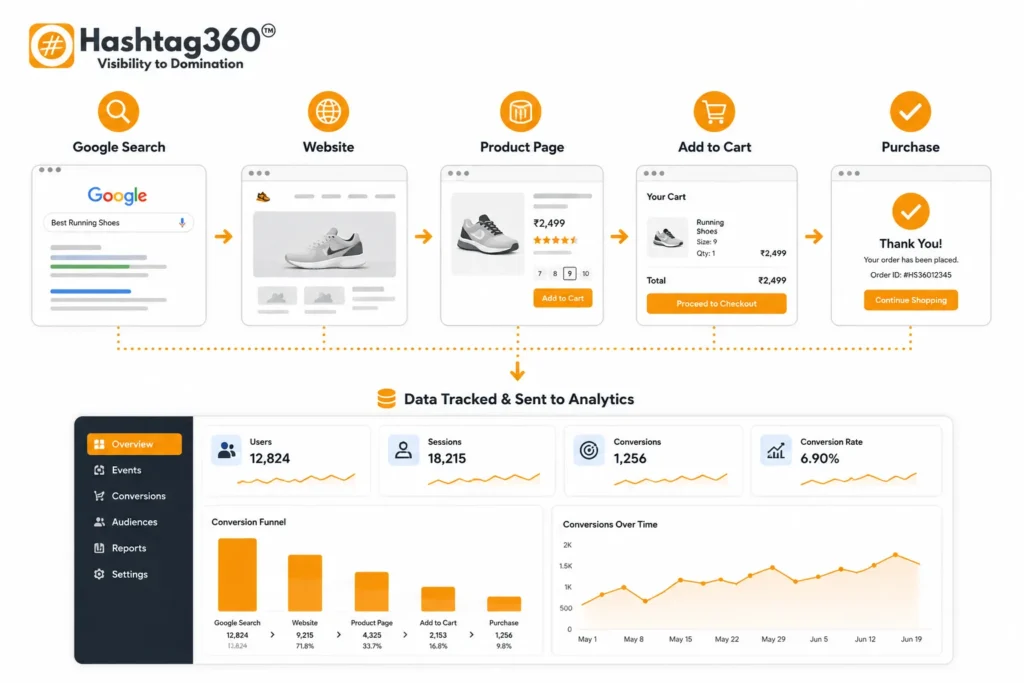
Table of Contents
What is Conversion Tracking?

Conversion tracking is the process of measuring specific actions that users complete after interacting with your website, advertisement, or digital marketing campaign.
These actions, known as conversions, represent valuable business outcomes.
Depending on your business goals, a conversion could include:
- Purchasing a product
- Filling out a contact form
- Calling your business
- Downloading an ebook
- Signing up for a newsletter
- Booking an appointment
- Starting a free trial
- Installing a mobile app
- Watching an important video
- Requesting a quote
Every business defines conversions differently based on its objectives.
For an eCommerce company, a completed purchase is typically the primary conversion.
For a law firm, submitting a consultation request may be considered a successful conversion.
For a software company, starting a free trial could be the most valuable customer action.
The primary purpose of conversion tracking is to identify exactly which marketing channels, campaigns, keywords, ads, devices, and audiences are driving these valuable outcomes.
Without conversion tracking, businesses only know how many visitors they receive.
With conversion tracking, they know how many customers they acquire.
That difference changes everything.
What Is a Conversion?
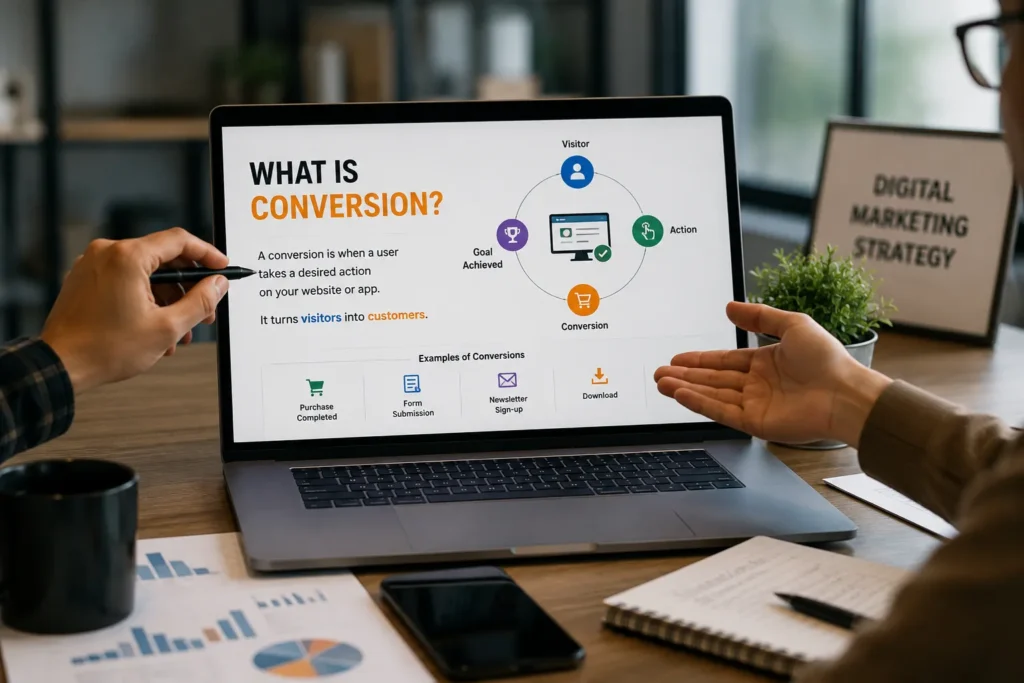
A conversion occurs whenever a visitor completes a desired action defined by the business.
Think of a website visitor as someone walking into a physical store.
Not everyone who enters the store buys something.
Some simply browse.
Some ask questions.
Some leave immediately.
Only a percentage become paying customers.
Similarly, websites receive thousands of visitors, but only some complete valuable actions.
Those valuable actions are called conversions.
For example:
| Visitor Action | Is It a Conversion? |
|---|---|
| Visits homepage | ❌ Usually No |
| Reads a blog | ❌ Usually No |
| Downloads brochure | ✅ Yes |
| Calls business | ✅ Yes |
| Purchases product | ✅ Yes |
| Books appointment | ✅ Yes |
| Signs up newsletter | ✅ Yes |
| Creates account | ✅ Yes |
Notice that not every website interaction is considered a conversion.
Businesses choose the actions that directly contribute to revenue or business growth.
Why Conversion Tracking Matters
Imagine spending $2,000 every month on advertising.
You receive:
- 50,000 website visitors
- 300 phone calls
- 400 form submissions
- 150 purchases
Without conversion tracking, you’d only know you received traffic.
You wouldn’t know:
- Which campaign generated the purchases
- Which keyword produced sales
- Which advertisement performed best
- Which audience converted more
- Which device users preferred
- Which location generated the highest revenue
Conversion tracking answers every one of these questions.
Instead of making marketing decisions based on assumptions, businesses use measurable data.
This leads to:
- Better advertising decisions
- Lower customer acquisition costs
- Higher conversion rates
- Better ROI
- Improved campaign optimization
- Increased profitability
Why Every Digital Marketer Needs Conversion Tracking
Modern marketing platforms like Google Ads use machine learning.
These AI systems need conversion data to optimize campaigns.
Without conversions, Google’s algorithm doesn’t know:
- Who is likely to buy
- Which users become customers
- Which keywords produce revenue
- Which audiences convert
As a result, campaigns become less efficient.
With accurate conversion tracking, Google’s Smart Bidding strategies automatically optimize toward users most likely to convert.
This often results in:
- Lower CPC
- Higher ROAS
- Better Quality Score
- Improved Ad Rank
- Increased conversions
Conversion tracking doesn’t just help marketers.
It also improves the advertising platform’s ability to deliver better results.
Real-Life Example of Conversion Tracking
Suppose an online furniture store runs two Google Ads campaigns.
Campaign A
- Cost: $600
- Clicks: 1,200
- Purchases: 15
Campaign B
- Cost: $600
- Clicks: 700
- Purchases: 55
If the business only looked at clicks, Campaign A appears more successful.
However, conversion tracking reveals the truth.
Campaign B generated significantly more sales despite fewer clicks.
Without conversion tracking, the business might increase spending on the wrong campaign.
This illustrates why clicks alone are not reliable indicators of marketing success.
Conversions tell the real story.
Goals of Conversion Tracking
Businesses implement conversion tracking to achieve several objectives:
Measure Marketing Performance
Know exactly which campaigns generate valuable customer actions.
Improve Return on Investment (ROI)
Invest more in campaigns that drive conversions while reducing spend on underperforming ones.
Optimize Advertising
Platforms like Google Ads automatically improve campaign performance using conversion data.
Understand Customer Behavior
Analyze how users interact with your website before completing a purchase or submitting a lead.
Increase Revenue
Better optimization leads to more qualified leads and higher sales without necessarily increasing ad spend.
Key Metrics Related to Conversion Tracking
Understanding conversion tracking also requires familiarity with a few important metrics:
Conversion
A completed business goal.
Example:
A purchase, phone call, or lead form submission.
Conversion Rate
The percentage of visitors who complete a desired action.
Formula:
Conversion Rate =
Conversions ÷ Visitors × 100
Example:
1,000 visitors
50 purchases
Conversion Rate = 5%
Cost Per Conversion
The average advertising cost required to generate one conversion.
Formula:
Cost Per Conversion =
Advertising Cost ÷ Number of Conversions
Return on Ad Spend (ROAS)
Measures revenue generated for every dollar spent on advertising.
Formula:
ROAS =
Revenue ÷ Ad Spend
Higher ROAS indicates a more profitable campaign.
Types of Conversions
Not all conversions have the same value. Some directly generate revenue, while others indicate that a potential customer is moving closer to making a purchase. Understanding the different types of conversions helps businesses measure success more accurately and optimize marketing campaigns for the right outcomes.
Below are the most common types of conversions used in digital marketing.
1. Purchase Conversions
Purchase conversions occur when a customer completes a transaction and buys a product or service. This is the most important conversion type for eCommerce businesses because it directly impacts revenue.
For example, if someone clicks on a Google Shopping Ad, visits your online store, and purchases a pair of shoes, that completed order is recorded as a purchase conversion.
Businesses often track additional details along with the purchase, including:
- Order value
- Product purchased
- Quantity
- Profit margin
- Customer location
- Device used
Tracking this information helps businesses identify which campaigns are generating the highest revenue—not just the most sales.
2. Lead Conversions
A lead conversion occurs when a visitor provides their contact information, expressing interest in your products or services.
Common lead actions include:
- Contact form submissions
- Requesting a quote
- Scheduling a consultation
- Booking a demo
- Downloading a brochure
- Registering for a webinar
Lead generation is particularly valuable for businesses such as:
- Real estate agencies
- Law firms
- Healthcare providers
- SaaS companies
- Educational institutions
- B2B service providers
Even though a lead is not yet a paying customer, it represents a potential opportunity that can later convert into revenue.
3. Phone Call Conversions
Many businesses receive valuable inquiries through phone calls rather than online forms.
Examples include:
- A customer calling a dental clinic to book an appointment
- A homeowner contacting a plumbing company
- Someone requesting a legal consultation
- A customer calling a travel agency
Google Ads can track phone calls generated by:
- Call Extensions
- Call Ads
- Website phone numbers
- Mobile click-to-call buttons
Businesses can also assign a monetary value to phone calls if they consistently lead to sales.
4. Newsletter Sign-Ups
Email marketing remains one of the highest ROI digital marketing channels.
A newsletter subscription may not generate immediate revenue, but it creates an opportunity to nurture potential customers through email campaigns.
Tracking newsletter sign-ups helps marketers evaluate:
- Landing page effectiveness
- Lead magnet performance
- Content quality
- Audience engagement
5. Account Registrations
Many online platforms encourage users to create accounts before making purchases.
Examples include:
- Streaming services
- Learning platforms
- Banking apps
- Fitness applications
- Membership websites
Even if registration is free, businesses often treat account creation as a meaningful conversion because registered users are more likely to become paying customers.
6. App Install Conversions
Mobile app developers frequently run advertising campaigns to increase app downloads.
Important app-related conversions include:
- App installation
- First app open
- User registration
- In-app purchase
- Subscription purchase
These conversions help developers understand which advertising campaigns are acquiring high-quality users.
7. Video Engagement Conversions
Video marketing plays a significant role in customer education and brand awareness.
Businesses may track actions such as:
- Watching 25% of a video
- Watching 50%
- Watching 75%
- Watching 100%
- Clicking a video CTA
These engagement metrics help identify highly interested audiences.
8. Download Conversions
Many businesses offer downloadable resources to generate leads.
Examples include:
- eBooks
- Whitepapers
- Case studies
- Product catalogs
- Templates
- Software trials
Every download can be tracked as a conversion, providing insight into which resources attract the most potential customers.
9. Add-to-Cart Conversions
Not every visitor purchases immediately.
Adding an item to the cart signals strong buying intent and is considered a micro-conversion.
Tracking add-to-cart events helps businesses identify where users drop off in the purchasing process and improve checkout performance.
10. Micro vs. Macro Conversions
Conversions generally fall into two categories.
Macro Conversions
These are the primary business goals.
Examples include:
- Product purchases
- Paid subscriptions
- Appointment bookings
- Completed payments
Macro conversions directly contribute to revenue.
Micro Conversions
These are smaller actions that indicate user interest.
Examples include:
- Watching a product video
- Visiting the pricing page
- Downloading a brochure
- Creating an account
- Adding products to the cart
- Clicking the contact button
Although micro conversions don’t generate immediate income, they provide valuable insights into the customer journey and can help improve overall conversion rates.
How Conversion Tracking Works
Conversion tracking may seem technical, but the underlying process is straightforward. It records specific actions users take after interacting with your website or advertisements.
The process generally involves four key steps.
Step 1: A User Clicks Your Advertisement
A potential customer discovers your business through:
- Google Search Ads
- Display Ads
- Shopping Ads
- Facebook Ads
- Instagram Ads
- LinkedIn Ads
- Email campaigns
- Organic search results
When they click the ad, tracking parameters such as the Google Click Identifier (GCLID) or UTM parameters are attached to the visit. These identifiers help connect future actions back to the original campaign.
Step 2: The User Visits Your Website
Once on your website, tracking technologies begin collecting data.
These may include:
- Google Tag (gtag.js)
- Google Tag Manager (GTM)
- Google Analytics 4 (GA4)
- Meta Pixel
- Microsoft UET Tag
- First-party cookies
These tools anonymously record user interactions such as:
- Page views
- Button clicks
- Form interactions
- Scroll depth
- Video plays
- Downloads
Step 3: The User Completes a Conversion
If the visitor performs a predefined valuable action—such as making a purchase or submitting a contact form—the tracking system fires a conversion event.
Examples of tracked events include:
purchasegenerate_leadsign_upbegin_checkoutadd_to_cartphone_calldownload
These events are sent to platforms like Google Ads or Google Analytics 4, where they become available for reporting and optimization.
Step 4: The Data Appears in Reports
After processing, conversion data becomes visible in reporting dashboards.
Marketers can analyze:
- Number of conversions
- Conversion rate
- Cost per conversion
- Conversion value
- Revenue
- Return on Ad Spend (ROAS)
- Campaign performance
- Keyword performance
- Device performance
- Audience performance
This information supports better budget allocation and campaign optimization.
Google Ads Conversion Tracking
Google Ads offers built-in conversion tracking to measure the effectiveness of advertising campaigns.
After setting up conversion tracking, Google Ads can determine:
- Which campaigns generate sales
- Which keywords produce leads
- Which ads drive purchases
- Which audiences convert most often
- Which devices perform best
It also enables Smart Bidding strategies such as:
- Maximize Conversions
- Target CPA
- Target ROAS
- Maximize Conversion Value
Without accurate conversion data, these automated bidding strategies cannot perform effectively.
Common Google Ads Conversion Actions
Google Ads allows advertisers to track a wide range of customer actions, including:
- Purchases
- Leads
- Phone calls
- Newsletter subscriptions
- App installs
- Local store visits (where available)
- Imported GA4 conversions
Each conversion action can be configured with its own value, attribution model, and counting method.
Google Analytics 4 (GA4) Conversion Tracking
Google Analytics 4 uses an event-based measurement model, making it more flexible than previous versions of Google Analytics.
Instead of relying on page views alone, GA4 tracks user interactions as events.
Common GA4 events include:
page_viewsession_startscrollclickview_itemadd_to_cartbegin_checkoutpurchaselogingenerate_lead
Any event can be marked as a key event (formerly called a conversion), allowing businesses to focus on actions that matter most.
GA4 also provides valuable insights into:
- User journeys
- Traffic sources
- Engagement
- Revenue
- Retention
- Cross-device behavior
Meta Pixel Conversion Tracking
Businesses running Facebook and Instagram Ads rely on the Meta Pixel to measure campaign performance.
The Meta Pixel tracks important website actions such as:
- Page views
- Content views
- Add to cart
- Initiate checkout
- Purchases
- Leads
- Registrations
- Search actions
By collecting this data, Meta’s advertising algorithms can optimize campaigns and build remarketing audiences, helping advertisers reach users who are most likely to convert.
Enhanced Conversions
Traditional conversion tracking depends heavily on browser cookies, which are increasingly limited by privacy regulations and browser restrictions.
Enhanced Conversions improve measurement accuracy by securely using first-party customer data—such as email addresses or phone numbers—that are hashed before being transmitted.
Benefits include:
- More accurate conversion measurement
- Better attribution
- Improved Smart Bidding performance
- Enhanced reporting
- Reduced data loss caused by browser privacy features
Because the information is hashed, it helps protect user privacy while still improving campaign measurement.
Server-Side Tracking
Server-side tracking shifts part of the data collection process from the user’s browser to a secure server managed by the business.
Compared with traditional browser-based tracking, server-side tracking can provide:
- Better data reliability
- Faster website performance
- Greater control over data sharing
- Improved resilience against browser restrictions and ad blockers
- Stronger privacy and security controls
As digital privacy standards continue to evolve, many businesses are adopting server-side tracking as part of a future-ready measurement strategy.
Event Tracking
Event tracking measures specific user interactions that go beyond simple page views.
Examples include:
- Clicking a CTA button
- Downloading a PDF
- Playing a video
- Scrolling to 90% of a page
- Expanding an FAQ
- Submitting a form
- Using a website search feature
These events help businesses understand how users engage with their content and identify opportunities to improve the user experience.
Attribution Models
A customer rarely converts after a single interaction. They may discover your business through a blog post, return via a Google Search Ad, and finally complete a purchase after clicking an email campaign.
Attribution models determine how credit for that conversion is assigned across these touchpoints.
Common attribution models include:
- Last Click: Gives all credit to the final interaction before the conversion.
- First Click: Credits the first marketing touchpoint that introduced the customer.
- Linear: Distributes credit evenly across all interactions.
- Time Decay: Gives more credit to touchpoints closer to the conversion.
- Data-Driven Attribution (DDA): Uses machine learning to assign credit based on the actual contribution of each interaction.
Choosing the right attribution model helps marketers better understand the true impact of each marketing channel and make smarter optimization decisions.
Benefits of Conversion Tracking
Implementing conversion tracking provides businesses with actionable insights that go far beyond website traffic metrics. Instead of guessing which marketing efforts are successful, companies can make decisions based on measurable data.
Here are some of the biggest advantages of conversion tracking.
1. Measure Real Marketing Performance
Many businesses focus on impressions, clicks, or website visits. While these metrics are useful, they don’t reveal whether campaigns are generating actual business results.
Conversion tracking helps answer questions like:
- Which campaign generated the most sales?
- Which keyword produced the highest-quality leads?
- Which ad copy delivered the best ROI?
- Which landing page converts the most visitors?
With these insights, marketers can focus on strategies that truly drive business growth.
2. Improve Return on Investment (ROI)
Every marketing dollar should contribute to business goals.
Conversion tracking helps businesses:
- Reduce wasted ad spend
- Allocate budgets to high-performing campaigns
- Pause underperforming ads
- Scale profitable campaigns
This leads to higher ROI and more efficient marketing investments.
3. Optimize Google Ads Smart Bidding
Google Ads uses conversion data to power automated bidding strategies like:
- Maximize Conversions
- Target CPA
- Target ROAS
- Maximize Conversion Value
Without accurate conversion tracking, Google’s machine learning has limited data to optimize campaigns effectively.
4. Understand Customer Behavior
Conversion tracking reveals how users interact with your website before converting.
For example, you can discover:
- Which pages users visit before purchasing
- Where visitors abandon the checkout process
- Which devices generate the highest conversion rates
- Which traffic sources produce the most qualified leads
These insights help improve the customer journey and increase conversions.
5. Improve Landing Pages
Sometimes the issue isn’t the advertisement—it’s the landing page.
Conversion tracking helps identify pages with low conversion rates, allowing businesses to optimize:
- Headlines
- Call-to-action buttons
- Forms
- Images
- Page speed
- Mobile responsiveness
- Trust signals
Even small improvements can significantly increase conversions.
6. Better Budget Allocation
Rather than distributing budgets evenly across campaigns, businesses can invest more in channels that consistently generate results.
For example:
- Increase spend on campaigns with the lowest cost per conversion.
- Reduce budgets for campaigns with poor conversion rates.
- Expand high-performing keyword groups.
- Test new audiences based on successful segments.
This ensures marketing budgets are used where they deliver the greatest impact.
7. Accurate Revenue Measurement
For eCommerce businesses, conversion tracking can connect advertising spend directly to revenue.
Marketers can analyze:
- Revenue by campaign
- Revenue by keyword
- Revenue by device
- Revenue by audience
- Revenue by location
This makes it easier to evaluate profitability rather than focusing solely on traffic.
8. Support Data-Driven Decision Making
Instead of relying on assumptions, conversion tracking provides measurable evidence to guide decisions.
Examples include:
- Launching new campaigns based on proven success.
- Refining messaging that resonates with customers.
- Identifying the most profitable products or services.
- Improving targeting for future campaigns.
Data-driven marketing consistently outperforms guesswork.
Common Conversion Tracking Mistakes
Even experienced marketers can make mistakes that lead to inaccurate reporting. These issues can result in poor optimization decisions and wasted advertising budgets.
1. Tracking Only Page Views
A page view alone does not indicate business success.
Instead, track meaningful actions such as:
- Purchases
- Lead submissions
- Phone calls
- Newsletter subscriptions
- Appointment bookings
2. Counting Duplicate Conversions
Improper implementation may record the same purchase or lead multiple times.
Duplicate conversions inflate performance metrics and make campaigns appear more successful than they actually are.
Always test conversion tracking thoroughly before launching campaigns.
3. Forgetting Conversion Values
Assigning a monetary value to conversions helps measure profitability.
For example:
- Product purchase = actual order value
- Lead form submission = estimated lead value
- Consultation booking = projected revenue
Without conversion values, it’s difficult to calculate ROAS or optimize for revenue.
4. Ignoring Mobile Users
Many customers browse and purchase using smartphones.
Ensure conversion tracking works correctly across:
- Desktop
- Mobile
- Tablet
A broken mobile tracking setup can significantly distort reporting.
5. Poor Tag Management
Incorrect placement of tracking tags can cause:
- Missing conversions
- Double counting
- Delayed reporting
- Inaccurate attribution
Using Google Tag Manager (GTM) simplifies tag deployment and maintenance.
6. Not Testing After Website Changes
Website redesigns, CMS updates, or checkout modifications can break tracking.
Whenever major changes are made:
- Test all conversion actions.
- Verify events in GA4 DebugView.
- Check Google Ads diagnostics.
- Confirm data is flowing correctly.
Regular testing prevents unexpected data loss.
7. Ignoring Privacy and Consent
Modern privacy regulations require businesses to handle user data responsibly.
Depending on your audience and region, you may need to:
- Display cookie consent banners.
- Respect user consent choices.
- Limit data collection when consent is not provided.
- Follow applicable privacy laws and platform policies.
A privacy-first approach helps maintain user trust while supporting compliant measurement.
Conversion Tracking Best Practices
Following industry best practices ensures reliable data and more effective optimization.
Define Clear Business Goals
Decide what actions truly matter.
Examples include:
- Purchases
- Qualified leads
- Demo requests
- Phone calls
- Newsletter sign-ups
Avoid tracking unnecessary events that don’t contribute to business objectives.
Track Both Macro and Micro Conversions
Monitor the entire customer journey.
Track macro conversions such as purchases alongside micro conversions like add-to-cart actions and form starts.
This provides deeper insights into user behavior.
Use Google Tag Manager
Google Tag Manager centralizes tracking tags, reducing the need to edit website code repeatedly.
Benefits include:
- Easier implementation
- Faster updates
- Improved organization
- Built-in testing tools
Enable Enhanced Conversions
Where supported, enhanced conversions can improve measurement accuracy by using securely hashed first-party data.
This helps recover conversions that might otherwise be missed because of browser privacy restrictions.
Regularly Audit Tracking
Schedule routine checks to ensure:
- Tags fire correctly.
- Conversion counts are accurate.
- Values are recorded properly.
- Reports match backend data.
A quarterly or monthly audit helps maintain data quality.
Integrate Google Analytics 4 and Google Ads
Linking GA4 with Google Ads allows businesses to:
- Import key events
- Build audiences
- Improve Smart Bidding
- Analyze customer journeys
- Measure cross-channel performance
An integrated measurement setup provides a more complete view of marketing effectiveness.
Industry Use Cases
Different industries define conversions based on their business goals.
eCommerce
Track:
- Purchases
- Add to cart
- Checkout
- Revenue
- Refunds (where applicable)
Healthcare
Track:
- Appointment bookings
- Contact forms
- Phone calls
- Online consultations
Education
Track:
- Course registrations
- Prospectus downloads
- Webinar sign-ups
- Inquiry forms
Real Estate
Track:
- Property inquiries
- Viewing requests
- Phone calls
- Brochure downloads
SaaS
Track:
- Free trials
- Demo bookings
- Paid subscriptions
- Feature adoption events
Essential Tools for Conversion Tracking
A reliable measurement strategy often combines multiple tools.
Some of the most widely used include:
- Google Analytics 4 (GA4)
- Google Tag Manager (GTM)
- Google Ads Conversion Tracking
- Meta Pixel
- Microsoft Clarity (for behavioral insights)
- CRM platforms (to connect leads with sales outcomes)
- Consent Management Platforms (CMPs)
Each tool serves a different purpose, but together they provide a comprehensive view of marketing performance.
Conversion Tracking Setup Checklist
Before launching any campaign, verify the following:
✅ Define primary business conversions.
✅ Install Google Analytics 4.
✅ Set up Google Tag Manager.
✅ Configure Google Ads conversion actions.
✅ Link Google Ads with GA4.
✅ Test all events before publishing.
✅ Assign conversion values where appropriate.
✅ Enable enhanced conversions if supported.
✅ Review reports regularly.
✅ Optimize campaigns based on conversion data.
Frequently Asked Questions (FAQs)
1. What is conversion tracking?
Conversion tracking is the process of measuring valuable actions users complete after interacting with your website or advertisements, such as purchases, form submissions, phone calls, or newsletter sign-ups.
2. Why is conversion tracking important?
It helps businesses identify which marketing campaigns generate meaningful results, improve ROI, optimize advertising budgets, and make data-driven decisions.
3. What is the difference between a conversion and a click?
A click indicates that someone visited your website, while a conversion means the visitor completed a desired business action, such as making a purchase or submitting a contact form.
4. Can small businesses benefit from conversion tracking?
Yes. Businesses of all sizes can use conversion tracking to understand customer behavior, improve campaign performance, and reduce wasted advertising spend.
5. What tools are commonly used for conversion tracking?
Popular tools include Google Analytics 4, Google Tag Manager, Google Ads Conversion Tracking, Meta Pixel, CRM systems, and consent management platforms.
6. What are enhanced conversions?
Enhanced conversions improve measurement accuracy by securely using hashed first-party customer information to better match conversions while helping protect user privacy.
7. How often should I audit my conversion tracking?
It’s a good practice to review and test your tracking after major website changes and perform routine audits monthly or quarterly to ensure accurate data collection.
Final Thoughts
Conversion tracking is the foundation of successful digital marketing. It transforms raw website traffic into actionable insights, allowing businesses to understand which campaigns, keywords, audiences, and landing pages contribute to meaningful business outcomes.
By implementing accurate conversion tracking, businesses can optimize advertising spend, improve customer experiences, and make informed decisions backed by real data. Whether you’re running Google Ads, social media campaigns, SEO, or email marketing, measuring conversions is essential for sustainable growth.
As privacy standards evolve and marketing platforms become increasingly data-driven, maintaining a reliable, privacy-conscious conversion tracking strategy will remain a competitive advantage.
About Hashtag360
If you’re looking to maximize the performance of your digital marketing campaigns, Hashtag360 can help you implement reliable conversion tracking and analytics solutions tailored to your business goals. From Google Ads and GA4 setup to tag management, campaign optimization, and performance reporting, our team helps businesses turn marketing data into measurable growth.
Whether you’re an eCommerce store, a service-based business, or a growing enterprise, accurate conversion tracking is the first step toward making smarter marketing decisions and achieving a higher return on investment.