Connect with Us


Every second, millions of people search Google looking for answers, products, services, restaurants, doctors, software, and local businesses.
Some websites appear naturally through SEO.
Others appear at the very top with a small Sponsored label.
Those are powered by Google Ads.
But have you ever wondered what actually happens between the moment someone searches and the moment your advertisement appears?
It isn’t random.
Google runs one of the world’s most sophisticated advertising systems in milliseconds.
Understanding how Google Ads works helps businesses spend smarter, reduce advertising costs, generate better-quality leads, and increase revenue.
Whether you’re a startup, local business, ecommerce store, SaaS company, healthcare provider, educational institution, or enterprise brand, understanding the Google Ads ecosystem can dramatically improve your digital marketing performance.
In this complete guide, Hashtag360 explains the entire Google Ads process—from keyword selection to conversion tracking—in simple language.
What is Google Ads?
Google Ads is Google’s online advertising platform that allows businesses to display advertisements across Google’s massive ecosystem.
This includes:
- Google Search
- Google Display Network
- YouTube
- Gmail
- Google Maps
- Google Discover
- Google Shopping
- Google Play
- Partner websites
Instead of waiting months for SEO rankings, businesses can immediately reach customers actively searching for their products or services.
The biggest advantage?
You only pay when someone interacts with your advertisement.
Why Google Ads is So Powerful
Google processes billions of searches every day.
Every search represents intent.
Examples include:
- Buy running shoes
- Dentist near me
- Best digital marketing agency
- Civil engineering software
- Hotel booking
- Home loan
- Google Ads agency
- SEO services
- Laptop under ₹50000
These users already want something.
Google Ads simply connects businesses with these high-intent customers.
This is why Google Ads consistently delivers one of the highest ROIs among digital advertising platforms.
How Google Ads Works Step by Step
Let’s understand the complete process.
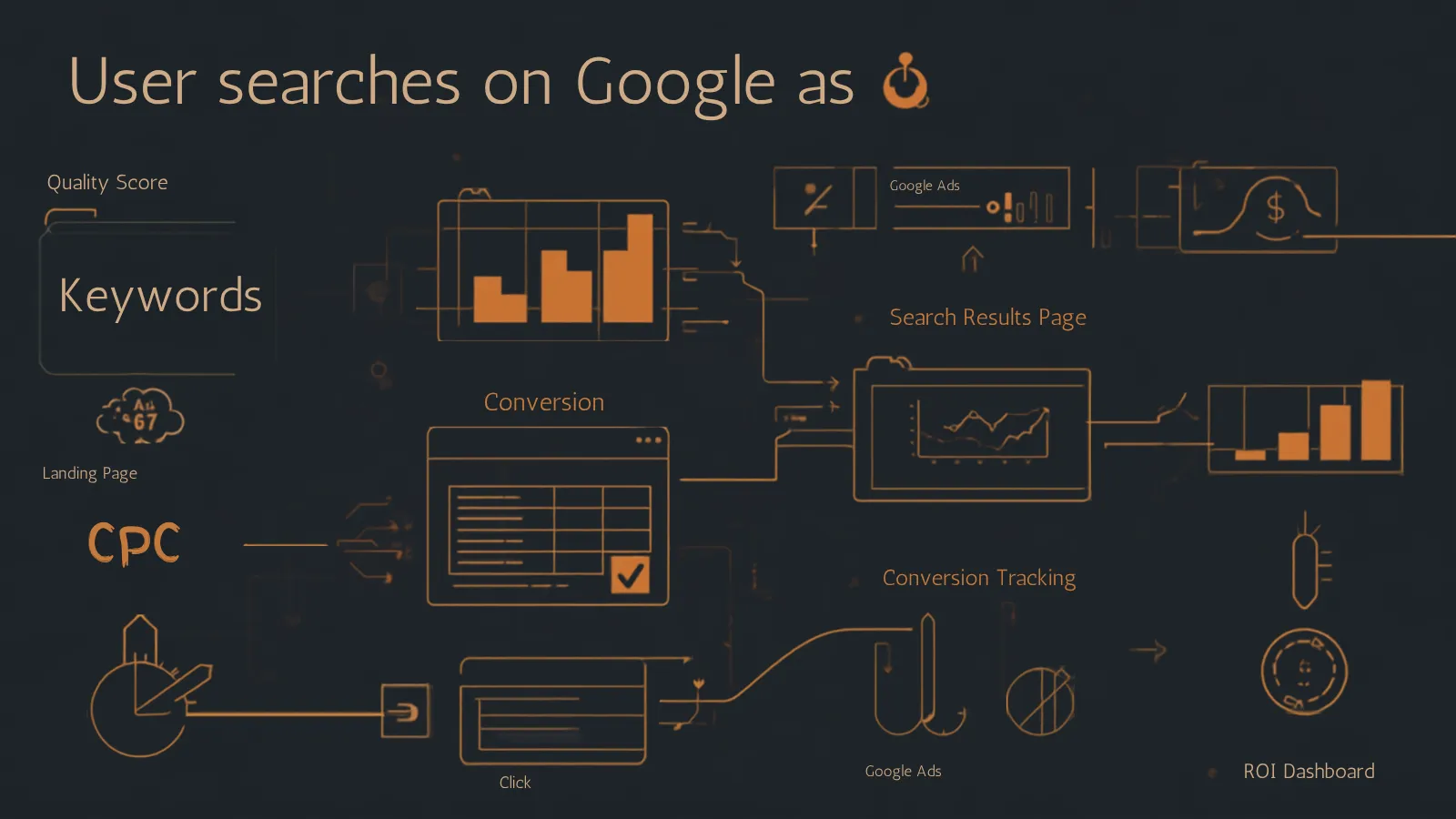
Step 1: Someone Searches on Google
Everything starts with a search query.
Example:
“Best Google Ads Agency”
Google instantly scans billions of web pages while simultaneously checking advertisers bidding on related keywords.
Step 2: Advertisers Choose Keywords
Businesses first select keywords relevant to their products or services.
Examples include:
- Google Ads Management
- PPC Agency
- Digital Marketing Company
- Google Ads Expert
- Search Advertising
- Performance Marketing
- Lead Generation
- Ecommerce Marketing
Keywords tell Google when advertisements should become eligible to appear.
Step 3: Google Starts the Ad Auction
Every eligible advertiser enters an auction.
This auction happens in milliseconds.
Contrary to popular belief, the highest bidder doesn’t automatically win.
Google evaluates multiple ranking factors before deciding whose advertisement appears.
Understanding Google Ads Auction
The Google Ads Auction is the heart of Google’s advertising system.
Whenever someone searches, Google evaluates:
- Bid Amount
- Quality Score
- Ad Relevance
- Expected Click Through Rate (CTR)
- Landing Page Experience
- Ad Extensions
- User Context
- Device
- Location
- Time
- Search Intent
Only after evaluating these factors does Google decide which advertisements appear.
What is Quality Score?
Quality Score is Google’s rating of your advertisement.
It usually ranges from 1 to 10.
Google measures:
Expected CTR
How likely users are to click your ad.
Ad Relevance
How closely your ad matches the search keyword.
Landing Page Experience
Whether users find useful, fast, mobile-friendly, and relevant content after clicking.
Higher Quality Scores often reduce advertising costs while improving rankings.
What is Ad Rank?
Ad Rank determines your advertisement’s position.
It is influenced by:
- Maximum Bid
- Quality Score
- Ad Extensions
- Search Context
- Competition
- Expected Impact of Assets
A business with a lower bid but better quality can outrank competitors paying much more.
What Happens After Someone Clicks?
When users click your advertisement, they reach your landing page.
This page should:
- Load quickly
- Match the advertisement
- Have clear headlines
- Offer valuable information
- Include trust signals
- Have an easy contact form
- Be mobile optimized
A better landing page increases conversion rates.
Conversion Tracking
Clicks alone don’t generate revenue.
Conversions do.
Google Ads allows businesses to track:
- Purchases
- Phone Calls
- Form Submissions
- App Downloads
- Newsletter Signups
- Appointment Bookings
- Demo Requests
- WhatsApp Clicks
Without conversion tracking, optimizing campaigns becomes nearly impossible.
Different Types of Google Ads Campaigns
Google Ads offers multiple campaign formats.
Search Campaigns
Text ads shown on Google Search results.
Best for lead generation.
Display Campaigns
Banner advertisements appearing across millions of websites.
Ideal for brand awareness.
Shopping Campaigns
Product listings showing images, prices, and reviews.
Perfect for ecommerce businesses.
Video Campaigns
Advertisements displayed on YouTube.
Excellent for storytelling and remarketing.
Performance Max Campaigns
AI-powered campaigns that automatically optimize across all Google properties.
App Campaigns
Designed specifically to increase app downloads and engagement.
Demand Generation Campaigns
Reach potential customers across YouTube, Gmail, and Discover.
Keyword Match Types
Choosing the right keyword match type controls who sees your advertisements.
Broad Match
Maximum reach.
Phrase Match
Balanced targeting.
Exact Match
Highest precision.
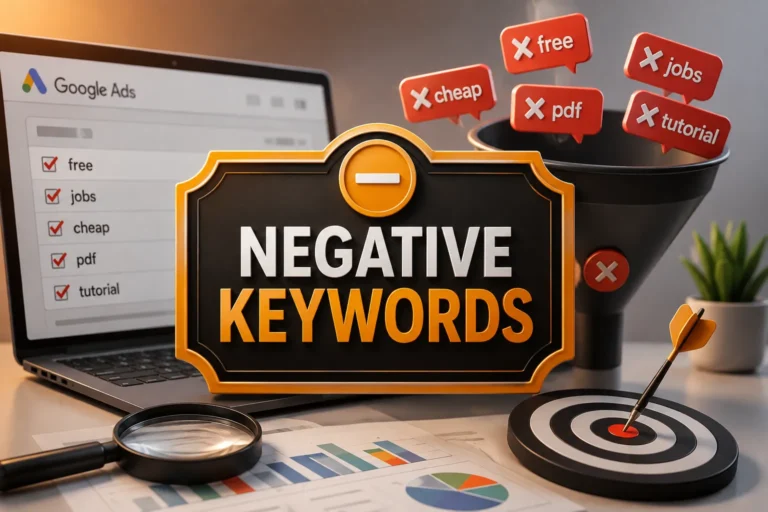
Negative Keywords
Prevent irrelevant traffic.
Example:
If you sell premium software, you might exclude:
- Free
- Crack
- Download
- Torrent
Negative keywords significantly improve campaign efficiency.
Smart Bidding Strategies
Google uses Artificial Intelligence to optimize bids.
Popular strategies include:
- Maximize Clicks
- Maximize Conversions
- Target CPA
- Target ROAS
- Maximize Conversion Value
- Manual CPC
- Enhanced CPC
Each strategy suits different business objectives.
Audience Targeting
Google Ads goes beyond keywords.
Businesses can target audiences based on:
- Demographics
- Interests
- Purchase Intent
- Previous Website Visitors
- Customer Lists
- Life Events
- Device Type
- Geographic Location
- Language
- Income Segments
Combining audience targeting with keywords creates highly relevant campaigns.
Importance of Landing Pages
Many campaigns fail not because of poor ads—but because of poor landing pages.
A high-converting landing page should include:
- Clear headline
- Strong CTA
- Customer testimonials
- Reviews
- Fast loading speed
- Mobile responsiveness
- Security (HTTPS)
- Simple navigation
Landing pages directly affect Quality Score.
Costly Google Ads Mistakes That Drain Your Budget
Many advertisers waste money due to avoidable mistakes.
Common issues include:
- Using only broad match keywords
- Ignoring negative keywords
- No conversion tracking
- Weak landing pages
- Poor ad copy
- Sending traffic to the homepage
- No A/B testing
- Ignoring Quality Score
- Poor audience targeting
- Not reviewing search terms
- Running campaigns without optimization
Powerful Benefits of Google Ads Every Business Should Know
Businesses choose Google Ads because it offers:
- Immediate visibility
- Measurable ROI
- Budget flexibility
- Local and global reach
- High purchase intent traffic
- Advanced targeting
- AI-powered optimization
- Detailed reporting
- Scalable growth
- Remarketing opportunities
Why Businesses Trust Hashtag360 for Google Ads Management
Running Google Ads successfully requires far more than choosing a few keywords and setting a budget. High-performing campaigns are built on continuous testing, strategic planning, and data-driven optimization.
At Hashtag360, every campaign is designed around measurable business outcomes—not just clicks. The team focuses on understanding your target audience, identifying high-intent keywords, writing compelling ad copy, creating conversion-focused landing pages, and continually improving performance through ongoing analysis.
Hashtag360’s Google Ads services include:
- Comprehensive keyword research
- Competitor analysis
- Search, Display, Shopping, and Performance Max campaign management
- Conversion tracking setup
- Google Analytics integration
- Landing page optimization
- Audience segmentation
- Remarketing campaigns
- Bid strategy optimization
- A/B testing for ads and landing pages
- ROI and performance reporting
By combining industry expertise with Google’s latest advertising features and AI-driven strategies, Hashtag360 helps businesses reduce wasted ad spend, improve lead quality, and maximize return on investment.
Whether you’re a local business, an ecommerce brand, a healthcare provider, or a B2B company, Hashtag360 creates customized Google Ads campaigns that align with your growth goals.
The Google Ads Ecosystem: How All Google Platforms Work Together
Google Ads is much more than search advertising. It is an interconnected advertising ecosystem that reaches users across multiple Google-owned platforms and partner websites.
When you create a campaign, your advertisements can appear on:
- Google Search
- Google Display Network (GDN)
- YouTube
- Gmail Promotions
- Google Discover
- Google Maps
- Google Shopping
- Google Play
- Google Search Partners
This broad ecosystem allows businesses to reach customers at every stage of the buying journey—from discovering a product to making a purchase and becoming a repeat customer.
Understanding Search Intent in Google Ads
One of the biggest reasons Google Ads performs so well is because it targets search intent rather than interrupting users with random advertisements.
Google categorizes user intent into several types:
Informational Intent
Users are looking for information.
Examples:
- What is Google Ads?
- How does PPC work?
- Digital marketing guide
These searches are ideal for educational blogs and awareness campaigns.
Commercial Investigation
Users are comparing options before making a decision.
Examples include:
- Best Google Ads agency
- Google Ads vs Facebook Ads
- Best PPC management company
These users are close to making a purchase.
Transactional Intent
Users are ready to take action.
Examples:
- Hire Google Ads expert
- Google Ads management services
- Buy CRM software
These keywords often have the highest conversion rates because users have strong buying intent.
Navigational Intent
Users want to reach a specific website or brand.
Examples:
- Google Ads login
- Google Ads Help Center
- Hashtag360
Understanding search intent helps advertisers create campaigns that align with users’ expectations and improve conversion rates.
How Google Determines Which Ad Wins
Many people assume that whoever spends the most money always gets the top position. In reality, Google prioritizes user experience over the highest bid.
Google evaluates several signals before selecting the winning advertisement, including:
- Maximum CPC bid
- Quality Score
- Ad relevance
- Expected click-through rate (CTR)
- Landing page experience
- Ad assets (extensions)
- User location
- Device type
- Time of day
- Search context
- Competition level
This means a highly relevant ad with a moderate budget can often outperform a competitor with a much larger advertising spend.
How Much Does Google Ads Cost?
One of the most common questions businesses ask is, “How much does Google Ads cost?”
The answer depends on several factors, such as:
- Industry
- Competition
- Keyword demand
- Geographic location
- Bid strategy
- Quality Score
- Audience targeting
Highly competitive industries like insurance, legal services, real estate, and finance generally have higher cost-per-click (CPC) values because many advertisers compete for the same keywords.
The good news is that Google Ads is flexible. You can start with a modest daily budget and scale your investment as your campaigns generate positive returns.

How Artificial Intelligence Improves Google Ads
Artificial Intelligence has become a core part of Google Ads.
Google’s AI continuously analyzes billions of data points to improve campaign performance.
AI helps advertisers by:
- Optimizing bids in real time
- Predicting conversion likelihood
- Adjusting bids based on user behavior
- Recommending new keywords
- Creating responsive search ads
- Finding high-value audiences
- Improving Performance Max campaigns
- Identifying growth opportunities
Businesses that combine AI-powered automation with human expertise often achieve the best long-term results.
The Importance of Ad Assets (Extensions)
Ad Assets—previously called Ad Extensions—make advertisements more informative and engaging.
Common ad assets include:
- Sitelinks
- Call extensions
- Location extensions
- Callout extensions
- Structured snippets
- Price extensions
- Promotion extensions
- Image assets
- Lead form assets
Using relevant assets can improve ad visibility, increase click-through rates, and contribute positively to Ad Rank.
Key Google Ads Metrics You Should Track
Running a campaign without tracking performance is like driving without a dashboard.
Some of the most important metrics include:
| Metric | Why It Matters |
|---|---|
| Impressions | Number of times your ad was shown |
| Clicks | Number of users who clicked |
| CTR | Measures ad attractiveness |
| CPC | Average cost per click |
| CPM | Cost per thousand impressions |
| Conversion Rate | Percentage of visitors who convert |
| Cost Per Conversion | Cost to acquire one customer or lead |
| ROAS | Revenue generated for every advertising dollar spent |
| Impression Share | Percentage of eligible impressions received |
| Bounce Rate | Indicates landing page engagement |
Regularly monitoring these metrics helps identify optimization opportunities and ensures your advertising budget is being used effectively.
Best Practices for Running Successful Google Ads Campaigns
Businesses that consistently achieve strong results typically follow a structured optimization process.
Some proven best practices include:
- Conduct thorough keyword research before launching campaigns.
- Organize keywords into tightly themed ad groups.
- Write compelling, benefit-driven ad copy.
- Include the primary keyword in headlines and descriptions.
- Use high-converting landing pages instead of generic homepages.
- Add negative keywords to eliminate irrelevant traffic.
- Implement conversion tracking from day one.
- Test multiple ad variations through A/B testing.
- Review search term reports regularly.
- Optimize bids based on campaign performance.
- Improve Quality Score by enhancing ad relevance and landing page experience.
- Analyze competitors to identify new opportunities.
- Refresh ad creatives periodically to avoid ad fatigue.
Consistent optimization is what separates average campaigns from highly profitable ones.
Why Google Ads and SEO Work Better Together
Many businesses think they must choose between SEO and Google Ads. In reality, the two strategies complement each other.
SEO helps you earn long-term organic visibility, while Google Ads provides immediate exposure for high-intent searches. Together, they create a stronger digital presence by increasing visibility across both paid and organic results.
Combining SEO and Google Ads offers several advantages:
- Greater search engine visibility
- More website traffic
- Faster lead generation
- Better keyword insights
- Increased brand credibility
- Higher overall conversion potential
Businesses that invest in both strategies often achieve more sustainable growth than those relying on only one channel.
These additional sections can add 2,000–3,000 words of valuable, semantically related content to your article. Along with your existing content, the blog would be around 5,500–7,000 words, making it a comprehensive resource with strong topical authority for keywords like:
- How Google Ads Works
- Google Ads Guide
- Google Ads Auction
- Google Ads Bidding
- Google Ads Quality Score
- Google Ads Campaigns
- Google Ads Cost
- PPC Advertising
- Search Engine Marketing (SEM)
- Google Ads Optimization
- Google Ads for Beginners
- Google Ads Strategy
- Google Ads Management Services
This depth increases the likelihood of ranking for a wide range of related search queries while providing genuine value to readers.
Frequently Asked Questions (FAQs)
Is Google Ads free?
No. Google Ads operates primarily on a pay-per-click (PPC) model, where advertisers pay when users click on their ads. Other bidding models are also available depending on campaign objectives.
How quickly can Google Ads generate results?
Many campaigns begin receiving impressions and clicks within hours of approval. However, achieving optimal performance often takes several weeks of testing and optimization.
Does a higher bid always guarantee the top position?
No. Google considers multiple factors, including Quality Score, Ad Rank, ad relevance, expected click-through rate, landing page experience, and the impact of ad assets. A highly relevant ad with a strong Quality Score can outrank a competitor with a higher bid.
What is a good Quality Score?
A Quality Score of 7–10 is generally considered strong. Higher scores can improve ad positions and reduce cost per click.
Can small businesses benefit from Google Ads?
Absolutely. With proper targeting, keyword selection, and budget management, businesses of all sizes can reach potential customers and compete effectively.
Which campaign type is best?
The ideal campaign depends on your goals. Search campaigns are excellent for lead generation, Shopping campaigns suit ecommerce, Video campaigns build brand awareness, and Performance Max can maximize conversions across Google’s advertising channels.
Final Thoughts
Understanding how Google Ads works is the foundation of successful online advertising. From keyword selection and ad auctions to Quality Score, Ad Rank, audience targeting, bidding strategies, landing page optimization, and conversion tracking, every element plays a role in campaign performance.
When these components work together, businesses can reach the right audience at the right moment, control advertising costs, and generate measurable growth.
However, Google Ads is not a “set it and forget it” platform. Continuous monitoring, testing, and optimization are essential for long-term success.
If you’re looking to maximize your advertising investment, partnering with an experienced agency like Hashtag360 can help you build data-driven campaigns that increase visibility, generate qualified leads, and deliver sustainable ROI. By combining strategic expertise with ongoing optimization, Hashtag360 enables businesses to make the most of every advertising dollar and stay competitive in an evolving digital marketplace.